Best Boy Career in India: Electric & Grip Departments Explained (2026)
-

Lavkush Gupta
-
Apr 28, 2026
-
35
There is a role on every film set that keeps two entire departments running — and almost nobody outside the industry can name it.
Not the gaffer. Not the key grip. Not the DP, who gets the Instagram followers and the magazine profile. We are talking about the best boy: the person standing one step behind the department head, holding everything together with scheduling spreadsheets, equipment checklists, crew WhatsApp groups, and a working knowledge of every cable, fixture, and rigging point on set.
If you are drawn to the electrical or grip department and you want to know what a genuine career path inside those departments looks like — not the glamorous top of the ladder, but the critical middle rung where real management begins — this is the guide you have been waiting for.
What Is a Best Boy in Film? (And Why Is It Called That?)
Let us get the obvious question out of the way first, because everyone asks it.
The title "best boy" has nothing to do with gender, age, or being anyone's favorite. It comes from early Hollywood, where the gaffer (head of the electrical department) would ask a neighboring crew for their "best boy" — their most skilled and reliable worker — to assist on a production. Over time, that loan-out role became a permanent position. The name stuck, the Hollywood studio system globalized, and now you will hear it on sets from Los Angeles to Lucknow.
In India, the title is used with increasing regularity on larger productions — especially on OTT originals, pan-Indian films, and any production with international co-production involvement. On smaller regional sets, the same function exists under different informal titles, but the job is the same: you are the department head's operational right hand.
Here is the key distinction that confuses newcomers: there are two entirely separate best boy roles, sitting in two different departments.
The Two Types: Best Boy Electric vs. Best Boy Grip
Best Boy Electric
The best boy electric works directly under the gaffer (chief lighting technician). The gaffer is the department head responsible for designing and executing the lighting plan the DP has conceived. The best boy electric is the gaffer's deputy — the person who makes the gaffer's vision operationally possible.
Your world is electricity: generators, distribution boxes, dimmers, tungsten fixtures, LED panels, HMI units, practicals, and kilometers of extension cable. You need to understand how to safely draw power from any source — a production generator, a film-grade three-phase board, or a building's mains — and distribute it across a set without blowing a fuse, creating a fire hazard, or putting anyone at risk of electrocution.
But the electrical knowledge is only half the job. The other half is people and logistics.
Best Boy Grip
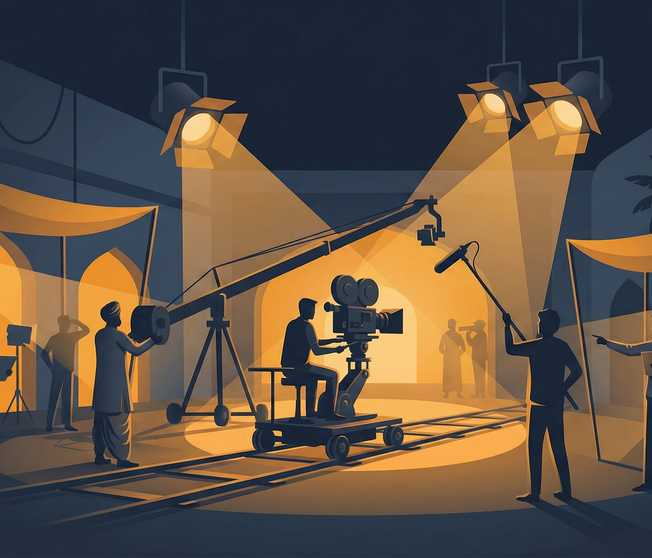
The best boy grip works under the key grip. The grip department handles everything that holds, supports, or moves a camera or a light: tripods, dollies, cranes, jibs, slider systems, speed rails, apple boxes, sandbags, C-stands, flags, and every rigging configuration imaginable. The grip world is mechanical and spatial — it is about weight-bearing, stability, and creative physical problem-solving.
The best boy grip is the key grip's operational deputy. Same management responsibilities, different technical domain.
Both roles share a common management layer. The technical content is different. The job of running a department crew — that part is identical.
What a Best Boy Actually Does All Day
Here is where most career guides fail you. They describe the role in abstract terms — "assists the department head," "manages crew" — without telling you what that looks like in the grind of a real production day.
We have spoken to working best boys across Mumbai, Hyderabad, and Chennai. This is what they actually do.
Pre-Production: Before the Camera Rolls
The shoot has not started, but your work has.
Equipment package negotiation and logistics. The gaffer or key grip will lock the equipment list with the DP. Your job is to work with the production department to source that equipment from rental houses, confirm availability dates, negotiate pricing if you have the leverage to do so, and arrange transport to the first location. On a 45-day schedule shooting across multiple cities, this is a full-time pre-production job by itself.
Crew hiring and scheduling. The gaffer says, "I need eight electricians for the first schedule and four for the second." You build that roster. You know which electricians in the city are available, reliable, and technically capable for this scale of production. You make the calls, confirm day rates, collect details for the production department's pay register, and build the WhatsApp group that will govern crew communication for the next two months.
Recce coordination. You attend location recces with the gaffer and key grip, walking each location with an eye toward practical logistics: where will the generator park, how close is the power source, what is the rigging situation on this ceiling, is there an adjacent room for equipment storage between shots?
Paperwork. Yes, paperwork. Department breakdowns, equipment logs, crew lists, safety sign-offs, transport schedules. If you hate paperwork, the best boy role will teach you to love it or it will teach you to hate yourself. There is no third option.
During the Shoot: The Operational Core
Crew call management. You are the one who decides — in consultation with the gaffer or key grip — what time each crew member needs to be on set for each day's shoot. On a morning exterior shoot that requires a full lighting rig before sunrise, your electricians might be called at 3 AM. You communicate this, confirm it, and follow up.
Bridging department head and crew. The gaffer is standing next to the DP working out lighting problems. The gaffer does not have time to answer crew questions, manage a squabble between two electricians, or track down a missing cable head. That is your job. You are the information relay, the conflict resolver, and the logistics tracker — all at once, simultaneously, on a set that is moving faster than it has any right to move.
Equipment tracking and accountability. Every piece of equipment that comes onto that set is your responsibility. If a fixture goes missing or a lens gets damaged, the rental house is coming after the production, and the production is coming after your department head, and your department head is looking at you. Equipment logs are not bureaucracy — they are self-protection.
Safety compliance. This is the one area where there is no shortcut and no compromise. Electrical safety on film sets is a matter of life and death — there have been serious and fatal accidents on Indian film sets caused by unsafe electrical practices. As best boy electric, you are partially responsible for ensuring that every cable is rated for its load, every connection is weatherproofed on outdoor shoots, every generator is properly earthed, and no crew member is ever working in an unsafe electrical environment.
Managing overtime and wrap logistics. When the shoot day runs long — and on Indian sets, it usually does — you are tracking overtime, communicating with the production manager, and beginning wrap logistics so that equipment can be returned, inventoried, and prepped for the next day.
Wrap: The End That Never Really Ends
When principal photography finishes, the work does not stop. Equipment must be returned, inventories reconciled against the rental house's list, any damaged or missing items reported, and final crew payments confirmed with the production accountant. If your department had a particularly complex equipment package, this wrap process can take days.
The Skills Nobody Tells You to Develop
Technical knowledge gets you into the department. It does not make you a best boy.
Technical Competency (Table Stakes)
You need to know your department's tools completely. For best boy electric: transformer calculations, generator sizing, lamp types and their color temperatures, dimming systems, DMX protocol basics, cable gauges and their amperage limits. For best boy grip: weight-bearing calculations for rigging rigs, camera support system mechanics, road and transport rigging for equipment.
This knowledge comes from years of hands-on work, not from a textbook. There is no shortcut here.
Logistics and Planning
The best boy role is fundamentally a logistics job. You are moving people and equipment around a complex, constantly changing environment. The film industry works to a schedule that changes every 12 hours. You need to think three steps ahead while managing the immediate present.
Start building this skill before you get the role. Volunteer to help with crew coordination. Offer to manage equipment lists. Learn how rental houses work and how production departments think.
Communication (Across Very Different Personalities)
You will spend your day communicating in multiple directions simultaneously: upward to the gaffer or key grip, downward to a crew of electricians or grips, sideways to the production department, and sometimes diagonally to the art department when the lighting rig is fighting with the set.
Film sets are high-pressure environments full of strong personalities and competing priorities. The best boys who survive and advance are the ones who can communicate clearly, stay calm when the pressure spikes, and resolve conflict before it escalates.
Basic Production Knowledge
You do not need to be a production manager. But you need to understand how the production department thinks, what a call sheet means, how the shooting schedule is structured, and what the production manager needs from your department in order to do their job. Best boys who operate in ignorance of production realities create friction. Best boys who understand production realities create efficiency.
The India vs. Hollywood Difference
In Hollywood, the best boy role is clearly defined and ring-fenced. A best boy electric does not cross into grip territory. The union structures — IATSE in the US — enforce departmental boundaries that have existed for decades.
In India, especially on smaller productions, those boundaries are porous.
On a mid-budget regional film in Hyderabad or a web series shooting in Pune, the person functioning as best boy electric might also be managing generator logistics that would fall under a different department on a larger set. On a small Bhojpuri production, the "best boy" equivalent might also be running production errands. On a big-budget pan-Indian film with a disciplined production structure, the roles begin to resemble the Hollywood model more closely.
This fluidity is both a challenge and an opportunity. It means that Indian best boys on smaller sets develop a broader operational knowledge than their Hollywood counterparts. It also means that role clarity and credit can be harder to establish.
The lesson: know what you are being hired to do before you agree to the day rate. Doing three jobs for one job's pay is the industry's oldest trick.
Day Rates: What Best Boys Earn in India
All figures below are market estimates based on industry conversations and should be treated as directional, not definitive. Rates vary significantly by production scale, city, and individual negotiation. Always clarify your rate and responsibilities in writing before a shoot begins.
Entry-level electrician / grip (0-2 years experience): Rs. 800 to Rs. 1,500 per day on smaller productions. Rs. 1,500 to Rs. 2,500 on mid-size OTT or ad productions.
Experienced electrician / grip (3-5 years, pre-best boy): Rs. 2,000 to Rs. 3,500 per day depending on city and production scale.
Best boy electric or grip (working in the role): Rs. 3,000 to Rs. 6,000 per day on mid-size productions. Rs. 6,000 to Rs. 12,000 per day on large OTT originals, major Bollywood productions, or international co-productions.
Mumbai and Hyderabad command the highest rates given the volume of large-scale productions. Chennai rates are competitive for Tamil industry work. Smaller industry hubs like Pune, Kolkata, or Lucknow will show rates at the lower end of these ranges.
Rates on ad film productions are generally higher than feature film rates for comparable roles, reflecting the compressed schedule and higher per-day budgets of advertising work.
Disclaimer: These are market estimates gathered through industry conversations. Rates change with inflation, production budgets, and individual negotiation. Do not quote these numbers as contractual benchmarks.
How to Become a Best Boy: The Real Path
There is no film school course that graduates you as a best boy. This role is earned through years of departmental work.
Step 1: Enter the department as a junior electrician or junior grip (0-2 years). You are running cable, setting up C-stands, operating dimmers on cue, and learning the equipment library inside out. You are watching everything that happens above you. The best boy and gaffer are your education.
Step 2: Move to senior electrician or senior grip (2-4 years). You are now executing complex setups independently, training juniors, and being trusted with equipment management. Good best boys start giving you small coordination tasks at this stage — this is deliberate, and you should treat it as training.
Step 3: Get your first best boy credit (typically 3-5 years into the department). This does not happen by asking for the title. It happens when a gaffer trusts you enough to hand you the crew management responsibility. That trust is built one reliable, low-drama shoot at a time.
The fastest way to accelerate this path: be the person on every shoot who the gaffer does not have to worry about. Show up on time, know the equipment, solve problems before they escalate, and never create drama. In a department where drama is constant, low-drama professionals rise fast.
Career Progression: Where the Best Boy Goes Next
The best boy role is explicitly a stepping stone. Here is the ladder:
Junior Electrician / Junior Grip Senior Electrician / Senior Grip Best Boy Electric / Best Boy Grip Gaffer (Chief Lighting Technician) / Key Grip Director of Photography (from the lighting/electrical path)
The gaffer and key grip roles are where the creative responsibility truly kicks in — and where the day rates jump significantly. Many experienced gaffers in Mumbai are earning Rs. 15,000 to Rs. 30,000 per day on large productions. Key grips at that level are in a similar range.
The path from best boy to gaffer or key grip is not guaranteed and is not linear. It requires not just technical mastery but a reputation — a body of work that convinces DPs and production companies that you can run a department independently. That reputation is built one project at a time.
Some best boys, particularly those with strong electrical knowledge, also transition sideways into related technical fields: lighting design for live events, theatrical lighting, or technical consulting for OTT platform productions.
City-Specific Demand in India
Mumbai is the highest-demand market. The volume of Bollywood productions, OTT originals, and ad films means there is consistent work for competent best boys year-round. Competition is fierce. Your network determines your work.
Hyderabad is the second most active hub, driven by Telugu and Telugu-dubbed pan-Indian films that consistently have large budgets and technically demanding production requirements. The rapid expansion of RRR-scale and Kalki 2898-scale productions has created genuine demand for technically sophisticated best boys who can manage large department crews.
Chennai is the home market for Tamil productions and has a structured, experienced crew ecosystem. Breaking in from outside the existing network is harder here than in Mumbai.
Pune and Bengaluru have active OTT production ecosystems — Amazon, Netflix, and Disney+Hotstar have commissioned significant regional language content shot in both cities. Best boys who can operate at OTT production standards are in demand here.
Kolkata and smaller regional hubs offer more work on smaller-budget Bengali, Bhojpuri, and other regional productions. Day rates are lower, but these markets offer a genuine path to first credits and experience accumulation for aspirants who are building their portfolio.
The Management Side Nobody Prepares You For
Here is something the industry will not tell you until you are in the middle of it.
Managing a film crew is genuinely hard. You are managing people who have their own pressures, their own financial constraints, their own egos, and their own relationships with the industry. A grip who has been working for fifteen years and thinks this junior best boy has no business telling him what to do. An electrician who is underperforming because he has a personal situation he has not disclosed. A crew member who is cutting safety corners because the schedule is running behind and everyone is stressed.
None of this appears in the job description. All of it is your responsibility.
We built AIO Cine because we kept watching technically brilliant crew members get blindsided by this management reality — they knew every fixture in the rental catalogue, and they had no idea how to have a difficult conversation with a crew member, negotiate overtime with a production manager, or document a safety incident correctly.
The best boys who last are the ones who invest in the management side as seriously as they invest in the technical side. That means observing how your gaffer or key grip handles difficult situations. It means reading about logistics and crew management. It means learning from every friction point rather than just surviving it.
Working Conditions: The Real Talk
Long hours are standard. A 12-hour set day is the baseline. A 16-hour set day is common. Night shoots, outdoor shoots in monsoon conditions, and back-to-back schedules without adequate rest are realities of the Indian film production calendar.
Best boys are generally among the first to arrive and among the last to leave. The electrical and grip departments are called early to rig and dismissed late after wrap.
Weekend work is the norm on production. Continuous shooting schedules of 20-30 days without a day off are not uncommon on large productions.
This is not meant to discourage you. It is meant to ensure that if you are coming from outside the industry, you are not surprised. The people who thrive in these departments love the work with enough intensity that the physical demands feel worth it. If you are not certain about that love, test it with a few short productions before you commit your career to it.
Your First Step Starts Here
The best boy role is one of the most underrated jobs in Indian cinema. It is where technical expertise meets operational management, where department culture is set, and where future gaffers and key grips are made. If you are building toward this role, the path is clear: enter the department, do excellent work, stay low-drama, and build trust with every department head you work under.
When you are ready to find your next production — or your first — register on AIO Cine, where every production house is verified before they can post crew calls. Because the right opportunity should find you based on your skills, not your connections alone.
All salary and day rate figures in this article are market estimates gathered through industry conversations. Actual rates vary significantly based on production scale, location, experience, and individual negotiation. Always clarify your rate and scope of work in writing before accepting any crew engagement.
SEO Notes
Heading structure:
- H1: Best Boy Career in India — The Second-in-Command Nobody Talks About
- H2 headings target informational sub-queries: "what is a best boy," "best boy electric vs grip," "how to become best boy," "best boy career progression," "best boy salary India"
- H3 headings break the "what a best boy does" section by production phase, which targets featured snippet pulls for "what does a best boy do on a film set"
Featured snippet opportunities:
- The "two types" section (Best Boy Electric vs. Best Boy Grip) is structured for a definition-style featured snippet
- The career ladder section (formatted as a clear linear list) targets "best boy career progression film India" snippet
- The day rates section targets "best boy salary India 2026" with a clear, structured format
Internal linking suggestions:
- Link "grip department" mention to
grip-department-career-india.md - Link "gaffer" first mention to an eventual gaffer career guide
- Link "film crew hierarchy" to
film-crew-day-rates-india-2026.md - Link "focus puller" if referenced elsewhere to
focus-puller-career-india.md - Link "FWICE membership" mention (if added) to
fwice-membership-card-guide-2026.md
External linking suggestions:
- FWICE official website (for union membership context)
- Indian Film and Television Directors' Association (contextual authority)
Image placement suggestions:
- Hero image: Grip or electrical department crew on an Indian film set (alt text: "best boy electric film crew India on set")
- Section image near "Two Types": Side-by-side diagram of electrical vs. grip department hierarchy (alt text: "film crew hierarchy India electrical grip departments")
- Section image near "Day Rates": Infographic of best boy day rates India 2026 (alt text: "best boy film crew day rates India 2026 market estimates")
Additional optimization:
- Target publishing date in early 2026 to capture "2026" modifier searches
- Consider adding FAQ schema markup for the "what is a best boy" and "how to become best boy" sections
- Meta title option: "Best Boy Career in India: Roles, Rates & How to Get There (2026)"
- Compress images and use WebP format for Core Web Vitals compliance
Related Blog Posts