Just Finished Board Exams? Your Filmmaking Career Roadmap for the Next 6 Months
-

Lavkush Gupta
-
May 04, 2026
-
9
The exam hall door just swung shut behind you. The hall ticket is crumpled in your pocket. And for the first time in years, nobody is telling you what to study next.
If your first thought wasn't calculus or organic chemistry but I want to make films, then read on — because what you do in the next six months might matter more than the next six years of formal education.
We built AIO Cine because we kept meeting talented young people from Ranchi, Coimbatore, Amravati, and Guwahati who had genuine filmmaking instincts and zero idea where to start. This guide is everything we wish someone had handed them on the day their boards ended.
The Golden Window Nobody Talks About
Between the day your last exam ends and the day college results arrive, you have approximately three to four months of the most undervalued time in your life. No attendance. No assignments. No one tracking where you are between 9 AM and 5 PM.
This window won't come back. Engineering students spend it watching YouTube series. Medical aspirants drop into NEET coaching again. But filmmakers — the ones who actually make it — use this window to create their first body of work.
The industry doesn't care about your board percentage. It cares about what you've made. Three months from now, you could have a short film on YouTube, a Reels portfolio with 10,000 views, and a basic understanding of editing software. Or you could have a deepening familiarity with OTT content while waiting for results.
The choice is that simple.
What to Do Right Now — Not Tomorrow, Now
Open your phone. Open the camera app. Point it at something interesting in your house and shoot for 60 seconds. That's it — you just became a filmmaker.
The mindset shift is the hardest part. Most aspiring filmmakers spend months "getting ready to start." The professionals started before they were ready. Here's your first week action list:
Day 1-3: Consume deliberately Watch three films you've never seen — one Bollywood (not a blockbuster, a critically noted one), one Tamil or Telugu, one international. Watch them twice: once for the story, once for the craft. Ask yourself after each: how did that shot make me feel, and why?
Day 4-5: Set up your digital presence Create or clean up your Instagram with a filmmaking focus. Create a YouTube channel. Name them consistently — your name, or a brand name you'll stick with for years. Post a one-minute video about why you want to make films. Don't overthink it. Ship it.
Day 6-7: Find your people Search "filmmaking" on Reddit (r/Filmmakers, r/BollywoodBehindScenes), join Facebook groups for your city's film community, and search Instagram hashtags like #MumbaiFilmmakers or #IndependentIndianCinema. You're not just looking for inspiration — you're looking for collaborators.
Film School vs. Jumping Straight In: The Honest Answer
This is the question every 17-year-old filmmaker asks, and most answers they get are either from film school marketing brochures or from self-taught filmmakers with survivorship bias. Here's an honest breakdown.
The Case for Film School
Film school gives you structured access to equipment, mentors, and — most importantly — peers who are equally serious. The last one is underrated. The friends you make at FTII or Symbiosis Film Institute will be your cinematographers, editors, and producers for the next 20 years.
Named institutions worth knowing:
- FTII Pune (Film and Television Institute of India): The gold standard. Government-run, deeply subsidised, and carries enormous industry credibility. Entrance is competitive. You need a diploma or degree to apply for most courses, but their short-term and certificate programmes are open to younger applicants. Pune is also a legitimate film city.
- SRFTI Kolkata (Satyajit Ray Film and Television Institute): FTII's eastern counterpart. Smaller batch sizes, strong craft focus, incredible alumni network in Bengali and pan-Indian cinema.
- Whistling Woods International, Mumbai: Private, expensive (fees can run Rs. 4-8 lakhs per year), but industry-connected. Their placement record in commercial Bollywood is genuine.
- Symbiosis Institute of Media and Communication, Pune: Undergraduate mass communication with film specialisation. More accessible fees, good infrastructure.
- L V Prasad Film & TV Academy, Chennai: Strong in South Indian industry connections. If you're targeting Telugu or Tamil cinema, this is a name that opens doors.
- Xavier Institute of Communications, Mumbai: Solid reputation, more affordable than Whistling Woods, good for documentary and journalism-adjacent filmmaking.
The honest con: film school costs money — often Rs. 3 to 15 lakhs depending on the institution. Not every family can absorb that without a clear ROI conversation. Which brings us to option two.
The Case for Jumping Straight In
Anurag Kashyap didn't go to film school. Neither did Zack Snyder, Christopher Nolan, or Quentin Tarantino. But these are the names survivors use. For every self-taught filmmaker who broke through, a thousand others plateaued without the structural discipline that formal education enforces.
The real answer: jumping straight in works if you replace the structure with your own — daily practice, obsessive watching, relentless feedback-seeking, and real set experience.
Our honest recommendation: If you can get into FTII or SRFTI, go. If you can afford Whistling Woods and the industry connection matters more than the debt burden, go. If neither is accessible, the gap year strategy below is a legitimate alternative — but you have to be ruthlessly disciplined.
The Gap Year Strategy: Work on Sets Before You Decide
Here's a path not enough people talk about: spend 12 months working on actual film sets as a production assistant or spot boy, then decide whether to go to film school.
Why? Because three months of real set experience will teach you things about the industry that no classroom module covers — the actual hierarchy, what ADs actually do all day, whether you can handle the physical and psychological demands of shoots, and whether you want to direct or are actually more drawn to art direction or sound.
Many FTII applicants who get in on their second or third attempt are people who spent a gap year on sets. Their applications and entrance interviews are immediately distinguishable from those who went straight from exam hall to application form.
How to Get on a Set as a Fresher
- Look for production companies in your city that make corporate films, ad films, or music videos — these shoot more frequently than feature films and are more willing to take on enthusiastic freshers
- Offer to work unpaid (or at minimal stipend) for the learning alone on your first 2-3 productions — then build from there
- Post in filmmaking groups that you're available as a production assistant in your city
- Register on platforms like AIO Cine, where verified production houses post crew calls — including fresher-friendly openings
The industry has a clear entry-level language: "PA" (production assistant) or "junior crew" for technical departments. Use it.
Making Your First Short Film This Summer: Rs. 0 to Rs. 50,000
Your first short film won't be good. We're saying this not to discourage you but to free you. The goal of your first short film is not to win at MAMI or Sundance. The goal is to finish something.
The Rs. 0 Budget Short Film
Your phone. Natural light. One location. Two actors (your friends or family). A story you can tell in five minutes.
The constraint of zero budget is not a punishment — it's a masterclass. Every great filmmaker has a story about what they made with nothing. The Rs. 0 short film forces you to make decisions that money would otherwise paper over. You'll learn more in 48 hours of guerrilla shooting than in a semester of theory.
A viable Rs. 0 story structure: One character. One location. One unresolved desire. One moment of decision. That's a film.
Free tools: DaVinci Resolve (professional-grade editing and colour grading, completely free), CapCut for quick mobile edits, YouTube for distribution.
The Rs. 10,000-25,000 Budget Short Film
Now you're talking external microphone (a Boya BY-M1 lapel mic costs Rs. 800-1,200 and transforms your audio), a simple ring light for interiors (Rs. 1,500-3,000), and potentially one paid location (cafes and small restaurants often allow shoots for Rs. 2,000-5,000 for a day).
Budget breakdown at Rs. 20,000:
- Sound: Rs. 1,500 (external mic + basic boom pole)
- Lighting: Rs. 3,000 (ring light + 2 softbox clamps)
- Location: Rs. 5,000 (one external location for one day)
- Food for cast and crew: Rs. 4,000 (never not feed your crew)
- Transport and contingency: Rs. 3,000
- Post-production music (licensed tracks from Artlist or Pixabay): Rs. 3,500
- Total: Rs. 20,000 — and you have a real short film
The Rs. 50,000 Budget Short Film
Rent a DSLR or mirrorless camera for Rs. 1,500-2,500 per day. Hire a sound recordist for one day (Rs. 3,000-5,000). Get a makeup person. Shoot over two days. Do a proper grade in DaVinci Resolve. Submit to student film festivals.
At this budget, you're making something you can genuinely put on a showreel.
Building Your Online Presence Starting Today
The film industry in India increasingly casts and hires based on digital footprint. Not follower count — quality of work shared publicly.
YouTube: Your Long-Form Portfolio
Upload your short films, behind-the-scenes, and video essays about films you love. The algorithm is not the point at this stage. The point is that when a casting director, production house, or film school admission officer Googles your name, something real comes up.
Post consistently — even if it's a two-minute breakdown of why a specific scene in a film you watched works cinematically. Film literacy on camera is its own credential.
Instagram Reels: Your Discovery Engine
Reels are currently the fastest organic reach mechanism on any platform. Short-form film content — micro-stories, filmmaking tips, behind-the-scenes from your short film — can reach thousands without paid promotion.
The strategy: post 3-4 Reels per week consistently for 90 days. Document your filmmaking journey, not just your finished work. "Day 1 of making my first short film with Rs. 0" performs better than a polished final cut at this stage of your career.
A Portfolio Website or Linktree
Free tools like Linktree, Carrd, or a basic Wix site cost nothing and give you a single link you can put in every bio. It should have your name, what you do, a link to your YouTube/Reels, and a contact email.
Learning for Free: The Filmmaker's Self-Education Stack
The film curriculum that used to cost lakhs is now mostly free.
YouTube channels that are genuinely excellent:
- Corridor Crew: VFX breakdowns that teach you to see what you're watching
- Film Riot: Practical production tutorials for micro-budget filmmakers
- Every Frame a Painting (archived): The gold standard for visual film analysis — watch every single episode
- Satyanshu & Devanshu Singh (YouTube): Indian filmmakers sharing honest process videos
Books every filmmaker should read before age 20:
- Story by Robert McKee — the most thorough screenwriting manual ever written
- In the Blink of an Eye by Walter Murch — a 100-page masterclass on editing philosophy by the editor of Apocalypse Now
- On Filmmaking by Alexander Mackendrick — structured, rigorous, revelatory
- Mahabharata for the Modern World by Devdutt Pattanaik — for understanding story structures native to Indian narrative tradition
Free online courses worth doing:
- Coursera's "Introduction to Film Studies" (free to audit)
- YouTube's Creator Academy for understanding online video production
- DaVinci Resolve's official free training from Blackmagic Design
Equipment You Actually Need (Hint: Less Than You Think)
The most common mistake new filmmakers make is spending money on gear instead of spending time making things.
Here's the real list:
Essential:
- Your smartphone (any phone from the last 3 years shoots better than what Satyajit Ray used on Pather Panchali)
- A tripod or gorilla pod (Rs. 800-2,000) — shaky footage reads as amateur; a tripod reads as deliberate
- An external microphone (Rs. 1,000-1,500) — bad audio kills a film faster than bad visuals
- Headphones for monitoring audio on set (Rs. 500-1,500)
- DaVinci Resolve installed on any laptop that's at least 4GB RAM
Not essential yet:
- A dedicated camera (wait until you've made 3-5 short films on your phone first)
- Drone (spectacular footage that hides lack of storytelling fundamentals)
- Gimbal (learn to shoot with intent before eliminating all camera movement)
- Lens collection (irrelevant if you don't own a camera body yet)
Smartphone filmmaking is not a compromise — it's a proven path. Tangerine (Sean Baker, 2015), shot entirely on iPhone, played at Sundance and changed the distribution model for independent films globally. The tool matters far less than the eye behind it.
Finding Your People: Filmmaking Communities in India
You cannot build a film career alone. The collaborative nature of filmmaking means your network is literally your professional infrastructure.
Where to find filmmakers in your city:
- Facebook groups: Search "Filmmakers [City Name]" — most major cities have active groups
- Instagram: Follow local DPs, ADs, and directors and engage with their content meaningfully
- Film festivals: Attend the Q&A screenings at your nearest film festival — these are the most accessible networking events in the industry
- WhatsApp networks: Ask in every filmmaking group you join if there's a local WhatsApp community
Specific hubs in major cities:
- Mumbai: Andheri, Versova, and Goregaon have active filmmaking communities. Film City is in Goregaon.
- Hyderabad: Ramoji Film City and the Jubilee Hills area have production offices and active freelancer communities.
- Chennai: Vadapalani and Kodambakkam are the traditional film hubs; active Instagram community among Tamil independent filmmakers.
- Pune: FTII campus community is surprisingly accessible for outsiders; Symbiosis area has a strong young filmmaker community.
- Delhi: Less of a production hub, but strong in documentary, documentary journalism, and music video work. The OTT expansion has created real production activity here.
The Conversation With Your Parents: Filmmaking as a Legitimate Career — With Data
This might be the conversation you're most nervous about. Let's give you the data.
The Indian Media and Entertainment industry was valued at approximately Rs. 2.1 lakh crore in 2024 (FICCI-EY report — flag for verification with current data). The OTT boom alone has created thousands of new technical crew roles that did not exist in 2018. Every OTT platform operating in India — Netflix, Amazon Prime Video, JioCinema, SonyLIV, Zee5, Disney+ Hotstar, MX Player — produces original Indian content that requires full crew. That's editors, sound designers, DPs, ADs, VFX artists, and more.
The conversation to have with your parents is not "I want to be a Bollywood star." That's the conversation they're bracing for. The conversation to have is: "I want to build a professional skill in a growing industry. Here are the specific roles I'm researching. Here's my 12-month plan. Here's how I'll know if it's working."
Concrete career paths with stable earning potential that parents can actually research:
- Film editor: Editors with 3-5 years of experience earn Rs. 40,000-2,00,000 per month on OTT productions
- VFX artist: Mid-level VFX compositors at Mumbai/Hyderabad studios earn Rs. 50,000-1,50,000 monthly
- Sound recordist/designer: Experienced location sound recordists earn Rs. 5,000-15,000 per shoot day
- Assistant director: 3rd AD starting rate in Bollywood is Rs. 800-1,200 per shoot day; 1st AD on OTT series earns Rs. 1,50,000-4,00,000 per month
These are skilled technical professions, not lottery tickets. The lottery-ticket conversation is for acting. Everything else in film is a craft that pays like one.
What Your Friends in Engineering and Medical Won't Tell You in 5 Years
Here's a truth that feels uncomfortable at 17 and obvious at 25: a significant number of people who go into engineering, commerce, or medical streams do so because it was the path of least resistance with their board scores and family expectations — not because they have a deep calling for it.
By age 23 or 24, a portion of those friends will be quietly miserable in jobs they didn't choose with conviction. Some will pivot. Some won't because the sunk cost of a 4-year degree and family expectations is too heavy.
You have the chance to choose now. That's not nothing.
The film industry is not easy. Nobody is pretending it is. The hours are brutal, the rejection rate is high, and the early years are financially lean. But the people who thrive in it are people who could not stop making things even if they tried. If that's you — if you've been making little videos, writing little scripts, noticing how films are cut since you were 13 — then the cost of not trying is higher than the cost of trying.
Entry Points by What You're Actually Drawn To
The film industry is not one career — it's 40 different careers under one umbrella. Know which door you're walking through.
Directing: Start with short films immediately. Study narrative structure. Make things. Apply to FTII or SRFTI for the long game.
Acting: CINTAA recognition matters for Bollywood. Start with theatre — it builds craft, discipline, and a network. Look at the National School of Drama (NSD) in Delhi or regional drama schools. Audition platforms like AIO Cine list legitimate acting calls.
Cinematography: Photography first — train your eye. Then learn camera operation. FTII's cinematography programme is the best in the country. Study every DP's work the way fans study cricket statistics.
Editing: DaVinci Resolve, today, free. Make cuts. Edit other people's footage for practice. The best editors often come from non-film backgrounds — they just edit obsessively until they're undeniably good.
Screenwriting: Write every day. One page minimum. Read scripts — the internet has every major Hollywood script in PDF form. Read Indian scripts wherever you can find them. FTII has a screenwriting programme. The Writers' Room (Mumbai-based) does workshops.
VFX: Learn After Effects and Nuke. Online courses exist for both. VFX studios in Mumbai and Hyderabad hire trained artists with strong portfolios regardless of their academic background.
Sound: Sound design is the most underappreciated and steadily employed department in Indian cinema. Learn basic audio recording, Adobe Audition, and Pro Tools. The FTII sound programme is exceptional.
Internship Opportunities for Freshers
The word "internship" in Bollywood often means unpaid work with learning as the compensation. That's a fair trade in your first year. Here's where to find legitimate ones:
- Production companies in your city that make corporate films, ad films, and branded content — these are the most fresher-friendly
- Post-production houses looking for runner/assistant positions
- YouTube channels and Reels creators who produce regular video content
- Local news channels with video production teams
- Event management companies that produce video documentation
Register on AIO Cine, where verified production houses post crew calls — including entry-level and fresher-friendly openings. Every production house on the platform is verified before they can post, which means you're not walking into a fake opportunity.
The Realistic Timeline: When Will You Earn Your First Rupee in Film?
Let's be honest, because vague optimism doesn't feed anyone.
Month 1-6 (where you are now): Learning, making, building. No income expected. This is investment time.
Month 6-18: If you've been making work consistently, you may start getting small paid gigs — event videography, corporate video, social media content for local businesses. These are Rs. 3,000-15,000 per gig. They're not glamorous and they're not film, but they're building your technical skill and your ability to deliver work for a paying client.
Year 2-3: If you've joined productions as a PA or junior crew, your day rate starts at Rs. 500-800 and climbs with experience. If you've gone to film school, you're in the thick of it. If you've been making short films, you may be attracting attention from the independent circuit.
Year 3-5: The first serious money for most technical crew — Rs. 25,000-80,000 per month depending on department and project. Directors and writers take longer; editors and VFX artists on the shorter end of this timeline.
The truth is that most people who make it in Indian film spent 3-5 years making very little money. The people who make it past year five almost never leave. The work becomes its own reason.
Start Here
If you've read this far and you're still thinking about film careers, here's your immediate action list:
- Download DaVinci Resolve tonight
- Set up your YouTube channel and Instagram with a clear filmmaking focus
- Watch Masaan (2015) and Thappad (2020) back-to-back — two of the finest examples of contemporary Indian storytelling craft
- Write a 2-page treatment for your first short film by the end of this week
- Register on AIO Cine so that when you're ready to connect with productions, verified opportunities find you first
The film industry doesn't ask where you went to school on day one. It asks what you've made. Start making.
Register on AIO Cine — where every production house is verified before they can post crew calls, so the right opportunity finds you, not a scammer.
SEO Notes
Primary keyword placement:
- "filmmaking career after 12th" appears in the title, first 100 words, and multiple subheadings
- "film career after board exams India" addressed in the opening section and meta description
- "how to start filmmaking career teenager India" woven naturally through the Rs. 0 filmmaking and entry points sections
Internal linking opportunities:
- Link to existing post:
top-film-institutes-india-2026-honest-review.mdfrom the "Film School vs. Jumping Straight In" section - Link to:
make-short-film-india-under-1-lakh.mdfrom the "Making Your First Short Film" section - Link to:
film-portfolio-india-beginners-guide-2026.mdfrom the "Building Your Online Presence" section - Link to:
moving-to-mumbai-film-career-guide.mdfrom the "City Guide" section - Link to:
how-to-become-screenwriter-india.md,how-to-become-film-editor-india-2026.md,how-to-become-a-cinematographer-in-india.mdfrom the "Entry Points" section - Link to:
film-crew-day-rates-india-2026.mdfrom the "Realistic Timeline" section
External links to consider:
- FTII official site (ftii.ac.in)
- SRFTI official site
- FICCI-EY M&E report for the industry valuation stat (flag: verify current year figure)
- DaVinci Resolve download page (Blackmagic Design)
Featured snippet opportunity:
- The "Entry Points by What You're Actually Drawn To" section is structured for snippet capture on queries like "how to become a filmmaker in India after 12th"
- The budget breakdown table in the short film section is snippet-ready
Image suggestions:
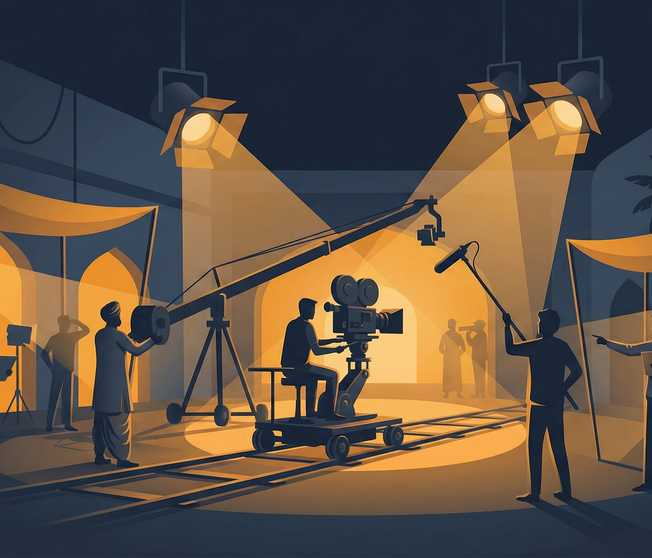
- Hero image: Young person with smartphone on a film set, golden light — alt text: "teenager filmmaking career India after board exams"
- Section image at "Film School" section: FTII Pune campus exterior — alt text: "FTII Pune film school India"
- Section image at "Equipment" section: Smartphone on gorilla pod with external mic — alt text: "smartphone filmmaking setup India beginner"
- Section image at "First Short Film" section: Behind-the-scenes of a micro-budget film shoot — alt text: "making first short film India on zero budget"
Readability: Estimated Flesch-Kincaid Grade 8-9, appropriate for the 17-19 target demographic. Short paragraphs, active voice, direct second-person address throughout.
Content length: Approximately 2,800 words — within the 2,500-3,000 word target range.
One fact to verify before publishing: The FICCI-EY Indian M&E industry valuation figure (Rs. 2.1 lakh crore) — confirm this is the most current available figure or update to the latest report year.
Related Blog Posts