Boom Operator Career in India: Complete Guide (2026)
-

Lavkush Gupta
-
May 04, 2026
-
9
There is a person on every film set who never appears on screen. Never gets a mention in the trailer. Never trends on Twitter when the film drops. But if they have a bad day — if their arm wavers two centimetres, if they misjudge an actor's movement, if they pick the wrong microphone for an outdoor scene — you will hear it. Every single person in that cinema hall will hear it.
That person is the boom operator.
And right now, in 2026, the boom operator career in India is one of the most underrated, most in-demand, and most genuinely skilled paths in the entire film sound department jobs landscape. We built AIO Cine because we kept watching talented people chase the wrong roles while roles like this went to whoever happened to be standing nearby holding the pole. That's changing. Slowly, but it's changing — and if you're reading this, you're ahead of the curve.
Let's break down exactly what this job is, what it takes, what it pays, and how you build a real career doing it.
What Does a Boom Operator Actually Do?
The short answer: they hold a microphone on a long pole over actors' heads and capture clean dialogue.
The accurate answer: they are a moving, breathing, reactive microphone placement system that must simultaneously track multiple actors, read subtext in a script, anticipate physical movement before it happens, maintain perfect microphone angle for polar pattern capture, avoid casting shadows in the frame, stay off the floor plan communicated by the camera operator, and hold a four-to-eight kilogram rig overhead — sometimes for four straight hours without a break.
The boom operator's fundamental job is to get the microphone as close to the sound source (the actor's mouth) as possible, without entering the frame and without creating noise. Everything else — the physical training, the acoustic theory, the equipment knowledge — exists in service of that one goal.
What makes this deceptively hard is that the goal requires mastery of multiple disciplines simultaneously. You need to understand acoustics the way a physicist does. You need to read actors the way a director does. You need to understand lenses and frame lines the way a camera operator does. And you need the arm endurance of someone who takes their physical training seriously.
This is not a "hold the stick" job. Anyone who tells you that has never done it under production conditions.
The Sound Department Hierarchy: Where the Boom Op Sits
Understanding the sound department structure is critical before you chase any film sound department job in India. The hierarchy runs like this:
Production Sound Mixer (also called Sound Recordist) The head of the department. They operate the recording equipment — the mixer console and recorder — from a cart or bag rig usually positioned off-set. They are responsible for the overall sound quality of the production, communication with the director and AD, and the final technical decisions about how dialogue is captured. They do not hold the boom. They listen, adjust levels, and direct the team.
Boom Operator Reports directly to the sound mixer. Operates the boom pole and microphone. On smaller productions, may also manage radio/lavalier mics for actors. The boom op is the mixer's "ears on the floor" — the person physically closest to the action, relaying information about the acoustic environment, set noise, and coverage options.
Sound Utility / Sound Assistant The entry-level role. Responsibilities include planting lavalier microphones on actors, cable management, battery checks, loading media, maintaining the equipment inventory, and assisting both the mixer and boom op. On smaller productions this role may not exist, with the boom op covering some of these duties.
Playback Operator Sometimes a separate role on music-heavy productions — manages playback of pre-recorded tracks for lip-sync sequences. Often not part of the core sound department reporting structure.
If you want to become a boom operator in India, the standard path is: Sound Utility first, boom operator second, production sound mixer eventually. We'll come back to the progression later.
The Skills You Actually Need
Arm Strength and Physical Conditioning
We're putting this first because every experienced boom operator you talk to will bring it up within the first two minutes. This job is physically brutal in a way that nobody prepares you for.
A standard boom pole with a shotgun microphone, shock mount, and windscreen weighs between three and seven kilograms depending on your rig. You hold this overhead — arms extended, elbows slightly bent, wrists locked — for takes that can run anywhere from thirty seconds to ten minutes, repeated across a twelve to sixteen hour shoot day.
The muscles most affected are the deltoids, trapezius, and the deep stabilisers of the shoulder girdle. Experienced boom operators develop these methodically. If you're serious about this career, start a shoulder and core strengthening routine now, before you land your first crew call. Injury from poor physical preparation ends careers early.
Acoustic Theory and Microphone Polar Patterns
You need to understand how sound behaves in physical space. How it reflects off hard surfaces. How it's absorbed by soft furnishings. Why a concrete-walled room sounds different from a carpeted bedroom even at the same decibel level.
More specifically, you need to understand microphone polar patterns cold. The two patterns you'll work with most are:
Supercardioid: Tighter front pickup, small rear lobe, excellent off-axis rejection. Best for indoor controlled environments where you need to isolate dialogue from ambient noise. Standard choice for most dialogue scenes in Indian film production.
Hypercardioid: Even tighter than supercardioid, more pronounced rear lobe, maximum side rejection. Used when you need extreme isolation — noisy sets, locations with significant ambient sound contamination, or when the camera is unusually close and the boom must stay unusually far.
Knowing which to use, and when to switch, is a call you make in real time on set. Get it wrong and the mixer is pulling noisy, off-axis audio that may or may not be salvageable in post.
Script Reading and Movement Anticipation
This is the skill that separates average boom operators from exceptional ones. You must read the script before every shoot day — not for story, but for blocking intelligence. Who speaks first in each line? Who interrupts? Does an actor turn away mid-dialogue? Does a character walk to a window while speaking?
Every physical movement an actor makes changes where the microphone needs to be. And the boom op must anticipate that movement and begin repositioning before it happens — because if you react after, you've already missed the first syllable of the line.
This requires reading rehearsals carefully, watching blocking during camera setups, and developing a near-instinctive read of how actors carry their energy before they move. The best boom operators describe it as "listening to the actor's body."
Frame Awareness
You must understand lenses. A 24mm wide lens has a vastly different frame line than a 100mm telephoto. The tighter the lens, the more the boom can dip into frame without being seen. The wider the lens, the higher the pole must stay and the harder the acoustics become.
You build this knowledge by spending time with camera operators. Ask questions. Learn to read the monitor. Eventually you develop the ability to feel frame lines instinctively.
Communication and Set Diplomacy
The boom operator communicates constantly with three parties: the sound mixer (via IFB earpiece), the camera operator (regarding frame lines), and the first AD (regarding schedule, setup changes, and calls). You need to be efficient, calm, and clear. On a noisy set with multiple things happening simultaneously, unclear communication costs time — and time on a film set costs money.
Equipment You'll Work With
Boom Poles Carbon fibre is standard — lightweight, rigid, minimal handling noise. Aluminium poles are cheaper but heavier and more prone to transferring vibration. Brands like K-Tek, Ambient Recording, and Boom Buddy are industry reference points. Pole length varies from three to six metres depending on the shot.
Shotgun Microphones The standard boom microphone category. Common references in Indian sync sound productions include the Sennheiser MKH 416 (arguably the most-used shotgun mic globally), the Rode NTG5, and the DPA 4017B. Each has different character — learn the differences. The MKH 416, for example, handles humidity well, which matters enormously if you're shooting outdoors in Mumbai during monsoon.
Shock Mounts Isolate the microphone from handling noise transmitted through the boom pole. Pistol grips with integrated suspension systems are standard. The Rycote Lyre system is considered a benchmark.
Windscreens Outdoor shooting requires wind protection. A foam windshield handles light breeze. A "blimp" or "zeppelin" system (a rigid outer shell with internal suspension and a furry outer cover, often called a "dead cat" or "softie") handles serious wind conditions. In India, outdoor shoots — beaches, fields, heritage sites, hill stations — are common. Knowing how to dress your microphone for wind conditions is non-negotiable.
Lavalier / Radio Microphones As a boom operator, you'll often work in conjunction with radio mics planted on actors by the sound utility. Understanding how to coordinate boom and lav coverage — when to prioritise each source, when they complement each other, how to avoid radio frequency interference on crowded sets — is part of your working knowledge.
A Typical Day on Set
Pre-call (before the general crew call) You're arriving with the sound department, helping unload and set up equipment. Testing all microphones, checking poles for rattles or cable issues, confirming IFB communication with the mixer.
Morning briefing The AD calls a production meeting. You're listening for the shooting order, the first setup, any special requirements (rain sequences, water, extreme crowd noise). You're mentally mapping which microphone you'll use for each scene on the schedule.
Camera setup While the camera department lights and frames the first shot, you're walking the set. Checking the floor for creaky boards (which your footsteps will pick up during a take). Identifying reflective surfaces that might cause room noise problems. Talking to the camera operator about the lens choice and approximate frame line.
Rehearsal This is critical. You watch blocking carefully. You note every line delivery, every movement, every moment where two actors overlap dialogue or where a character turns away mid-sentence.
Takes You're on the floor, boom overhead, tracking. After each take, the mixer gives you notes via IFB — "a little left on that last line," "you got some floor noise on the final move." You adjust.
Lunch You're eating quickly and checking the afternoon schedule.
Afternoon New setups, new lighting conditions, potentially outdoor locations. The work continues across a standard twelve-hour day, often running to fourteen or sixteen on a heavy shoot.
Wrap Help break down and load equipment. Make sure all media and gear is secured. Brief the mixer on any acoustic issues encountered that day that the post team should know about.
The Physical Reality Nobody Talks About
Let's be direct about this because we've seen too many people enter sound departments underprepared for the physical demands.
Holding a boom pole overhead for extended periods causes shoulder impingement, rotator cuff strain, and cervical spine issues if your technique is wrong or your conditioning is inadequate. Professional boom operators train specifically to prevent this. Shoulder press variations, lateral raises, face pulls for posterior deltoid, and deep core work for stabilisation.
Beyond the arms, there's the standing. Twelve to sixteen hours. On hard floors, on concrete, on rough outdoor terrain. Your footwear matters. Your posture matters. Boom operators develop technique around weight transfer and rest positions between takes that a camera department crew member would never need to think about.
This is a young person's entry role — and the physical base you build early determines how long and how well you can do it.
How to Become a Boom Operator in India
Step 1: Understand Sound Fundamentals
Take an audio engineering course or a film sound specialisation. Institutions like the Film and Television Institute of India (FTII) in Pune and Satyajit Ray Film and Television Institute (SRFTI) in Kolkata offer structured sound programmes. Private institutes including Whistling Woods International in Mumbai offer production sound courses. Online platforms like Coursera and Berklee Online offer acoustics and audio fundamentals that complement hands-on training.
You don't need a formal degree — but you need the knowledge the degree would give you. Self-study is legitimate if it's rigorous.
Step 2: Start as Sound Utility
The entry point is the sound utility / sound assistant role. You handle lavalier mics, cables, batteries, and media. You observe the boom operator and mixer working. You absorb everything. Budget at least one to two years in this role before expecting to operate the boom on anything other than a small indie production.
Step 3: Build Equipment Familiarity
Start with a basic boom kit — a mid-range carbon pole, a Rode NTG3 or equivalent shotgun, a simple shock mount and blimp. Practise in your flat. Practise outdoors. Record everything and listen back critically. Learn to hear what good audio sounds like and, more importantly, what bad audio sounds like and why.
Step 4: Network Within Sound Departments
In India's film industries, departments are insular by necessity — you're trusting your colleagues with your livelihood and your reputation. Getting known as reliable, skilled, and easy to work with is everything. Production sound mixers in Bollywood, Tollywood, and the OTT production ecosystem hire boom operators they know or operators vouched for by people they trust.
FWICE (Federation of Western India Cine Employees) membership is your credential for working on union productions. Get it as soon as you're eligible — it signals professional seriousness and gives you access to regulated work conditions.
Day Rates and Career Growth
These are market estimates based on prevailing rates in 2026 across Mumbai, Hyderabad, and Chennai productions. Actual rates vary by production scale, your experience level, and individual negotiation. Treat these as orientation, not guarantees, and always verify current market rates with working professionals.
Sound Utility / Sound Assistant: Rs. 1,500 to Rs. 3,000 per day on mid-range productions. Entry-level OTT shoots and feature films may go higher for experienced assistants.
Boom Operator (mid-level, 2-4 years experience): Rs. 3,500 to Rs. 7,000 per day on OTT and mid-budget feature productions.
Boom Operator (senior, 5+ years, known name in the department): Rs. 8,000 to Rs. 15,000+ per day on major Bollywood or big-budget south Indian productions. A senior boom op on a premium Netflix or Amazon Prime India production is frequently at the higher end of this range.
Production Sound Mixer (your eventual progression): Rs. 15,000 to Rs. 50,000+ per day depending on the project scale. Top-tier mixers on major Hindi or Telugu features command packages, not day rates.
The career arc from utility to mixer typically spans seven to twelve years of consistent work. The boom operator phase — three to five years — is where you build the acoustic intuition and set knowledge that makes a great mixer.
The Boom Op-Mixer Relationship
This is the most important professional relationship in your working life as a boom operator. The mixer is your technical lead and your advocate with the director. You are their primary source of real-time information from the floor.
Great boom-mixer pairs develop a shorthand. A good mixer trusts their boom op's judgment on microphone choice for a given shot. A good boom op trusts their mixer's level adjustments without needing to understand the technical reasoning in the moment.
The breakdown of this relationship — ego, poor communication, lack of trust — is the most common reason a sound department underperforms on a production. Take the relationship as seriously as you take the equipment.
Common Mistakes and the Boom Shadow Problem
The boom shadow is the nightmare scenario. If your pole or microphone drifts too low and the lighting catches it, a shadow of the boom appears on the actor or the set wall — and if it makes it into a printed frame, it's a reshoot or a visual effects fix.
Preventing it requires understanding where the key light source is and keeping your boom on the opposite side whenever possible. It requires constant awareness of your pole angle relative to the light direction. And it requires honest, immediate communication with the camera operator and gaffer when shadow risk is high — because the solution may be a lighting adjustment, not just a boom repositioning.
Other common mistakes:
Off-axis rejection failures: Tilting the microphone at the wrong angle relative to the actor, moving the sound source into the rejection zone of the polar pattern. This produces thin, phasey audio that is often unfixable in post.
Handling noise: Gripping the pole too tightly, allowing cable vibration to reach the microphone. Good technique keeps the grip relaxed and the cable management clean.
Missing the first syllable: Reacting to movement instead of anticipating it. The first word of a line is often the most important for emotional clarity. Missing it creates a continuity problem in editing.
RF interference complacency: On crowded sets with multiple radio mics, frequency coordination is critical. Not participating in this process as a boom op — assuming it's only the mixer's job — creates problems mid-take.
Different Productions, Different Challenges
Dialogue-Heavy Drama (Feature Films, OTT Series) The core environment for boom work. Controlled setups, multiple takes, clear blocking. The acoustic challenges are interior acoustics and set noise. The physical demand is sustained endurance across a long shooting day.
Action Sequences Camera setups are more complex, the action is unpredictable, and sound is often lower priority than safety and choreography. Boom work on action sequences is more about capturing reference audio (the dialogue and sound that guides the post team) than broadcast-quality dialogue. Know your role — this is not the primary capture session.
Outdoor and Location Shoots Wind, ambient noise, crowd noise, traffic — outdoor locations are the hardest acoustic environments. Your wind protection game must be solid. Your polar pattern knowledge must be precise. And your communication with the mixer about environment conditions must be continuous.
Music Video and Song Sequences Almost entirely playback-based. Your job is reference capture and ensuring playback levels and timing are correct. Very little pressure compared to sync dialogue — but valuable experience in set workflow and music production environments.
The Sync Sound Revolution in India
If you're entering the boom operator field now, you're entering at exactly the right moment. This deserves emphasis.
For decades, Indian film production — particularly Hindi cinema — relied on post-production dubbing for the majority of its dialogue. Actors would perform on set, the audio would be used only as a guide track, and the entire cast would later come into a studio to record the same dialogue to picture. This practice, called "dubbing" or ADR (Automated Dialogue Replacement), was the standard workflow.
OTT platforms changed this. Netflix, Amazon Prime Video, Disney+ Hotstar — all of them have global technical delivery specifications, and sync sound (dialogue recorded live on set, used as the primary audio in the final cut) is either required or strongly preferred. The quality difference in naturalistic performance is audible. Audiences trained on international content notice.
The result: sync sound adoption in Indian feature films and OTT series has accelerated sharply since 2019. Which means the demand for qualified, experienced sound department professionals — particularly boom operators who can deliver clean location audio — has grown significantly.
Dolby Atmos delivery requirements, increasingly common on premium OTT releases, add another layer of technical demand on the entire post-sound chain. Clean, well-captured production audio makes everything downstream easier. The production sound department's work is no longer being papered over by a dubbing session — it has to stand on its own.
This is good for you.
City-Specific Opportunities
Mumbai The largest concentration of Bollywood feature film and OTT production. Also the centre of advertising film (ad film) production, which runs year-round and pays well. The most competitive market but also the most active. FWICE is based here; union membership matters more in Mumbai than anywhere else.
Hyderabad Tollywood is producing at scale, and Hyderabad has become a significant hub for pan-Indian production — films shot in Telugu that release simultaneously in Hindi, Tamil, Malayalam, and Kannada. The production volumes are enormous and the appetite for sync sound is growing as Telugu films reach global OTT platforms. Hyderabad Film Chamber of Commerce is the local industry body.
Chennai Kollywood (Tamil film industry) has a strong tradition of technical excellence. Sync sound adoption is solid in high-budget Tamil productions. Chennai also feeds Malayalam cinema production at times. The South Indian Film Chamber of Commerce governs the industry.
Bengaluru Growing OTT and indie production scene, particularly for Kannada (Sandalwood) and for pan-India productions choosing Karnataka locations. Less concentrated than Mumbai or Hyderabad but growing.
Smaller Hubs Kolkata (Bengali cinema), Kochi (Malayalam), Lucknow and Patna (Bhojpuri/Hindi regional) — all have active local film industries with their own demand for sound professionals. Pan-Indian productions also regularly shoot on location across India, meaning sound department crew travel frequently.
Career Progression to Production Sound Mixer
The boom operator phase is not a destination — it is a school. Everything you learn holding the pole prepares you to lead the department.
A production sound mixer who came up through boom operating knows the physical realities of every position they're directing. They know what acoustic problems look like from the floor, not just from the cart. They know how to read a set, how to communicate with camera and lighting, and how to manage the acoustic environment of any location.
Most working production sound mixers in India spent three to seven years as boom operators before making the transition. The transition point usually arrives when you've built enough trust and enough technical reputation that a producer or director specifically requests you as mixer, or when a mentor-level mixer recommends you for a project they can't take.
As you progress, invest in your own equipment. A mixer who owns a professional bag rig, quality microphones, and reliable recording equipment has leverage and flexibility that a kit-borrower doesn't. Equipment investment at the right point in your career is career investment.
Your Next Step
The boom operator career in India is unglamorous by design. The entire job is structured around being invisible. But if you're the kind of person who gets satisfaction from technical precision, from physical mastery, from knowing that the emotional peak of a scene — the line that makes the audience cry — was captured cleanly because of a decision you made in the two seconds before the actor delivered it, this is a deeply rewarding path.
The sync sound shift is real. The demand is growing. The supply of genuinely skilled boom operators is still catching up. The moment is yours if you want to build toward it seriously.
Start by getting your FWICE credentials and building toward your first sound department role. And when you're ready to look for verified crew calls from legitimate production houses — without the guesswork of who's real and who's running a scam — register on AIO Cine, where every production house is verified before they can post crew calls. Because your time and your skill deserve to go to productions that are actually running.
The best dialogue you've never noticed was captured by someone exactly like you. Go make that your job.
Salary and day rate figures are market estimates based on available industry data as of early 2026. Actual rates vary by production budget, location, experience level, and individual negotiation. Always verify current rates with working professionals before making career decisions.
SEO Notes
Internal link suggestions:
- Link "FWICE credentials" to the FWICE membership guide post (
fwice-membership-card-guide-2026.md) - Link "sound design" to the sound design career post (
sound-design-career-indian-film-industry.md) - Link "film sound department" to the sound mixing vs sound design post (
sound-mixing-vs-sound-design-career-india.md) - Link "day rates" to the film crew day rates post (
film-crew-day-rates-india-2026.md) - Link "film set etiquette" reference where appropriate to (
film-set-etiquette-guide-india.md) - Link "Hyderabad film industry" reference to (
hyderabad-film-industry-career-guide.md)
External link suggestions:
- FTII Pune official site (ftii.ac.in) on first mention
- SRFTI Kolkata official site on first mention
- FWICE official site on membership mention
- Sennheiser MKH 416 product page or trusted review source when referencing equipment
Image placement suggestions:
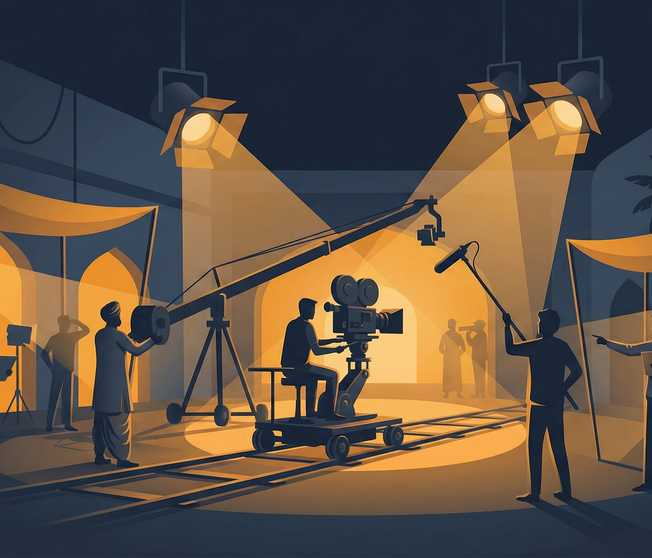
- Hero image: Boom operator on a film set, overhead angle showing the pole and set. Alt text: "Boom operator holding microphone pole overhead on Indian film set"
- Section image near "Equipment" section: Shotgun microphone with blimp/dead cat windscreen. Alt text: "Shotgun microphone with zeppelin windscreen and shock mount used by boom operators"
- Section image near "Sound Department Hierarchy": Simple infographic showing mixer → boom op → sound utility hierarchy. Alt text: "Film sound department hierarchy chart showing production sound mixer, boom operator, and sound utility roles"
Featured snippet opportunity: The "What Does a Boom Operator Actually Do?" section and the "Sound Department Hierarchy" section are both structured to be pulled as featured snippets for "what does a boom operator do" and "film sound department hierarchy" queries. Keep these sections with clear, direct language and the hierarchy listed cleanly.
Technical SEO:
- Primary keyword "boom operator career India" should appear in: H1, first paragraph, one H2, and naturally in body copy (target 4-6 occurrences)
- "Film sound department jobs India" should appear 3-4 times naturally
- Page title suggestion: "Boom Operator Career in India: Skills, Salary & How to Start (2026)"
- URL slug:
/boom-operator-career-india - Estimated word count: ~2,800 words (within target range)
- Readability target: Grade 8-9 Flesch-Kincaid (accessible but authoritative)
Related Blog Posts