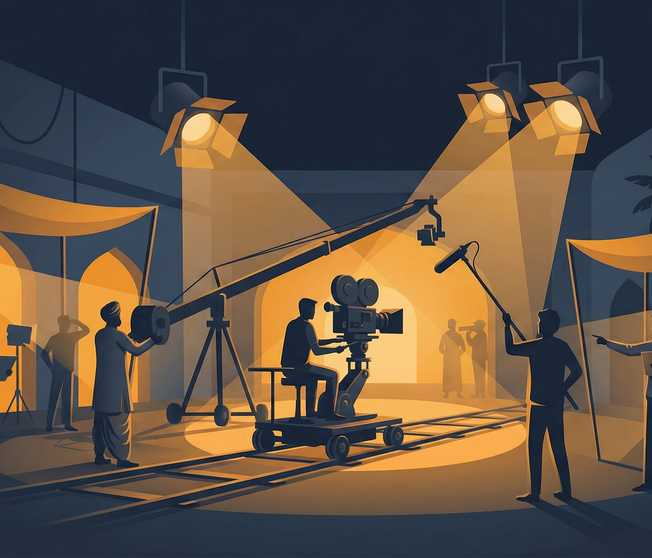
How to Become a Casting Director in India: The Gatekeeper Role That Can Make or Break a Film
-

Lavkush Gupta
-
May 04, 2026
-
10
Think about the last film that wrecked you emotionally. The one where the performances hit so precisely that you forgot you were watching actors. Now think about the first question most people ask when they walk out: who directed it? Who wrote it?
Almost nobody asks who cast it.
That's the great invisible irony at the heart of Indian cinema. The person most responsible for whether you believe the story — the casting director — is also the most overlooked credit on the poster. And yet, ask any seasoned director off the record, and they'll tell you: a great casting director doesn't just fill roles. They find the human truth in a script that even the director hasn't fully articulated yet.
If you've been drawn to the story-building side of filmmaking — if you notice actors before you notice the camera — this career path might be the one you've been circling without knowing its name.
Here's everything you need to know about building a career as a casting director in India. The real version. Not the romanticized one.
What a Casting Director Actually Does (It's Not Just "Picking Actors")
Let's kill the most common misconception first. A casting director does not sit in a chair, watch actors perform, and say yes or no. That's a two-sentence summary that strips out ninety percent of the job.
What a casting director actually does is translate a director's vision into human form.
When a director says "I want this character to feel like someone who's been running from something for fifteen years but still tries to smile at strangers," that's not a breakdown. That's a feeling. The casting director's job is to deconstruct that feeling, connect it to a specific physical and emotional type, search their mental catalogue of hundreds of faces and performances, and then find the actual person — known or unknown — who can embody it.
That process involves:
Script analysis. Before a single audition is held, a casting director reads the script multiple times, often alongside the director and writer, building character breakdowns that go far beyond "male, 30s, tall." They map character arcs, identify the emotional pivot points a performer needs to carry, and flag roles where miscasting could sink entire sequences.
Building the longlist. This is a research-intensive phase. Established names get pulled from existing databases. Emerging talent gets sourced from theatre productions, short films, YouTube originals, regional cinema, OTT supporting roles, and increasingly from platforms where talent registers their profiles directly. Every name on the list has to be a considered choice, not just an obvious one.
Coordinating auditions and look tests. Casting directors design the audition process — what scenes to use, what to ask performers to do, what camera format to use for look tests. They also manage the logistics: availability windows, reader assignments, scheduling conflicts, and the ever-present reality that a top-tier actor's dates are guarded by three layers of management.
Managing the director's expectations. This is the part nobody talks about publicly. Sometimes a director has a fixed idea that isn't castable — the actor they want is too expensive, unavailable, or genuinely wrong for the role even if they can't see it yet. A great casting director knows how to redirect without confronting, and how to present an alternative that makes the director feel like they discovered it themselves.
Negotiating dates and broad fee ranges. While talent agents handle the actual contract negotiations, casting directors are typically the first point of contact with actor managers. They do the groundwork: checking availability, gauging interest, establishing whether a conversation with producers is even worth having.
Supporting reshoots and replacements. When a film runs into trouble mid-production — a performance isn't working, an actor's dates collapse, chemistry between leads dies on screen — the casting director is called back in. This happens more often than any production house will ever publicly admit.
The CD Ecosystem in India: Who Built This Profession
India's casting industry didn't have a formal structure until relatively recently. For most of Bollywood's history, casting happened through personal networks: the director called the star's secretary, the producer called the star's father, and that was the industry.
The shift toward professional casting — where directors actually worked with dedicated casting consultants who built talent pipelines — gathered serious momentum in the 2000s and accelerated through the 2010s as content complexity increased.
A few figures shaped what the profession looks like today.
Mukesh Chhabra is probably the most recognized name in Indian casting. He runs the Mukesh Chhabra Casting Company, and his credits span films like Dangal, Dear Zindagi, Dil Dhadakne Do, and the Netflix series Jamtara. What made Chhabra distinct early in his career was his commitment to discovering non-actors and regional talent — a radical act in a Bollywood ecosystem that was almost reflexively star-dependent. His talent for finding faces that feel lived-in rather than crafted pushed him into the directorial chair as well, with Dil Bechara in 2020. He's the clearest proof that a casting director in India can become a cultural authority in their own right.
Shanoo Sharma is the head of casting at Yash Raj Films, which makes her effectively the gatekeeper of one of Hindi cinema's most powerful production houses. She runs YRF Talent, the agency arm that nurtures emerging actors through a structured program. Sharma's approach is talent-development-focused — she's not just filling roles for current productions but building a bench of actors who will be castable five years from now. Her influence on who breaks through from the YRF system is enormous and largely understated in industry conversation.
Nandini Shrikent runs Casting Bay, one of the more prominent independent casting agencies operating across Bollywood, regional, and OTT productions. Casting Bay has worked on a wide range of projects and represents the model of the mid-sized casting agency that can handle multiple simultaneous productions without the overhead (or exclusivity constraints) of the big studio arms. Shrikent's work is an example of what a well-run independent CD operation looks like in practice.
Beyond these names, there is a broader ecosystem: casting directors who specialize in regional industries (Tamil, Telugu, Malayalam, Marathi, Bengali), casting consultants who focus exclusively on OTT content, and a growing number of assistant casting directors who are building careers in a profession that — unlike most below-the-line roles — has no formal union structure in India.
How Casting Directors Work With Directors
The relationship between a casting director and a director is one of the more unusual creative partnerships in filmmaking. It requires deep trust, blunt honesty, and the ability to hold two realities simultaneously: the director's vision and the practical constraints of the industry.
In the best cases, a CD enters the process at the script stage. This early collaboration means the casting director can flag potential issues before anyone gets attached — a character written as a 19-year-old who needs to carry six emotionally complex scenes, for instance, is a casting challenge that's better surfaced at the draft stage than after the production timeline is locked.
In most cases in India, CDs are brought in after the script is locked and often after the lead has already been attached. The first call is usually about the supporting cast, which is both where casting directors have the most creative freedom and where they can have the most outsized impact on a film's texture.
Great supporting casting is what makes the world of a film feel real. The casting director who finds the perfect character actor for a two-scene role — someone who brings a history to the character that the script doesn't spell out — is adding value that a cinematographer or editor cannot replicate.
Working with a director requires understanding their visual language, their relationship with performance, and their tolerance for risk. Some directors only cast recognizable faces because they need box office certainty. Others actively want unknowns because they don't want the audience to bring associations. A casting director adapts their methodology accordingly.
The Career Path: From Casting Assistant to Independent CD
There is no straight line, and anyone who tells you there is has probably only worked for one production house.
Stage 1: Casting Assistant
Most people enter casting as assistants — unpaid or underpaid at first, paid modestly once they've proven themselves useful. The work at this level is unglamorous: maintaining databases, scheduling auditions, managing actor submissions, handling the logistics of coordinating between a dozen people who all have conflicting priorities.
What you're actually doing, though, is building your eye. You watch hundreds of auditions. You see what works on camera versus what works in a room. You start developing opinions about why certain performances land and others don't. You learn the business of actors: their management structures, their fee expectations, their career patterns.
Assistant stints typically last one to three years. The best ones happen inside active production houses or established casting agencies rather than in freelance chaos, because you need volume — you need to process a high number of casting decisions to develop real judgment.
Stage 2: Associate Casting Director
After assistanting, most CDs move into an associate role — either with the same outfit or by moving to a larger one. At this level, you start leading portions of the casting process: running a casting brief independently, presenting shortlists, conducting initial audition rounds. You're still reporting to a senior CD, but you have real decision-making authority over certain projects or certain cast tiers.
This phase is where your network starts becoming genuinely valuable. The actor managers who answer your calls, the theatre directors who trust your eye, the producers who know you can be relied on — these relationships take years to cultivate and they are, ultimately, your most durable professional asset.
Stage 3: Casting Director (Employed)
Senior CDs at established studios — a Shanoo Sharma at YRF, for instance — run their department, manage teams of associates and assistants, oversee multiple simultaneous productions, and often have influence over broader creative decisions at the production house level. This is a staff position with a salary, and it offers security in exchange for exclusivity. You are the face of one company's casting identity.
Stage 4: Independent Casting Director / Agency
The other trajectory is going independent — running your own casting consultancy and working project to project. This is higher risk, higher reward, and requires a strong reputation before it becomes financially sustainable. Independent CDs typically charge a project fee (more on that below) and build their agencies over time by adding associates and taking on more simultaneous projects.
The most successful independent CDs in India have built talent databases, operational systems, and reputations substantial enough that production houses come to them rather than the reverse.
How Casting Directors Scout for Talent in 2026
Scouting is where the romanticism of the profession actually lives up to the reality. And in 2026, the scouting toolkit is more diverse than it's ever been.
Theatre. Every serious casting director in India still mines the theatre circuit — not because theatre actors are automatically great on camera, but because theatre training produces a certain quality of physicality and emotional availability that is genuinely harder to find in purely screen-trained performers. The Mumbai theatre scene (Prithvi Theatre, Rangashankara in Bengaluru, the Chennai and Kolkata theatre ecosystems) remains a core scouting ground.
Film festivals. Short film festivals — MAMI, KASHISH, Habitat Film Festival, regional ones — are where you find the next generation of performers before they become unaffordable. A CD who spots a face in a student short film and signs them before they blow up is doing their job at its highest level.
Regional cinema. Tamil, Telugu, and Malayalam cinema have historically produced performers who arrive in Hindi cinema fully formed — because they've already done the work. A casting director who has watched three hundred South Indian films has a vastly deeper bench to draw from than one who hasn't.
OTT platforms. Streaming has created a permanent archive of performances that a casting director can access, review, and reference at any time. A supporting actor in a 2022 web series who caught your eye for fifteen minutes of screen time is now findable, searchable, and contactable. This has democratized discovery in a way that the film-only ecosystem never could.
Digital talent platforms. This is where the profession is actively shifting. Platforms like AIO Cine, where talent registers profiles with their work samples, physical stats, and location data, function as living databases that casting directors can search by specific criteria. Instead of relying purely on submissions from managers (who only pitch their current roster), a CD can run targeted searches — find performers based in Pune with theatre backgrounds between 25 and 35, for instance — and surface names they would never have encountered through traditional channels. This is not replacing instinct; it's giving instinct more data to work with.
Social media. Instagram and YouTube have created an entirely new tier of discoverable talent. Casting directors have found leads in web series through Reels. They've found stunt performers through Instagram fight choreography videos. The content creator ecosystem has produced a generation of people who are extraordinarily comfortable in front of a camera even if they've never been on a set. Translating that comfort into performance craft is a different challenge, but the raw material is there.
Casting Director vs. Talent Agent: Not the Same Job
This confusion costs a lot of aspiring industry professionals their time and energy, so let's resolve it cleanly.
A talent agent represents performers. Their client is the actor. They negotiate contracts, seek out roles, protect their clients' interests, and take a commission (typically 10-15%) on whatever their clients earn. They work for the talent.
A casting director serves the production. Their client is the director, the producer, or the production house. They are paid to find the best person for each role in a specific project. They do not take commissions from actors — doing so would be a direct conflict of interest, and in a healthy industry, it's considered unethical.
In India, this distinction is often blurred in practice. Some casting agencies run adjacent talent management operations, which creates obvious questions about objectivity. The more professionally the industry matures, the more this separation is being enforced — particularly on OTT productions where studio compliance teams are far more rigorous about these conflicts than traditional production houses.
If you're an actor and someone calls themselves a casting director but asks you for a commission on your bookings, they are a talent agent at best and a scammer at worst. They are not functioning as a casting director.
Salary and Fee Structure: What Casting Directors Actually Earn
The honest answer is: it varies enormously, and not always in proportion to talent.
Employed casting directors at large production houses — YRF, Dharma, Excel Entertainment, or the Indian arms of Netflix and Amazon — typically earn between Rs. 80,000 and Rs. 3,00,000 per month, depending on seniority, the scale of their slate, and how much they negotiated at hiring. Department heads at the top studios are at the upper end of that range and sometimes beyond it. These are stable, salaried positions with the tradeoffs that come with exclusivity.
Independent casting directors working on a project-fee basis charge anywhere from Rs. 2,00,000 to Rs. 15,00,000 per project depending on the scale, duration, complexity, and their reputation in the market. A low-budget indie feature might pay Rs. 1,50,000 for full casting services. A major OTT series with a large ensemble cast might pay Rs. 10,00,000 or more. Some senior CDs charge a day rate on retainer for ongoing projects; others prefer flat fees.
Associate casting directors at independent agencies typically earn between Rs. 35,000 and Rs. 80,000 per month, with some taking a cut of project fees as they develop ownership over casting briefs.
Casting assistants are often paid Rs. 15,000 to Rs. 30,000 per month during their learning years, and some begin as unpaid interns inside production houses — a practice that is worth scrutinizing carefully before you accept.
What drives the top end of casting director compensation is reputation plus network. A CD whose name on a project signals to actors that the production is legitimate and professionally run has leverage that goes beyond their skill — they are themselves a mark of quality, and that has monetary value.
How OTT Has Elevated (and Complicated) the Casting Director's Role
Before streaming, the Indian film industry operated on a star-first model that severely constrained what casting directors could actually do. The equation was simple and brutal: a major producer would not greenlight a film without a top-tier star attached, which meant the lead was decided before a casting director was even hired.
OTT changed that calculus in a fundamental way.
Streaming platforms — Netflix, Amazon Prime Video India, Disney+ Hotstar, JioCinema, SonyLIV — are commissioning content based on story, not stars. Their data-driven approach to acquisition means that a compelling ensemble drama with unknown performers can be greenlit if the narrative is strong enough. This has shifted enormous creative power toward the casting director, who is now being asked to build full ensembles from scratch rather than just fill supporting slots around a predetermined lead.
The scale of OTT production in India has also created volume. In 2025, the major streaming platforms collectively released hundreds of original Indian series. Each series requires a full casting process. The demand for professional casting services has outpaced the supply of experienced casting directors, which is one reason why the profession is actively growing and why skilled associates can move into senior roles faster now than they could a decade ago.
OTT has also raised the bar on casting specificity. Film audiences forgive a slightly-wrong casting choice because they see the actor for two hours and move on. Streaming audiences live with a character across six to ten episodes. The cost of a miscasting is dramatically higher. This has made casting directors more valuable — and their decisions more scrutinized.
Building a Talent Database: The Unglamorous Work That Defines Great CDs
Your talent database is your most important professional asset, and building it is an ongoing, never-finished process.
A serious CD's database is not a spreadsheet with actor names and phone numbers. It is a structured, searchable catalogue that includes:
- Physical attributes (height, build, age range, coloring)
- Language capabilities and regional accents
- Performance background (theatre training, film credits, OTT work, short films)
- Special skills (horse riding, combat training, classical dance, specific dialects)
- Management contacts and current availability status
- Notes from past auditions — what this performer does well, what they struggle with, what type of material brings out their best work
- Links to reels and work samples
The best casting directors update this database continuously. Every audition, every festival screening, every OTT series they watch is an opportunity to add or update an entry. The CD who remembers a supporting actor from a 2021 Marathi film when the exact role comes up in a 2026 OTT thriller has a database behind that memory.
Today, platforms like AIO Cine function as a crowdsourced extension of this database — talent registers their own information, keeps their profiles current, and signals their availability actively. A casting director who has registered on such platforms and uses them for active searches is building their pipeline faster than one who relies exclusively on agent submissions.
Running a Casting Agency: What It Actually Takes
Moving from independent CD to agency owner is a business decision as much as a creative one.
An agency requires:
Systems. How do you intake briefs? How do you manage multiple simultaneous casting processes without one project's chaos contaminating another? How do you track where every audition tape is and who's seen it? The answer is software, process design, and disciplined team habits. Most small agencies in India are still running on WhatsApp groups and Google Drive folders. The ones that grow past two or three simultaneous projects typically invest in proper project management infrastructure.
Staff. Associates who can own portions of the work. An office manager or coordinator who handles scheduling and logistics. Eventually, an accounts person. None of this is free, and the fees have to cover it.
Reputation management. Your agency's name needs to mean something. Actors need to trust that they'll be treated with respect when they come in for your auditions. Directors need to trust that your shortlists represent real creative thinking, not just the first five names that came to mind. Production houses need to know that your agency delivers on time and under pressure. This reputation is built one production at a time and can be damaged by a single badly-handled project.
Ethical clarity. Never take money from actors for access to auditions. Never charge registration fees. Never promise roles you cannot deliver. These boundaries are not just legal considerations in India — they are the difference between building a sustainable professional reputation and becoming another cautionary tale that the industry whispers about.
The Ethical Weight of Being a Gatekeeper
This part does not get discussed enough, so we're going to sit with it for a moment.
Casting directors in India — particularly those attached to large production houses — hold life-changing power over working actors. A phone call from a Mukesh Chhabra or a Shanoo Sharma does not just book a role. It can launch a career. It can validate years of training and sacrifice. It can change what a performer believes is possible for them.
That power comes with responsibilities that the profession is still reckoning with.
The first is diversity. Indian cinema has historically been narrow in its definition of who gets to be a lead — narrow in skin tone, narrow in body type, narrow in regional representation. Casting directors who actively push against those defaults — who bring a South Indian face to a Hindi film, who cast a dark-skinned actor in a romantic lead, who find a performer from a Tier 3 town who has never been in a film — are doing something that has genuine cultural consequences beyond the project itself.
The second is transparency. Actors have a right to clear communication about the process — what they're being considered for, what the timeline is, what happens after their audition. The ghosting culture that is normalized in Indian casting is not inevitable; it is a choice, and casting directors have the power to change it.
The third is protection. Vulnerable performers — particularly young, unknown actors who are desperate to break in — are targets for exploitation. A casting director who allows their office, their process, or their name to be used as cover for predatory behavior is complicit in that behavior. The profession's gatekeeping power is exactly what makes it dangerous when exercised without ethical guardrails.
Where to Start If This Is the Path You Want
If you're reading this from an assistant director background, or from a theatre stage management background, or from a film school production design program — you have more transferable skills than you probably realize. The ability to break down a script, manage logistics under pressure, read people quickly, and hold a vision in your head while executing the practical steps to get there: that's the core of casting work.
Start here:
- Assist before you lead. Reach out to casting agencies and production house casting departments directly. Offer to assist. Accept that the first year or two will pay poorly and teach enormously.
- Watch everything, systematically. Not passively. Actively — with a notebook, building your mental catalogue of performances and faces. Theatre, short films, OTT, regional cinema, YouTube. Your database starts in your head before it lives anywhere else.
- Build your network before you need it. Connect with actors, managers, directors, and other casting professionals. Attend industry events. Go to theatre. Go to film festivals. The relationships you build now are the ones you'll use throughout your career.
- Register on verified platforms. AIO Cine — where every production house is verified before they can post crew calls — is where active productions are looking for talent and crew. As a developing casting professional, being present where the industry is operating is not optional.
- Study the ethics. Read about casting practices in industries where the profession is more formalized — the Casting Society of America's guidelines, for instance, are a useful reference even for Indian practice. Know what good looks like before the temptation to cut corners arrives.
The Credit You Never See, The Career You Can Build
The casting director's name appears in a font size that most audiences never pause to read. The director gets the poster. The stars get the billboards. The casting director gets to know — quietly, privately — that the film worked in part because of decisions they made in a room before the camera ever rolled.
If that's enough for you, if the creative satisfaction of finding the right person for the right role feels like a reward in itself, then this is a career worth building. It is not easy to enter, it is not glamorously paid at the start, and it requires a kind of patient, persistent attention to human beings that not everyone has.
But if you have it, this industry needs you. OTT is producing content at a pace that the current generation of casting directors cannot cover alone. Regional cinema is finding global audiences and needs professionals who can serve both local authenticity and international scale simultaneously. And the profession — still young in India, still defining its own standards — is being shaped right now by the people who choose to do it with integrity.
Register on AIO Cine, where production houses are verified and the connections are real. Because the talent ecosystem you build your career on should be as serious about quality as you are.
AIO Cine is India's film industry talent marketplace and job board — connecting verified production houses with actors, crew, and industry professionals across Bollywood, regional cinema, and OTT.
SEO Notes
Internal link recommendations:
- Link "assistant director" to the existing post
how-to-become-assistant-director-bollywood.md - Link "OTT platform jobs" to
ott-platform-jobs-india-2026.md - Link "fake casting calls" or any scam mention to the scam guide post
- Link "film industry salary" to
film-industry-salary-guide-india-2026.md - Link "FWICE" or union/credential mentions to
fwice-membership-card-guide-2026.md
External link recommendations (authoritative sources to cite):
- Mukesh Chhabra Casting Company (official site)
- Casting Bay / Nandini Shrikent official credits (IMDb)
- CINTAA (Cine & TV Artistes' Association) — for the ethical section on actor protections
- Casting Society of America guidelines — for the ethics section reference
Image suggestions:
- Hero image: Behind-the-scenes of an audition room (alt text: "Casting director reviewing actor auditions in Mumbai")
- Inline image 1: Mugshots/headshots on a casting wall (alt text: "Talent photos arranged on a casting director's board in a Bollywood production")
- Inline image 2: Graph or infographic of CD salary tiers in India (alt text: "Casting director salary range India 2026")
- Inline image 3: Screenshot or mockup of a talent platform profile (alt text: "Talent profile on AIO Cine casting platform India")
Featured snippet opportunity: The "Casting Director vs. Talent Agent" section is structured cleanly for a featured snippet pull. Consider adding a two-column comparison table in the published version to increase snippet probability.
Additional optimization tips:
- Add FAQ schema markup with questions like "How much does a casting director earn in India?", "How do I become a casting director in Bollywood?", "What is the difference between a casting director and a talent agent in India?"
- Consider splitting into a two-part series: Part 1 (this post) covering the career path, and Part 2 covering how actors can work with casting directors effectively — which would target "how to get noticed by casting directors India" as a separate high-intent keyword
- Word count: approximately 2,950 words — within the 2,500-3,000 target range
Related Blog Posts