How to Become a Film Choreographer in India: Dance, Direction, and the Song Sequence Business (2026)
-

Lavkush Gupta
-
May 04, 2026
-
15
Here is the thing nobody tells you when you first start dancing for the camera: choreography in Indian cinema is not about dancing. Not primarily. It is about directing.
The best film choreographers in the country are visual storytellers who happen to speak fluent dance. They read a song before anyone else does, break it into emotional beats, assign those beats to bodies in space, and then work with a director, a DOP, and an editor to make sure what ends up on screen is not just technically impressive but cinematically alive. The dancing is the tool. The vision is the job.
If you are a trained dancer — classical, contemporary, hip-hop, folk, or that specific Bollywood hybrid that does not belong to any single category — and you have spent years wondering whether there is a real career in film beyond the backup dancer line, this guide is your answer. It is also the unfiltered version. Rates, timelines, the reality TV shortcut, the regional cinema opportunity, and the exact moment in your career when things can shift from surviving to building something.
What a Film Choreographer Actually Does (It Is More Than You Think)
Let us clear this up immediately. A film choreographer — often credited as "dance director" in Indian productions — does not simply arrive on set, teach steps, and go home. The job begins weeks, sometimes months, before a single frame is shot.
Pre-production work includes:
- Breaking down the song with the music director and lyricist to understand its emotional arc
- Discussing the song's narrative function with the director — is this a character revelation, a fantasy sequence, a crowd spectacle, or an intimate moment between two people?
- Scouting locations alongside the production designer to understand what the floor, walls, and negative space allow
- Casting backup dancers — which is a full audition and management process in itself
- Designing formations, transitions, and solo passages that will photograph well from specific camera angles
- Working with the costume department so that fabric, silhouette, and footwear work with the movement
- Scheduling rehearsals and managing a team of dancers over multiple weeks
On set, the choreographer runs the floor. They communicate constantly with the director and DOP about coverage — which move gets the wide, which gesture deserves a close-up, where the cut will land. The good ones have an innate sense of editing rhythm. They know that a two-count arm extension reads completely differently at 24fps with a slow push-in than it does in a static wide shot.
Post-shoot, choreographers often review playback with the editor to ensure the cut matches the musical phrasing they designed around. The very best dance directors in India are in that edit suite whether the director invites them or not, because they understand that a great sequence can be killed in post.
That is the full job description. If you were picturing something smaller, recalibrate now.
The Career Path: From the Backup Dancer Line to the Director's Chair
There is no accredited degree in film choreography in India. There is no formal licensing body. What there is, however, is a well-worn path that almost every successful dance director in the country has walked in some form.
Stage One: Becoming a Trained Dancer
This seems obvious but it is worth stating precisely. "Trained" in the context of Bollywood means more than one style. The industry demands versatility. A choreographer who can only do classical Bharatanatyam or only do street hip-hop will find their range of projects severely limited. The dancers and choreographers who break through are typically fluent in three to five styles, with one being their dominant signature language.
Useful formal training includes Bharatanatyam, Kathak, Odissi, Kuchipudi (strong base for South Indian projects), hip-hop and waacking, contemporary and jazz, folk styles from at least one regional tradition, and the Bollywood-specific hybrid vocabulary — which you learn from working, not from classrooms.
Training at a reputed institute matters more for discipline and foundation than for industry connections. The Shiamak Davar Institute for the Performing Arts, Terence Lewis Contemporary Dance Company, and regional academies across Mumbai, Hyderabad, and Chennai produce dancers who enter the industry with professional habits. That said, plenty of exceptional choreographers are entirely self-taught and industry-trained.
Stage Two: The Backup Dancer Years
This is non-negotiable. Almost without exception, India's working dance directors spent years as backup dancers — learning the industry from the floor up, watching how choreographers operate from a few feet away, absorbing production rhythms, understanding what a DOP wants, learning which formations die in wide shots and which solos come alive in close-up.
The backup dancer years are hard. The work is physical, the pay is variable, the hours are long, and the hierarchy is real. But they are also an education you cannot get anywhere else.
You learn the difference between a choreographer who has a vision and one who is winging it. You learn that the most technically gifted dancer in the room is rarely the one who gets called back — it is the one who is easy to work with, quick to learn corrections, and reliable. You learn how a song sequence is broken into blocks and shot over multiple days across multiple locations. You learn, slowly, how the camera thinks.
If you are currently in this phase, treat every single project as a masterclass. Watch. Ask questions when appropriate. Build your network ferociously and your reputation more ferociously.
Stage Three: Assistant Choreographer
This is where the transition from performer to director begins. Assistant choreographers are the bridge between the dance director and the backup dancer line. They run rehearsals, teach formations, give notes, manage scheduling, and are often the ones managing the floor when the dance director is in conversation with the film's director.
Getting here requires either a direct relationship with an established choreographer who promotes you, or a track record strong enough that smaller projects — ad films, regional productions, music videos — will hire you directly as the lead choreographer, giving you the credits you need to step up to larger productions.
Stage Four: Associate and Independent Choreographer
This is where a career becomes a career. Associate choreographers on major Bollywood productions handle specific sequences or second-unit dance work while the lead dance director takes the headline songs. Independent choreographers on mid-budget and regional films carry full responsibility for the dance department.
Building a body of work at this stage — specifically a reel — is everything. More on that shortly.
The Legends: What the Masters Teach Us About the Job
The history of Indian film choreography is a history of specific visions colliding with specific eras.
Saroj Khan defined the classical-contemporary Bollywood grammar for three decades. Her genius was in understanding that a film song is not a music video — it lives inside a narrative, and the dance must serve the emotion of that moment, not overpower it. Her work with Madhuri Dixit on songs like "Ek Do Teen" and "Dola Re Dola" was character-driven choreography. Every gesture had intention. Her death in 2020 left a gap in the industry that has still not been fully filled.
Prabhu Deva brought South Indian street dance to national and international attention before "street dance" was a branded category. His technical precision — particularly his isolation work and footwork density — combined with a filmy theatricality that read perfectly on screen. He crossed over into direction and acting, proving that dance directors who understand the full scope of filmmaking can move laterally across the industry.
Farah Khan demonstrated something different: the power of spectacle and emotional populism. Her massive crowd sequences, her ability to work with actors who are not trained dancers and make them look great on screen, and her acute understanding of what a mainstream Hindi audience wants from a song sequence made her one of the most commercially successful dance directors of her era. She also crossed over into direction, and her choreography sensibility — big, warm, inclusive — is visible in her films as a director.
Ganesh Acharya has been a quiet workhorse of Bollywood for decades, responsible for some of the most recognizable mainstream hits across multiple generations of Hindi cinema. His craft is in accessibility — his choreography is designed to be learned and replicated by audiences, which is a specific and underrated skill.
Remo D'Souza made hip-hop a commercially viable language in mainstream Bollywood and simultaneously built a career as a television personality through Dance India Dance, which shaped a generation of dancers who now work across the industry. His career demonstrates clearly how reality TV can function as both platform and brand-building tool for choreographers.
Dance Styles In Demand Right Now
The Indian film industry in 2026 is more stylistically diverse than it has ever been, which is genuinely good news for trained dancers with range.
Bollywood Contemporary remains the dominant commercial language — the hybrid form that blends classical Indian gesture with contemporary Western movement vocabulary. This is what most leading song sequences are built on. Versatility in this style is table stakes.
Hip-Hop, Breaking, and Waacking have moved from niche to mainstream, especially in youth-oriented projects and OTT productions targeting Gen Z audiences. Street dance has cultural legitimacy in the industry that it did not have even eight years ago.
Classical Indian forms — Bharatanatyam, Kathak, Kuchipudi — are experiencing a prestige revival. The success of films like Mani Ratnam's Ponniyin Selvan and the cultural confidence of South Indian cinema has made classical choreography commercially viable at scale again. Choreographers who can work authentically in classical traditions are in strong demand for big-budget productions.
Folk dance traditions are essential for regional cinema and are increasingly appearing in mainstream Bollywood as filmmakers seek authentic regional flavour. Garba, Lavani, Ghoomar, Bihu, Dandiya — knowledge of even two or three regional folk traditions dramatically expands your project range.
Acrobatics and stunt-dance hybrids are growing, particularly in the action-oriented South Indian productions that have captured national audiences over the past five years.
The Backup Dancer Economy: Rates and Working Conditions
Let us be direct about money, because nobody else is.
Backup dancers in Mumbai and Hyderabad work on a day-rate system. Rates in 2026 broadly land in the following ranges:
- Junior / crowd dancer: Rs. 1,500 to Rs. 3,000 per shoot day
- Background dancer (trained): Rs. 3,000 to Rs. 6,000 per shoot day
- Featured background dancer: Rs. 6,000 to Rs. 12,000 per shoot day
- Principal dancer (non-star facing): Rs. 12,000 to Rs. 30,000 per shoot day
These rates vary significantly based on production budget, whether it is a film or an ad film, the choreographer running the floor, and your own track record and negotiating position.
Working conditions vary equally widely. On organised, union-respecting productions, you get defined call times, proper catering, transport, and prompt payment. On smaller productions, all of these can disappear. Understanding which productions are professionally run before you commit is a skill that comes with experience.
Backup dancer work is physically demanding and career-lifecycle short. Most working backup dancers transition — to assistant choreography, to dance teaching, to fitness training, to corporate event performance — within eight to twelve years. The ones who do not plan for that transition often find themselves in a difficult position in their thirties.
This is one reason why developing choreographic skills from as early as possible in your backup dancer years is not ambition — it is career planning.
How Song Sequences Are Planned and Shot
Understanding production workflow is what separates choreographers who directors want to work with again from those who do not get called back.
A major Bollywood song sequence typically works like this:
Pre-production (two to six weeks before shoot): The choreographer receives the song, usually without visuals, sometimes with reference moodboards from the director. They do a creative session with the director and DOP to align on visual grammar — is this song handheld and intimate, or wide and operatic? What is the editing rhythm? Where are the cut points in the music?
Rehearsals (one to three weeks before shoot): The choreographer and their team teach the sequences to the principal artists (actors) and backup dancers. This is where the bulk of the creative work happens. Most actors who are not trained dancers need significant time; the choreographer's ability to teach efficiently and build confidence is as important here as the quality of the choreography itself.
Shoot (two to five days, sometimes longer for complex sequences): Song sequences are broken into blocks — perhaps a verse shot at one location in a wide setup, a chorus at another location with a different camera configuration, a bridge in close-up work. The choreographer is on the floor for all of it, making adjustments in real time for lighting changes, space constraints, and performance energy.
Post-shoot review: Good choreographers stay involved through the edit to ensure the cut respects the choreographic phrasing.
Reality TV as a Platform: DID, Jhalak, and What Actually Happens
Let us talk about the reality TV ecosystem honestly, because it is simultaneously the most visible platform for dance talent in India and the most misunderstood.
Dance India Dance (DID), Jhalak Dikhhla Jaa, Dance Plus, Super Dancer — these shows have launched and relaunched dozens of choreographers into mainstream visibility. Several working dance directors and assistant choreographers today built their public profile through reality TV stints, either as contestants, as backup performers, or eventually as mentors and judges.
What reality TV actually does for a choreography career:
- It builds public recognition, which matters for brand deals, corporate event bookings, and eventually for productions that want a choreographer with personal visibility
- It connects you with established choreographers who serve as judges and mentors — some of the most important industry relationships have started on reality TV sets
- It demonstrates performance range under pressure and in front of a camera, which directly translates to on-set credibility
What it does not do: it does not automatically translate into film work. The Bollywood film industry and the reality TV dance ecosystem overlap but are not the same. Plenty of reality TV champions have found that film productions still require the network and credits that come from working your way through the assistant choreographer path.
Reality TV is a platform amplifier, not a shortcut. Use it as one.
The Ad Film and Music Video Market
This is where a large portion of working choreographers actually build their income and their reel. Do not underestimate it.
Ad films are a Rs. 5,000+ crore industry in India. A significant percentage of major ad campaigns — FMCG, telecom, entertainment, consumer goods — involve dance sequences. The choreography budgets on premium ad films can rival mid-budget Bollywood productions. Rates for lead choreographers on national ad campaigns range from Rs. 50,000 to Rs. 5 lakh per project, depending on the brand, the campaign scale, and the choreographer's profile.
Music videos for independent artists and major label releases have exploded as a category because of streaming platforms. A well-choreographed music video can generate hundreds of millions of views, which means brands and artists are investing seriously in the production quality — and the choreography quality — of what they release.
Both categories are more accessible earlier in your career than Bollywood film work. They are where you build your reel, develop director relationships, and demonstrate your visual language before the bigger productions call.
Regional Cinema: Tollywood Item Songs, Tamil Folk, and the South Indian Opportunity
If you are a choreographer building a career in 2026 and you have not seriously looked at the South Indian market, you are missing significant opportunity.
Tollywood (Telugu cinema) produces more songs annually than Bollywood. The item song economy in Telugu films is substantial, the budgets on major productions are competitive, and the visual scale of Tollywood song sequences — particularly on RRR-calibre productions — has set a new standard for the entire industry.
Tamil cinema has a distinct choreographic tradition rooted in folk forms — Kummi, Kolattam, Therukoothu-influenced gesture — that requires specific training. The Tamil film industry has increasingly sought choreographers who can work authentically within these traditions rather than applying generic Bollywood vocabulary.
Kannada, Malayalam, and Marathi cinemas all have growing production ecosystems with genuine demand for skilled choreographers. Rates are lower than Mumbai rates at the mid-budget level, but the volume of work and the creative freedom offered to newer choreographers is often significantly higher.
Dancers who build a regional base before attempting the Mumbai market frequently arrive with credits, confidence, and a reel that opens doors faster than starting at the bottom of the Mumbai backup dancer pool.
Choreographer Salary Ranges in India (2026)
Here is where the money actually lands across career stages:
Assistant Choreographer (0-3 years):
- Rs. 20,000 to Rs. 50,000 per month on regular productions
- Rs. 15,000 to Rs. 40,000 per project (ad films and music videos)
Independent Choreographer — Mid-Budget Films and Regional Productions:
- Rs. 1 lakh to Rs. 5 lakh per song/sequence
- Rs. 3 lakh to Rs. 15 lakh for full-film choreography responsibility
Established Dance Director — Major Bollywood Productions:
- Rs. 10 lakh to Rs. 50 lakh per film, depending on the scale and the choreographer's market position
- Top-tier dance directors on premium productions command Rs. 75 lakh to Rs. 1.5 crore or more
Ad film choreography (per project):
- National campaigns: Rs. 50,000 to Rs. 5 lakh
- International brand campaigns: Rs. 3 lakh to Rs. 15 lakh
Corporate event choreography (per event):
- Branded events and product launches: Rs. 30,000 to Rs. 3 lakh
- IPL-scale performances and large-format entertainment events: Rs. 5 lakh to Rs. 25 lakh
These figures reflect 2026 market rates and are broad ranges. Actual income depends heavily on your network, your credits, your city of operation, and whether you have positioned yourself as a specialist in a particular style or format.
Building a Choreography Reel That Actually Works
A choreography reel is not a highlight compilation. It is a directorial showreel. The industry difference matters enormously.
Most young choreographers make the same mistake: they cut their best dancing into a three-minute reel and put it online. That is a dancer's reel. A choreographer's reel needs to show something different — your eye, your spatial sense, your ability to work with performers at different skill levels, the range of your visual language.
What belongs in a choreography reel:
- Sequences that show you working in multiple styles — not the same vocabulary repeated six times
- A range of performer types — principal artists, trained dancers, non-dancer actors
- Production variety — film set, ad film, music video, live stage
- At minimum one sequence that demonstrates your ability to create a visually coherent moment rather than just a string of impressive moves
How long: Ninety seconds to two minutes. Not longer. Production coordinators and directors who are casting a dance director for a project watch the first twenty seconds and make a provisional judgement. If you have not shown them something compelling by then, the rest is background noise.
Where to host it: YouTube (for discoverability and shareability), Instagram Reels (for mobile-first discovery), and a personal website or AIO Cine profile where it can be embedded with your full credits and contact information.
How to build it if you do not have film credits yet: Documentary-style reels of teaching and workshop footage are legitimate. Music video work and ad film work count. Even a well-produced, original choreography piece shot specifically as a demonstration reel — on a clean set, with good lighting, with three to five dancers — beats a shaky BTS clip from a production that would not give you a credit anyway.
The reel is the first conversation. Make it a compelling one.
Finding Verified Opportunities in a Market Full of Noise
Here is the part of a choreography career that nobody enjoys talking about: getting work requires navigating an industry where informal casting, last-minute calls, WhatsApp groups, and middlemen of varying legitimacy all intersect in ways that can be genuinely confusing and occasionally exploitative.
Choreographers — especially those early in their careers — get asked to work on "exposure" projects. They get brought in for "audition sequences" that are essentially unpaid work for uncommitted producers. They get promised credits that do not materialise. The informal nature of how dance work is sourced in Indian film productions means that protections are weaker here than in almost any other below-the-line department.
Which is exactly why a platform that verifies the production houses before they can post opportunities matters as much for choreographers as it does for actors and technical crew.
Register on AIO Cine — every production house is verified before they can post crew calls, which means the choreography calls, backup dancer auditions, and dance director positions on the platform come from employers who have cleared a basic legitimacy threshold. In a market where the distinction between a genuine production and a time-wasting operation is often invisible until you have already invested hours, that verification is not a small thing.
Your career deserves better than the WhatsApp group lottery. Use tools built for the industry you are trying to enter.
The Longer Game
A film choreography career in India is not a linear climb. It is a series of bets — on projects, on directors, on your own developing visual language, on whether you have built enough of a network to weather the dry spells that every working choreographer faces.
The ones who last are not necessarily the most technically gifted. They are the ones who understood early that this is a director's job that happens on a dance floor, built relationships as carefully as they built technique, treated every backup dancer credit as a step toward something larger, and kept developing their eye even when the industry was not looking.
Saroj Khan choreographed her first major Bollywood number in 1974. She was still defining the gold standard of Hindi film dance in 2019. That is forty-five years of staying essential by staying curious.
The floor is yours.
SEO Notes
Internal linking suggestions:
- Link "how to build your film industry portfolio" to
film-portfolio-india-beginners-guide-2026.md - Link "film crew day rates" reference to
film-crew-day-rates-india-2026.md - Link "moving to Mumbai" reference to
moving-to-mumbai-film-career-guide.md - Link "Tollywood" reference to
how-to-get-into-tollywood-telugu-film-industry.md - Link "Tamil cinema" reference to
kollywood-tamil-film-industry-career-guide.md - Link "OTT productions" reference to
ott-platform-jobs-india-2026.md - Link "freelancing in Indian film" reference to
freelancing-in-indian-film-industry.md
Image placement suggestions:
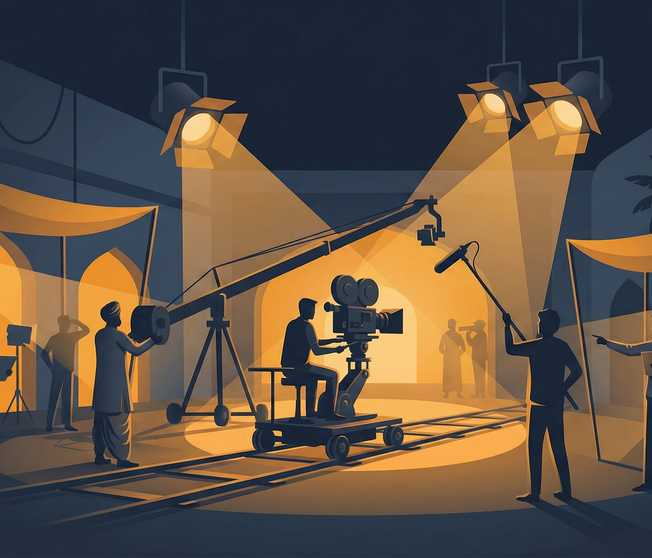
- Hero image: behind-the-scenes of a Bollywood song sequence rehearsal. Alt: "film choreographer directing backup dancers on Bollywood set India"
- Section image after "The Legends": side-by-side creative stills of iconic Bollywood song sequences. Alt: "legendary Bollywood dance directors Saroj Khan Farah Khan choreography"
- Section image after "Building a Choreography Reel": phone displaying a well-edited dance reel. Alt: "choreography reel for film industry India"
- Section image after salary table: working dance director on set with DOP. Alt: "dance director choreographer salary India film set"
Featured snippet opportunity: The "Choreographer Salary Ranges" section is structured to pull as a featured snippet for "choreographer salary India" — the tiered format with clear labels and rupee figures is optimized for this.
Additional optimization tips:
- Publish URL:
/blog/film-choreographer-career-india - Add FAQ schema for questions like "How much does a film choreographer earn in India?", "How do I become a dance director in Bollywood?", "What is the difference between a choreographer and a dance director?"
- The primary keyword "film choreographer career India" should appear in the URL slug, the H1, and at least twice more in the first 300 words — currently met
- Consider adding a "Related Posts" block at the bottom linking to the stunt coordinator, makeup artist, and costume designer career guides for cross-audience discovery
Related Blog Posts