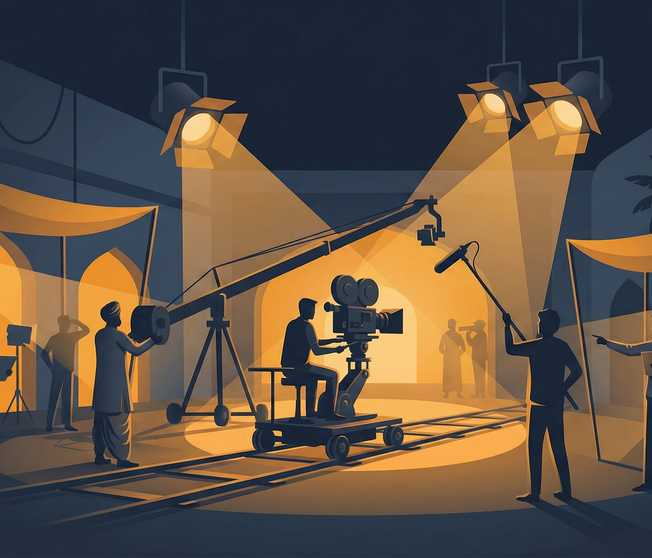
Film PR and Marketing Career in India: The People Who Make or Break a Film's Opening Weekend
-

Lavkush Gupta
-
May 04, 2026
-
9
What Film PR Actually Involves (It's Not What You Think)
Let's clear something up immediately. Film PR is not about writing press releases and emailing them to journalists. That's one task. One. Out of maybe forty-five things you'll be doing in a given week.
Film PR and marketing is the full ecosystem of perception management around a film — from the moment a project is announced to months after it releases. Here's what that actually looks like in practice.
Media Management is the core. You're building and maintaining relationships with entertainment journalists, critics, entertainment desks at newspapers and digital outlets, and broadcast media teams. When your film is ready for press coverage, those relationships determine whether you get a five-paragraph story or two lines buried under a sports headline.
Press Junkets and Interviews are logistical marathons. During the promotions phase, a major Bollywood release will put its cast through thirty to fifty interviews in a single week. You're coordinating schedules, managing media pecking order (who gets exclusive access, who gets group interviews), preparing talent with talking points, and making sure nobody says anything that becomes a controversy — while also making sure the coverage is interesting enough that people actually read it.
Premieres and Events involve event management, red carpet coordination, managing the celebrity ecosystem (who walks with whom, how long they stay, what they say on camera), and handling the media pen so that the footage coming out of the premiere looks like a major cultural moment, not a crowded hotel lobby.
Social Media Campaigns have become as important as the theatrical release itself. Hashtag strategy, meme seeding, fan engagement campaigns, trailer premiere events on YouTube — these all sit inside the PR and marketing function now. We'll go deeper on this later.
And then there's Crisis Management. Because films are made by human beings, and human beings create controversies. A lead actor's old tweet resurfaces. A co-star makes an off-color comment during an interview. A reviewer publishes a scathing review before the embargo lifts. A box office number gets misreported and the trade press runs with it. When any of this happens, the PR team is the first line of response — and how they handle it in the first four hours often determines whether a controversy dies or metastasizes.
Film PR Agencies vs. In-House Marketing Teams: Two Very Different Jobs
When people say "film PR," they often lump together two distinct career tracks that work very differently.
PR Agencies are hired per project. They take on multiple clients — production houses, individual stars, streaming platforms — and run campaigns for each. Working at an agency means you'll be handling three or four films simultaneously at different stages. It's chaotic, fast-paced, and gives you exposure to a wide range of projects quickly. The tradeoff: you're always on, you're always pitching, and your job security depends on retaining clients.
In-House Marketing Teams exist at production companies, studios, and streaming platforms. If you're part of the marketing team at a banner like Dharma Productions, Yash Raj Films, or Excel Entertainment, or at a streaming platform like Netflix India or Prime Video India, you work on a steady pipeline of projects from that company. You get more institutional knowledge and stability, but your creative exposure is narrower — you become very good at that specific banner's style and audience.
Both tracks are legitimate. Agencies are better for building breadth quickly. In-house is better for depth and stability. Most experienced professionals have worked both sides.
Major Film PR Companies and Agencies in India
The film PR landscape is Mumbai-centric, but Hyderabad and Chennai have meaningful local ecosystems.
Mumbai — The Centre of Gravity
Spice PR is one of the most established names in Bollywood publicity, handling major star-driven films and prestige projects. Hype PR has built a strong reputation for managing star PR and high-profile project launches. Parachute PR handles a range of projects including independent and mid-budget films. Dale Bhagwagar's firm is known for personal PR for Bollywood celebrities. Seventeen Communication and Tipping Point Communication handle a mix of film and entertainment corporate PR.
On the digital-first side, companies like Big Bad Wolf Media and several boutique agencies have emerged that focus almost entirely on social media strategy, influencer seeding, and digital press — a function that barely existed a decade ago but is now central to any major release.
Hyderabad — The Tollywood Machine
The Telugu film industry runs a robust PR ecosystem. 9 Arts PR, Socialyte PR, and multiple local boutique firms handle Tollywood releases. The market here moves fast and is intensely competitive — a major Prabhas or Mahesh Babu film will have a PR operation rivalling any Bollywood campaign in scale.
Chennai — The Kollywood Circuit
Tamil cinema has its own dedicated PR network. Firms like Sri Balaji PR and several individual publicists have long-standing relationships with major Tamil studios and stars. The culture of fan clubs in Tamil Nadu means PR professionals here have to navigate an additional layer — managing fan army social media activity and coordinating with fan clubs for promotional events, which is almost a specialization unto itself.
The Career Path: From Intern to PR Head
Let's be direct about what this journey looks like.
Intern / Entry Level (0-2 years)
You start by doing everything nobody else wants to do. Drafting press lists. Coordinating interview scheduling. Writing first drafts of press notes. Managing media credentials for events. Transcribing interviews. Pitching story ideas to entertainment desks and getting ignored most of the time.
This phase is unglamorous and essential. You're learning how the machine works. You're building your first media relationships — and those relationships, maintained over years, become your most valuable professional asset.
Market estimate: Rs. 15,000-25,000/month at a Mumbai PR agency. Rs. 20,000-35,000/month at a production house or streaming platform. These are estimates — verify current ranges with industry contacts or job listings.
Junior PR Executive / PR Executive (2-4 years)
You're now running specific campaign elements. You own media outreach for a project. You're in the room when strategy is being discussed, even if you're not leading it yet. You've built enough media contacts that editors recognize your name when you call. You're the person who drafts the crisis communication note at 11 PM when something goes sideways.
Market estimate: Rs. 30,000-55,000/month. Streaming platform in-house roles may offer Rs. 50,000-70,000 with benefits.
PR Manager / Senior Manager (4-8 years)
You're managing client relationships, leading campaigns, mentoring junior staff, and sitting in pitches with production houses. If you're agency-side, you're probably managing a small book of clients. If you're in-house, you're heading up a specific vertical — theatrical PR, digital marketing, awards campaigns.
Market estimate: Rs. 70,000-1,50,000/month depending on employer and film slate.
PR Head / VP Marketing (8+ years)
You're setting strategy, managing large teams, and often the person who gets called directly by the producer or director. At this level, the work is as much about relationships and judgment as it is about execution. You've seen enough campaigns succeed and fail that you have a calibrated sense of what works. This is a small club, and getting here takes time — but it's not inaccessible if you've put in the work.
Market estimate: Rs. 1,80,000-4,00,000/month and above. Senior in-house roles at major streaming platforms can exceed this significantly.
Disclaimer: All salary figures in this article are market estimates based on industry conversations and publicly available data as of early 2026. Actual compensation varies by employer, city, scope of role, and negotiation. Verify current ranges independently before making career decisions.
Skills You Actually Need
The job description for film PR usually lists "excellent communication skills" and "passion for cinema." Both are true, but they undersell the specificity of what you need.
Media Relationships — the only non-teachable skill. Everything else can be learned. This one is built over years through consistent, honest interactions with journalists and editors. You cannot manufacture this with charm or hustle. You build it by being reliable, by never spinning them a bad story, and by giving them genuinely useful information.
Crisis Communication Instinct. When something breaks, the first fifteen minutes are everything. You need to be the person who can read a situation, assess the damage potential, draft a response, get it approved, and get it out — while everyone else is still panicking. This is a learnable skill, but it requires exposure to actual crises, which is why agency work (where you handle more projects) builds this faster.
Social Media Fluency — at a strategic level, not just a usage level. Knowing how to post is not the same as knowing how to build a three-month social media campaign that peaks at release weekend. Understanding platform algorithms, content timing, community management, and paid amplification is increasingly a core PR competency.
Writing. You need to write clearly, quickly, and in multiple registers — a press note sounds nothing like a WhatsApp forward being seeded into fan groups, which sounds nothing like a crisis statement, which sounds nothing like an awards consideration campaign piece. The ability to shift between these modes without losing quality is what separates good PR professionals from great ones.
Stakeholder Management. You are always managing at least five parties simultaneously: the production house, the talent, the media, the distribution partners, and your own team. Everyone has different expectations and different pressure points. Film PR people who can't manage internal politics don't last long.
What Your Days Actually Look Like at Different Phases
Film PR operates in phases, and each phase has a completely different tempo.
Pre-Release Buzz Building (3-6 months before release)
This is where the campaign is architected. You're working on the announcement strategy (when to announce, in what format, which media gets the first look), building the press list, identifying key media partnerships, planning the trailer rollout, and starting to brief entertainment journalists so they have context before the campaign officially begins. The pace is intense but not yet chaotic. This is the planning phase — enjoy it, because it ends.
Promotions Sprint (4-6 weeks before release)
This is the machine at full speed. Press junkets. City tours. Morning show interviews. Primetime talk show appearances. Film festival screenings. Influencer screenings. Advance booking announcements. Social media content dropping daily. You're managing media access to talent who are exhausted from doing fifty interviews while also promoting the film authentically. Sleep becomes a negotiable concept.
Release Week
Opening weekend is everything. You're monitoring box office numbers in real time. You're managing media response to reviews. If it's a hit, you're feeding the momentum — quote from the stars celebrating, fan footage, morning-after celebratory content. If it's struggling, you're managing the narrative around it without looking desperate. You're also handling any press that happens organically — good or bad.
Post-Release Management
For films that perform well, this is awards campaign territory. Submitting to film festivals. Coordinating with OTT platforms for streaming announcements. Managing the film's second life. For films that underperform, it's about protecting relationships — with the production house, with the talent, and with your own team's morale.
How Digital Marketing Rewrote the Rules
Ten years ago, film marketing was roughly: poster, trailer, music launch, press junkets, premiere. The PR team managed media. The marketing team managed advertising spend. And those were often separate teams.
Today, that distinction has largely collapsed.
The trailer launch is itself a social media event — coordinated drops across YouTube, Instagram, Twitter/X, and now short-form platforms like YouTube Shorts and Instagram Reels, all timed to maximize simultaneous engagement so the algorithm treats it as a cultural moment. The music launch involves weeks of lyric video teasers, dance challenge seeds, and content creator collaborations before the song officially releases.
Fan communities have become a marketing asset that is actively managed. Production houses now have official fan club communication channels. PR teams coordinate with fan armies on social media — not to control them (you can't), but to give them early content so their organic enthusiasm becomes amplified.
And the shift to streaming has added a new dimension: when a film moves to OTT, there's a second PR push. Films that struggled theatrically have found new audiences through smart OTT PR campaigns, and that second life increasingly shapes a filmmaker's or actor's next opportunity.
Influencer Marketing in Film Promotion: What's Real and What's Not
Let's be honest about this because there's a lot of mythology around it.
Film influencer marketing works — but not in the way brands often think it does. A beauty influencer with two million followers posting about a film does not directly translate to two million ticket sales. The effect is more diffuse and more powerful: it's about normalizing the film's presence in someone's feed, making it feel like a thing people in their world are excited about, so that when they're choosing what to watch Friday night, it surfaces naturally.
The campaigns that actually move the needle are the ones built around genuine reactions. When influencers are given early screenings and trusted to give their honest response — and the film is actually good — the resulting content is far more persuasive than any sponsored post. When the reaction is manufactured, audiences can smell it. This is a thing that becomes more true with every passing year.
The PR team's role in influencer campaigns is coordination and curation: which creators are the right fit for this specific film, what kind of access do they get, how do you manage embargo dates so everything drops at maximum impact, and how do you handle a situation where an influencer posts a negative reaction you didn't anticipate.
Trailer Launch Strategies and Viral Social Campaigns
A trailer launch for a major film in 2026 is a multi-week event. Here's what a well-executed one looks like.
Six weeks out: teaser. Not the trailer — a ten-to-thirty-second clip that reveals almost nothing but creates a mood. This is seeded on social first, then picked up by entertainment press. The goal is to make the actual trailer feel anticipated.
Four weeks out: the trailer. Simultaneous drop across YouTube, Instagram, and Twitter/X at a specific time — usually 9 AM or 11 AM to catch morning traffic without competing with evening entertainment. The PR team has pre-briefed fifteen to twenty entertainment journalists who have embargoed articles ready to publish the moment the trailer drops. Fan communities have been given a sixty-minute heads-up so they can be ready to engage at launch. Within the first hour, the goal is trending — on YouTube's trending tab, on Twitter/X, and on Google Search.
The campaigns that go genuinely viral share one quality: they give audiences something to do. The DDLJ-anniversary re-release that asked fans to share their first cinema memory. The Pushpa 2 promotions that turned a dance step into a national participation event. The campaigns built around recreating iconic scenes. The ones built around a puzzle that unlocks content. Engagement-first, reach as a byproduct.
Working With Stars: Access, Management, and Keeping Your Sanity
This part of the job doesn't get written about much, but it's where a lot of PR professionals either develop their most valuable skill or burn out.
Stars are human beings under extraordinary pressure. During a promotions sprint, they're doing their tenth interview of the day with someone asking them the exact same question they've answered nine times already. The PR person in the room is the one who keeps them from going dead-eyed, redirects an interview that's veering off-script, steps in when a journalist asks something that's been agreed as off-limits, and manages the talent's energy so they can still be genuinely present for the last interview of the day.
Managing access — who gets what level of access to talent, in what format, for how long — is a complex negotiation that happens constantly. Get it wrong and you've insulted a journalist you'll need next time, or you've burned out your star before a critical weekend appearance.
The best PR professionals in this space are essentially translators — between what the production needs, what the talent can actually deliver, and what the media is looking for.
Film Festival PR and International Distribution PR
This is a niche within the niche, and it's growing.
Film festival PR is a specialized function. Getting a film into Cannes, Toronto, Berlin, or Sundance is half the battle — the other half is making sure the right people actually see it, the press coverage frames it correctly for its intended audience, and the filmmaker gets the right meetings during the festival's industry events.
Indian production companies handling international distribution — and there are more of them every year as South Indian films particularly build global audiences — need PR professionals who understand both domestic and international media landscapes. This is still an underdeveloped skill pool in India, which means there's genuine opportunity for people who build it.
Building Your Portfolio With No Experience
Here's the honest path in.
Agency internships are the most direct entry point. Mumbai has enough PR agencies handling entertainment clients that a persistent, well-targeted application effort will eventually land you somewhere. Many internships are unpaid or minimally compensated — this is a genuine problem with the industry's labour practices, not something to romanticize — but they do provide access and learning that's difficult to get otherwise.
Freelance social media management for indie films is underrated as a portfolio builder. Independent filmmakers with short films or debut features often have no marketing budget and desperately need someone to manage their Instagram presence, coordinate press outreach, and build pre-release buzz. Offer to do it for credit and a genuine learning experience. Three or four of these, done well, is a portfolio.
Entertainment journalism, briefly. Some of the best film PR professionals started as entertainment journalists. Spending one to two years on the media side gives you an irreplaceable understanding of how journalists think, what they actually need, and why certain pitches get ignored. That perspective makes you a far better PR professional than someone who's only ever been on the pitching side.
Build a digital presence. PR professionals who understand digital from the inside — who have run Instagram accounts with real followings, who have managed communities, who have done influencer collaborations — have a demonstrable skill set that pure communications backgrounds don't always have. Build something real online.
The Relationship Between PR and Box Office
Let's close with the question that hangs over all of this: does PR actually move the needle on box office?
The honest answer is: yes, but not in isolation.
A great PR campaign cannot save a bad film — audiences still have to sit through two and a half hours of it and decide whether it's worth their time. But a poor campaign absolutely can kill a good film's opening weekend. The opening weekend is determined by awareness and anticipation — two things that PR and marketing directly shape.
The industry data, when you look at it honestly, shows that films with robust pre-release campaigns consistently outperform their projected openings relative to films with minimal campaigns of equivalent budget and star power. The gap is most pronounced for mid-budget films — the ones that don't have the built-in awareness that a Rs. 200 crore franchise entry generates automatically.
That's where smart PR makes the biggest difference. Not on the tentpoles, but on the films that need someone to believe in them and build that belief in audiences, one media relationship and one well-timed Instagram reel at a time.
Your Entry Point Into This Career
If you're a marketing or communications professional who wants to cross into film, the path is available to you. The skills you've built — campaign management, media relations, social media strategy, crisis communication — are directly transferable. The gap, usually, is not skill. It's access and the industry-specific knowledge of how the film ecosystem works.
That gap is closable.
One of the things we built AIO Cine to address is exactly this: the lack of a credible, verified place where film industry job opportunities — including marketing, PR, and communications roles at production houses and agencies — are listed without the noise of fake postings and unverified recruiters. Every production house and agency on AIO Cine is verified before they can post crew calls and job listings.
If you're looking for your first film industry role in PR, marketing, or communications, register on AIO Cine. The listing is free, your profile goes in front of verified Indian production companies and agencies, and you won't spend six months applying to listings that turn out to be either fake or already filled.
The people who shape how India watches its films are working somewhere right now. Some of them are looking for their next team member.
Sources and verification: Industry salary data represents market estimates compiled from conversations with working professionals, publicly available job listings, and industry reports as of early 2026. Actual compensation varies significantly based on employer, project scale, city, and individual negotiation. Readers are encouraged to cross-reference with current job listings and industry contacts before making decisions based on these figures.
SEO and Publishing Notes
Suggested Title: Film PR and Marketing Career in India: The Complete Insider Guide (2026)
Meta Description: From intern to PR head — everything you need to know about building a film PR and marketing career in India, including salaries, top agencies, and how to break in. (154 characters)
Target Keywords:
- Primary: film PR career India
- Secondary: movie marketing jobs India, film publicity career, Bollywood PR career, film marketing salary India, how to get into film PR India
Internal Link Suggestions:
- Link "film journalism" section to
/blog/film-journalism-career-india - Link "film festivals" section to
/blog/film-festivals-india-complete-guide - Link "Mumbai" city reference to
/blog/moving-to-mumbai-film-career-guide - Link "Hyderabad" reference to
/blog/hyderabad-film-industry-career-guide - Link "freelance" section to
/blog/freelancing-in-indian-film-industry - Link "film industry salary" references to
/blog/film-industry-salary-guide-india-2026
Image Recommendations:
- Hero image: A film premiere red carpet or press junket setup (alt text: "Film PR team managing a Bollywood premiere event in Mumbai")
- Inline image near agency section: Mumbai skyline or film district (alt text: "Film PR agencies in Mumbai handle major Bollywood and streaming platform campaigns")
- Inline image near career path section: Professional at desk reviewing media coverage (alt text: "Film marketing executive reviewing press coverage during film promotions")
- Inline image near social media section: Mobile phone showing Instagram campaign content (alt text: "Social media campaign for Bollywood film trailer launch India 2026")
Publishing Notes:
- Word count: approximately 2,900 words
- Flesch-Kincaid target: Grade 8-9
- Recommended publish time: Tuesday or Wednesday morning (entertainment industry content performs well mid-week)
- Featured snippet opportunity: The "Career Path" salary table section — consider converting to a proper markdown or HTML table for better snippet eligibility
- Consider adding a FAQ section in a future update to capture voice search queries like "how much does a film PR person earn in India" and "what does a movie publicist do"
Related Blog Posts