Film School vs Self-Taught India: The Honest Debate Nobody Settles for You
-

Lavkush Gupta
-
May 04, 2026
-
9
Every year, a version of the same conversation happens in living rooms across India.
A 19-year-old tells their family they want to make films. The family Google searches "filmmaking course fees India," sees numbers like Rs. 8 lakhs, Rs. 14 lakhs, Rs. 25 lakhs, and the negotiation begins. The student counters with "but Anurag Kashyap didn't go to film school." The family counters back with "but he had connections." And there the conversation dies — unresolved, unsatisfying, with everyone a little more anxious than before.
We built AIO Cine because we kept meeting people stuck in exactly that moment. Not bad at their craft. Not lacking ambition. Just without a clear map of how the Indian film industry actually works — and whether the Rs. 5-25 lakh question of film school was a necessary investment or an expensive detour.
This is our attempt at a real answer. Not a motivational poster. Not a film school brochure. The actual, department-by-department, rupee-counted, honest breakdown.
First, Let's Kill the False Binary
The debate is usually framed as: film school OR hustle your way in. Like you're choosing between two clean options.
You're not.
Most working film professionals in India built their education out of a messy combination — some formal training, a lot of assisting, online courses when something specific was needed, workshops that cost Rs. 5,000 and changed how they saw their work. The film school vs. self-taught debate is a useful frame for thinking, but the answer for most people will be somewhere in the middle.
Keep that in mind as you read. The goal isn't to crown a winner. It's to help you figure out which combination is right for you, your department, and your bank account.
The Film School Argument (It's Stronger Than You Think)
Let's give film school its full due before we start picking at it.
Structured Learning in a Chaotic Industry
Film sets are organized chaos. The industry itself is more chaotic still. Film school is one of the very few places where you get to fail slowly, safely, and with someone qualified to explain why.
You don't get that on a live set. On a live set, you fail fast, quietly, and the lesson is: don't do that again. What you often miss is understanding why that was wrong — the technical, aesthetic, or craft-based principle underneath. Good film education closes that gap.
Equipment You Cannot Access Otherwise
A good cinematography student at FTII gets access to 16mm and 35mm film cameras, professional sound recording setups, edit suites, and lighting rigs that would cost crores to rent commercially. For technical departments — camera, sound, lighting, DI — this hands-on access to professional-grade equipment is not a small thing. It is, for many students, irreplaceable.
The raw truth: if you want to be a cinematographer in India and you've never shot on film — even once — you are missing a foundational experience. Film school may be the only realistic way to get it.
The Peer Network Is the Hidden Curriculum
Here is the thing nobody puts in the brochure because it sounds too intangible: your batch is your future.
The director you study with becomes the person who hires you as a DP five years later. The editor in your batch becomes the person you call when your cut isn't working. The producer who always seemed more business-minded than creative becomes the one who funds your first feature.
FTII alumni networks are genuinely powerful. NID, Whistling Woods, Symbiosis — the peer connections made inside those institutions become lifelong professional relationships. That network effect compounds over decades. It's the single biggest argument for formal film education that nobody can easily replicate on their own.
Mentorship From People Who've Actually Done It
When Ram Madhvani teaches a workshop, when a working sound designer walks a class through their workflow — that transmission of knowledge, judgment, and taste is different from watching a YouTube tutorial. The difference is context. A mentor doesn't just show you what to do. They show you why they make specific choices, when rules exist to be broken, and what the industry actually values versus what it says it values.
Good mentorship shapes your aesthetic instincts. That's harder to quantify than a certificate, but it may be more valuable.
The Credential Question
Let's be honest: in most creative industries, the credential matters less than the portfolio. But "less" is not "zero."
For certain institutional roles — faculty positions, government film body positions, some corporate media roles — the degree carries real weight. And at the start of a career, when you have no track record, a diploma from a recognized institute is a signal that says: this person completed something difficult, got selected competitively, and was taken seriously enough to be trained formally.
It's not a magic pass. But it's not worthless either.
The Self-Taught Argument (It's Also Stronger Than You Think)
Three to Four Years Is a Lot of Time
A full film school program at FTII runs 3 years. Many private institute programs run 2-3 years. That's a significant slice of your 20s — the exact years when the Indian film industry is most open to hungry, energetic, cheap-to-hire assistants who just want to be on set.
Many self-taught filmmakers use those years to assist two or three times over — AD to multiple directors, work on a dozen shorts, run a production company that breaks even, build a reel that's 3 years deeper than their film school counterparts. Time in this industry is a currency. Spending it in a classroom has an opportunity cost.
The Financial Reality Is Brutal and Needs to Be Said Out Loud
FTII Pune (Film and Television Institute of India): Fees are subsidized by the government. The total program cost for a diploma ranges roughly from Rs. 1.5 lakhs to Rs. 3 lakhs depending on your specialization — an extraordinary deal by any standard. The catch: admission is ferociously competitive, and the entrance exam selects for a very specific kind of cultural and theoretical preparation.
Private Film Schools in India (Whistling Woods, LV Prasad, Zee Institute, Symbiosis, etc.): Fees range from Rs. 5 lakhs to Rs. 25 lakhs for full programs. Add living expenses in Mumbai, Pune, or Chennai and you're looking at Rs. 8-35 lakhs total, often financed by education loans that follow you into your early career.
Self-Taught Investment: A good laptop, Adobe Creative Suite subscription, a used DSLR or mirrorless camera, MasterClass annual plan, a few weekend workshops, and your first few film projects — you're looking at Rs. 1-3 lakhs over the same time period.
The ROI calculation matters. If a Whistling Woods graduate spends Rs. 20 lakhs on education, starts as an AD at Rs. 20,000/month, and works up to Rs. 60,000/month over 5 years — that loan takes nearly a decade to offset. The self-taught filmmaker who spent Rs. 2 lakhs starts the same race with a 10-lakh head start.
This is not an argument against film school. It's an argument for being honest about what you're paying and what you're getting in return.
Learn by Doing Is Not a Motivational Slogan — It's How Film Actually Works
The apprenticeship model — assist someone great, absorb everything, eventually do it yourself — built the careers of more working Indian film professionals than any institution. It's how Bollywood has always worked. It's how the south Indian industries work. The set is the school.
Self-taught filmmakers who are disciplined about their self-education — who watch films analytically, who study shot lists, who read screenplays alongside the films they adapt, who assist aggressively and ask intelligent questions — often arrive at the same place as film school graduates, just via a different route.
Online Resources Are Now World-Class. That's New.
Ten years ago, arguing that you could self-educate in filmmaking using online resources was a stretch. Not anymore.
MasterClass: Martin Scorsese's filmmaking masterclass. David Lynch on creativity. Ron Howard on directing. Aaron Sorkin on screenwriting. These are not content creators making tutorial videos — these are the actual legends, in long-form, talking about their process.
Coursera and edX: Michigan State, NYU, and CalArts offer legitimate filmmaking certifications online. The learning is real.
YouTube: D4Darious. In Depth Cine. Corridor Crew. Filmmaker IQ. These channels go genuinely deep on technique, technology, and craft. They are not film school, but they are not nothing.
Screenwriting software + script libraries: Final Draft, Fade In, and dozens of free screenplay databases let aspiring writers read and analyze what actually got produced. That's a film school writing curriculum in your browser.
The honest caveat: online resources are excellent for theory, technique, and analysis. They cannot replace the tactile experience of working with professional equipment, a crew, and real-world time pressure. Keep that distinction clear.
Portfolio Over Pedigree — And This Is Increasingly True
Casting directors, producers, and DPs who hire for Indian film projects are more interested in your last 3 minutes of work than your diploma. Show me your reel. Show me a short film that made someone feel something. Show me a scene that demonstrates you understand light, or timing, or story.
This matters more every year as the tools to produce excellent work get cheaper and more accessible. A 22-year-old with a mirrorless camera, a stabilizer, and a genuine eye has no equipment disadvantage over a film school graduate. The playing field has leveled on the technical side. Execution and taste are what separate people.
The Department-by-Department Honest Breakdown
Stop treating "filmmaking" as one thing. It's many departments with very different learning curves.
Film School Helps MORE For:
Cinematography: Equipment access to film cameras, controlled laboratory environments, and direct mentorship from practicing DPs make formal education genuinely valuable here. Color science, optics, and the physics of light are better learned with professional tools in hand.
Sound Recording and Design: Sound is the most underestimated and technically demanding discipline in Indian film. Professional studios, location recording setups, and mixing suites are expensive to access outside of an institution. FTII's sound department consistently produces India's best-trained professionals.
Film Editing: Non-linear editing can be self-taught, but the analytical framework — understanding rhythm, pacing as story, how the editor shapes performance — is better absorbed with a structured curriculum and a mentor who can critique your cuts in real time.
Production Design: Spatial thinking, art direction, and the ability to realize a director's visual language across an entire film — this benefits from structured study and collaboration with directors and DPs in a controlled environment.
Self-Taught Works BETTER For:
Directing: You cannot teach taste. You can teach grammar — and grammar matters — but the essential quality in a director is a singular vision, the ability to make a hundred micro-decisions per day under pressure, and the conviction to fight for a specific truth in every scene. These qualities develop by directing — as many projects as possible, as fast as possible, with whatever resources you have. The best training for a director is making films.
Screenwriting: The screenplay is the most democratic art form in cinema. You need a laptop, a script, and the willingness to read 100 produced screenplays analytically and write 10 drafts of your own. No classroom required. The Writers' Room model — collaborative, feedback-intensive, deadline-driven — is more useful than a writing seminar. Find a writing group. Write constantly. Read constantly.
Producing: Film school does not teach the business of film. It teaches the craft of film. Producing is almost entirely about the business — deal structures, agreements, talent negotiation, investor relations, distribution, marketing. These skills are learned in rooms and on phones, not in classrooms. The best producing education is to produce — start small, survive the mistakes, learn from the losses.
What Film Schools Don't Teach (And Nobody Tells You This)
Even the best film schools leave significant gaps.
The business of film: How deals are structured, what a distribution agreement looks like, what a reasonable fee for a first-time short film director is, how to invoice a production company, what rights you're signing away when you sign that agreement. Film school graduates routinely get exploited early in their careers because nobody explained how the money works.
Self-promotion and personal brand: Your work needs to find an audience. That means a reel, a presence, an ability to articulate what you make and why. Film school teaches you to make. It does not teach you to be seen.
Resilience and rejection tolerance: The Indian film industry will reject you — often, casually, without explanation. No curriculum prepares you for the specific psychological weight of this. Self-taught filmmakers who hustled their way through early rejections often have more durable careers because they built rejection tolerance as part of their education.
Networking in the real industry: Film school gives you a network of other students. The working industry network — the line producers, the post houses, the casting offices, the production companies that are actually commissioning work — is a different world. Learning to navigate it takes time outside any institution.
The Hybrid Approach (What Most Smart People Actually Do)
Short intensive workshops — 3 days to 3 weeks — at places like the Mumbai Academy of Moving Image, MAMI's film lab, or visiting international faculty programs give you structured input without the 3-year commitment.
Pair those with deliberate assisting — choose your senior carefully, not just whoever will take you — and with self-directed study through online resources and analytical film watching.
This hybrid is not a compromise. For many departments, it is genuinely the optimal path. You get mentorship and structure in targeted doses, combined with the real-world experience accumulation that no classroom can replicate.
International Film Schools Worth Considering (If the Budget Is There)
If you have a clear artistic vision and the financial means, international programs are worth serious consideration.
AFI Conservatory (Los Angeles): One of the most consistently excellent filmmaking programs in the world. Tuition is significant — approximately USD 40,000 per year — but the alumni network and production resources are exceptional.
NFTS (National Film and Television School, UK): Strong reputation, particularly for narrative directing and producing. European sensibility, excellent industry connections.
FAMU (Prague): An underrated, genuinely world-class institution with lower costs than US or UK equivalents. International students are welcome.
La Femis (Paris): One of the most selective and prestigious film schools in the world. Requires French language proficiency. For serious applicants who are willing to learn the language.
Important caveat: An international degree does not guarantee an easier path into Indian cinema. The industry relationships and local knowledge you'd develop by spending those years in Mumbai or Hyderabad may ultimately be more valuable.
Famous Self-Taught Filmmakers Who Prove the Point
Anurag Kashyap: No formal film school. Learned by writing scripts, assisting Ram Gopal Varma, and making films that the system initially rejected. Went on to direct Black Friday, Gangs of Wasseypur, and reshape Indian independent cinema.
Quentin Tarantino: Worked in a video rental store. Watched everything. Wrote obsessively. No formal training.
Christopher Nolan: Read English at Cambridge, made short films on weekends with borrowed equipment. Film school: none.
S.S. Rajamouli: Learned filmmaking by assisting his father, writer V.V. Vijayendra Prasad. No film school. Made RRR.
The lesson these careers teach is not "film school doesn't matter." It's that the drive to make films, combined with relentless self-education, can achieve anything formal training can — for the right person.
Famous Film School Graduates Who Prove the Other Point
Mira Nair: Delhi University and Harvard. Trained as a theatre director. Her formal education in narrative and performance shaped films like Monsoon Wedding and Salaam Bombay.
Martin Scorsese: NYU film school. Has spoken extensively about how the analytical education he received shaped his approach to every film he's made.
Vikramaditya Motwane: Studied at the University of Southern California School of Cinematic Arts. Trained at Film Comment magazine and under Sanjay Leela Bhansali before making Udaan.
Alfonso Cuaron: Mexico's Centro Universitario de Estudios Cinematograficos. The formal training shows in every technical and visual decision in Gravity and Roma.
The common thread in the film school success stories: these were people for whom the structured environment accelerated something that was already there. Film school amplified an existing instinct. It didn't create one.
The Decision Framework: Questions to Ask Yourself Honestly
Before you decide, sit with these:
1. Which department are you targeting? Technical departments (camera, sound, editing) benefit more from formal training. Creative-conceptual departments (directing, writing) benefit more from doing.
2. Do you have the self-discipline to structure your own learning? Self-taught is not passive. It requires you to build your own curriculum, hold yourself accountable, and seek feedback actively. If you know you need external structure and deadlines, formal education may serve you better.
3. What's your financial situation, including opportunity cost? Can you take the education loan without it becoming a psychological burden that constrains your early career choices? Is the investment in a private school proportionate to your realistic earning timeline?
4. Can you get into FTII? If the answer is possibly yes, prepare hard and apply. The quality of education relative to the cost is unmatched in India. Treat the entrance exam like a serious competitive exam, because it is.
5. Do you have an existing network? If you're starting from zero in a new city with no industry relationships, the peer network from film school becomes more valuable. If you already have strong industry connections — through family, through prior work — the network argument weakens.
6. Are you running toward film school, or away from fear? Film school can be a genuine investment. It can also be a way to avoid the terrifying uncertainty of just starting. Know which one you're doing.
The Honest Conclusion
Film school in India is the right choice for: people targeting technical departments, people who need structured learning environments, people who can access FTII's program at its subsidized cost, and people who understand they're buying a peer network as much as an education.
Self-taught is the right choice for: directors, writers, producers, people with strong self-discipline, people with pressing financial constraints, and people who can build their own intensive alternative curriculum.
The hybrid — targeted workshops, disciplined assisting, online resources, constant making — is the right choice for almost everyone else.
What no path substitutes for: making films. The shortest distance between where you are and a working career in Indian cinema is a short film on a hard drive that demonstrates you have a genuine eye, a point of view, and the capability to bring both to a set. That film will open more doors than any certificate.
Build it. Then build another one. The industry will notice.
When you're ready to put yourself in front of verified, real Indian productions — not fake casting calls, not exploitative auditions, not companies that don't exist — register on AIO Cine. Every production house on the platform is verified before they can post a single crew call or casting listing. Your profile, your reel, your availability: all in one place where legitimate producers are actively looking.
Because your education — however you built it — should lead somewhere real.
SEO Notes
Primary Keyword: "film school vs self-taught India" — used in H1, first body paragraph, and naturally throughout body copy.
Secondary Keywords: "should I go to film school India" — used in the decision framework section heading. "Filmmaking education India" — used in financial reality and department breakdown sections. "Best film institutes India" — used in international film schools section and FTII references. "Self-taught filmmaker India" — used in the self-taught section and closing.
Featured Snippet Opportunity: The "Department-by-Department Honest Breakdown" section is structured to pull as a featured snippet for queries like "should I go to film school for cinematography" or "film school vs self-taught directing."
Internal Link Suggestions:
- "top film institutes India 2026 honest review" — link from the FTII and private school mentions
- "how to become a cinematographer in India" — link from the cinematography department entry
- "film portfolio India beginners guide 2026" — link from the portfolio-over-pedigree section
- "moving to Mumbai film career guide" — link from the hybrid approach and self-taught sections
- "outsider vs insider bollywood data analysis" — link from the network effect section
- "film crew day rates India 2026" — link from the ROI/financial calculation section
External Link Suggestions: FTII official admission page (ftii.ac.in), MasterClass filmmaking courses, NFTS official site — all high-authority, relevant, and non-competing.
Image Suggestions:
- Hero image: FTII campus or a filmmaker behind a camera in a workshop setting. Alt text: "Film school vs self-taught filmmaking education India"
- Section image: Comparison table visual for department breakdown. Alt text: "Film school vs self-taught by department India guide"
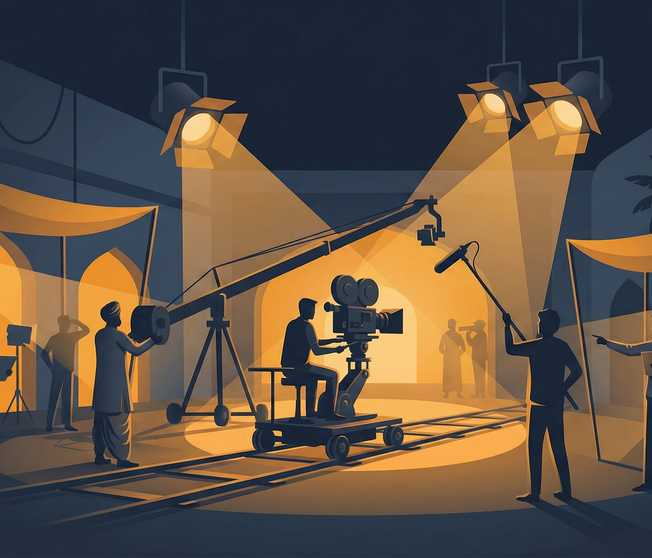
- Section image: Indian filmmaker on set with crew. Alt text: "Self-taught filmmaker India on film set"
Content Length: Approximately 2,800 words — within the optimal range for competitive ranking on this keyword cluster.
Meta Title Suggestion: Film School vs Self-Taught India: The Honest 2026 Breakdown (58 characters)
Related Blog Posts