Filmmaking After 12th in India: Every Career Path Explained (No Engineering/Medical Needed)
-

Lavkush Gupta
-
May 04, 2026
-
7
Meta Description: Film school, acting courses, or direct entry — every career path in Indian cinema after Class 12. Fees, timelines, and honest advice for students and parents.
Your boards are done. Or almost done. And while your classmates are comparing JEE ranks and NEET coaching schedules, you're watching behind-the-scenes footage of your favourite film and thinking: can this actually be my life?
The short answer is yes. The honest answer is: it depends on which path you choose and how seriously you pursue it.
This is not a motivational poster. This is a real breakdown of every legitimate route into the Indian film industry after Class 12 — with actual fees, actual entrance requirements, and actual timelines. We're going to address your parents' concerns head-on too, because they deserve honest answers, not cheerleading.
Let's get into it.
The Myth You Need to Demolish First: "Film Is Not a Real Career"
Here's what your parents are probably imagining when you say you want to work in films: one struggling actor in a Mumbai chawl, waiting for a phone call that never comes.
Here's what they should be imagining instead.
The Indian film and entertainment industry generated approximately Rs. 19,500 crore in revenue in 2024, and it employs millions of people — most of whom are never on screen. Cinematographers. Sound designers. Editors. VFX artists. Production managers. Costume designers. Colourists. Script supervisors. Location managers. The list goes on for pages.
For every actor whose face you see, there are 200 crew members who built the world around that face. Most of them earn stable, predictable incomes. Some earn very good incomes. And the industry is not shrinking — it is expanding rapidly, driven by OTT platforms that now commission content in 12+ Indian languages simultaneously.
The concern your parents have is legitimate. The film industry does have a high dropout rate among people who enter it without a plan, without skills, and without a realistic understanding of how it works. The answer to that concern is not to avoid the industry — it's to enter it intelligently.
That's what this guide is for.
Does Your Stream (Science/Commerce/Arts) Matter?
Honest answer: No. Not for most roles.
Film schools and diploma programs in India do not require a specific Class 12 stream for admission. FTII's entrance exam tests cinematic aptitude, not physics formulas. Acting programs care about your presence and potential, not whether you took economics or biology.
Arts students have a slight head start because subjects like literature, history, fine arts, and theatre often develop the observational sensitivity and cultural awareness that good filmmakers need. But this is an advantage, not a requirement.
If you're a Science student who fell in love with cinema, nothing about your stream disqualifies you. Some of India's best DPs (Directors of Photography) came from technical backgrounds — the understanding of light, optics, and physics is genuinely useful in cinematography. Editors who studied mathematics have a natural feel for rhythm and structure. Commerce students who understand business make excellent producers and production managers.
Your stream matters for exactly one thing: college entrance exams in non-film fields. For the film industry, what matters is your portfolio, your aptitude, and your commitment.
Every Career Path After 12th — Mapped Out
Path 1: The Film School Route
This is the most structured and arguably the most respected entry point. India has several genuinely excellent film institutions that can give you a world-class education — if you can get in.
Film and Television Institute of India (FTII), Pune
FTII is India's most prestigious film school. It offers diploma programs (not degrees — important distinction) in direction, cinematography, editing, sound recording and design, screenwriting, and production design.
- Eligibility: Any graduate. Not Class 12 — you need a bachelor's degree first. So FTII is not a direct post-12th option.
- Entrance exam: FTII Joint Entrance Test (FTII JET), held annually
- Duration: 2-3 years depending on specialization
- Fees: Approximately Rs. 1.5-2 lakh per year (subsidized by the Government of India — this is one of the best-value film educations in the world)
- Key fact for parents: FTII alumni include Jaya Bachchan, Naseeruddin Shah, Shabana Azmi, Adoor Gopalakrishnan, Mira Nair. The alumni network is extraordinary.
Note: FTII requires a graduation degree. If you want to go this route, you can study any bachelor's degree first — film studies, arts, literature, even BSc — while building your film knowledge independently.
Satyajit Ray Film and Television Institute (SRFTI), Kolkata
SRFTI is FTII's eastern counterpart, run by the Ministry of Information and Broadcasting. Equally prestigious. Particularly strong in documentary filmmaking and Bengali-language cinema traditions.
- Eligibility: Graduate degree required (same situation as FTII)
- Entrance exam: SRFTI Joint Entrance Test (same JET exam as FTII)
- Duration: 2-3 years
- Fees: Rs. 1-1.5 lakh per year (similarly subsidized)
- Key advantage: Smaller batch sizes, intensive mentorship, Kolkata's rich cultural ecosystem
Whistling Woods International (WWI), Mumbai
WWI is India's largest and most globally-networked private film school, founded by filmmaker Subhash Ghai. Unlike FTII/SRFTI, it offers full degree programs (BA and MA level) and accepts students directly after Class 12.
- Eligibility: Class 12 pass for undergraduate programs
- Programs: BA in Film, Media & Communication; specialized programs in direction, cinematography, acting, production, writing, and more
- Duration: 3 years (BA) or 2 years (postgraduate)
- Fees: Rs. 4-7 lakh per year (private institution fees)
- Entrance: Written test + interview + portfolio/aptitude assessment
- Key advantage: Direct industry connections, Mumbai location, alumni placement network, global collaborations
This is the most practical film school for a Class 12 student who wants to enter a formal program immediately.
L.V. Prasad Film and Television Academy (LVPFTA), Chennai and Hyderabad
LVPFTA (named after the legendary filmmaker Lakshmi Vara Prasad) offers post-graduate diploma programs in filmmaking, cinematography, editing, and production. Strong connections to South Indian cinema industries — Kollywood and Tollywood.
- Eligibility: Graduate degree preferred; some programs open to Class 12 with strong aptitude
- Fees: Rs. 2-4 lakh per year
- Key advantage: South India industry network, good placement for Tamil and Telugu industry roles
Symbiosis Institute of Media and Communication (SIMC), Pune
SIMC offers undergraduate programs in media communication that include strong film and television tracks. More accessible for Class 12 students, and respected for its journalism and media production curriculum.
- Eligibility: Class 12 pass
- Duration: 3 years (BA)
- Fees: Rs. 3-5 lakh per year
- Entrance: SNAP (Symbiosis National Aptitude Test)
Path 2: Diploma and Specialized Short Courses
Not everyone needs a three-year degree. India has a strong ecosystem of diploma and certificate programs that train you for specific technical roles in 6 months to 1 year. These are worth considering if you want to enter the workforce quickly or if you're certain about your technical specialization.
What's available:
- Editing: 6-month to 1-year diploma programs at institutions like Zee Institute of Media Arts (ZIMA), JD Institute of Fashion Technology (which has film programs), and independent post-production schools. You'll learn Avid Media Composer, Adobe Premiere Pro, and DaVinci Resolve.
- Cinematography: Short-term DOP assistant and camera department courses, often offered by rental houses and private academies. Practical, equipment-focused, and a good way to get your hands on actual cameras.
- Sound Design and Recording: Arena Animation and Frameboxx offer sound production tracks. The Film and Television Producers Guild of India also runs short programs periodically.
- Screenwriting: The Film Writers Association (FWA) runs workshops. Platforms like Scott Free Productions India, Kathaas (workshop platform), and independent mentors offer structured screenwriting programs.
One important note: For diploma programs, verify the institution's alumni track record before paying fees. Ask specifically: where did the last three graduating batches get placed? If they can't answer that question clearly, that tells you everything.
Path 3: Acting Courses After 12th
Acting is the career path most people imagine when they say "film industry." It is also the most competitive and the most misunderstood.
National School of Drama (NSD), New Delhi
NSD is the gold standard for acting training in India. Three years of full-time, intensive theatre training that has produced Naseeruddin Shah, Om Puri, Irrfan Khan, Pankaj Kapur, Nawazuddin Siddiqui, and dozens more.
- Eligibility: Open to students who have completed their 10+2 or graduation. NSD accepts post-12th applicants.
- Duration: 3 years
- Fees: Heavily subsidized — approximately Rs. 10,000-15,000 per year. Students also receive a stipend.
- Entrance: Audition + interview process. Extremely competitive — typically 15-25 seats per batch from thousands of applicants.
- Key insight: NSD trains theatre actors, not film actors specifically. The transition from theatre to screen is a separate journey. But NSD's training foundation is considered the most rigorous in the country.
Film Actor Prepares (FAP), Mumbai
FAP is one of Mumbai's most respected acting schools, founded on Stanislavski-method principles. Strong film industry connections and a placement track record.
- Eligibility: Post-12th
- Duration: 1 year
- Fees: Rs. 1.5-2.5 lakh per year
- Entrance: Audition-based
Barry John Acting Studio, Mumbai
Barry John (who famously trained Shah Rukh Khan and Manoj Bajpayee at NSD) runs his own studio in Mumbai. Smaller batches, intensive training, strong reputation.
- Duration: Programs ranging from 3 months to 1 year
- Fees: Rs. 80,000-1.5 lakh depending on program
- Key advantage: Direct access to a master teacher whose methodology produced some of India's finest performers
Regional Theatre Programs
If you're not in Mumbai, don't wait to start. Every major city has active theatre groups — Prithvi Theatre (Mumbai), Rangashankara (Bengaluru), Ank (Ahmedabad), Yatrik (Delhi), Irom Sharmila's work in Manipur — that offer training, performance opportunities, and real stage experience. Theatre is not a consolation prize for people who can't get into film. It is the foundation that the best film actors are built on.
Path 4: Direct Entry — No Degree Required
Here's the path that nobody puts in a pamphlet but that the majority of working film professionals actually used.
The Indian film industry runs on an apprenticeship model. Every department has a hierarchy. At the bottom of every hierarchy is a trainee or assistant who learns by watching, doing, and being useful on set. No film school. No degree. Just showing up, being reliable, and learning faster than everyone around you.
This is called the assistant route, and it is a completely legitimate professional path.
How it works:
You go to Mumbai (or Hyderabad or Chennai), you find a way to connect with a working professional in the department you want to enter — a production company, a director, a cinematographer, a costume designer — and you offer to assist them. You don't get paid much in the beginning. You learn everything you can. You build your reputation.
This sounds vague, but it's not. There are specific, actionable steps:
- Identify your department: Directing? Camera? Art? Production? Sound? Pick one.
- Build a portfolio: Short films, college productions, anything. Create before you arrive.
- Make yourself findable online: An IMDb page, a Vimeo portfolio, a professional profile. Production coordinators and ADs actively search for new assistants.
- Network at film screenings, industry events, workshops: Mumbai's Prithvi Theatre, the MAMI film festival, industry meetups — these are real entry points.
- Register on industry platforms: AIO Cine and similar platforms let you create a professional profile that verified production companies can find. No degree required. No experience required. Just a clear, honest profile.
The assistant route takes longer to start paying well. But it also produces working professionals who understand the industry from the ground up — which is often more valuable than a diploma.
Path 5: VFX, Animation, and Technical Roles
If you're technically inclined — if you spent your Class 11 and 12 years building 3D models instead of studying, or if you're the one in your group who actually understands how visual effects work — the VFX and animation track might be your best entry point.
This path is worth taking seriously because:
- It is skill-based, not connection-based
- Remote work is possible (you can start from your hometown)
- Starting salaries are more predictable than performance-based roles
- The demand curve is aggressively upward — OTT platforms have created an explosion in VFX work
Key institutions:
Arena Animation (national chain, multiple cities): Offers programs in VFX, 3D animation, motion graphics, and game design. Duration: 1-2 years. Fees: Rs. 1-2.5 lakh total. Practical and industry-aligned.
MAAC (Maya Academy of Advanced Cinematics) (national chain): Similar to Arena — diploma programs in VFX, 3D, compositing, character animation. Strong placement track record in gaming and advertising sectors as well as film.
Frameboxx Animation and Visual Effects (national chain): Specializes in VFX and compositing. Programs range from 6 months to 18 months.
Backstage Academy, FX School, and Reliance MediaWorks Training (Mumbai/Hyderabad): Higher-end institutes with direct pipeline to large VFX studios.
The software you'll learn: Autodesk Maya, Adobe After Effects, Nuke (compositing), Houdini (visual effects simulation), Cinema 4D, ZBrush. Python scripting is becoming increasingly important for technical artists.
A VFX artist with 3-4 years of experience in India earns Rs. 40,000-80,000 per month. Senior technical artists at studios like Prime Focus or DNEG India earn significantly more.
Cost Comparison: Every Option in One Table
| Education Path | Institution | Duration | Total Fees (Approx.) | |---|---|---|---| | Government film school | FTII / SRFTI (post-graduation) | 2-3 years | Rs. 3-6 lakh | | Private film school (UG) | Whistling Woods International | 3 years | Rs. 12-21 lakh | | Regional film school | LVPFTA Chennai/Hyd | 1-2 years | Rs. 2-8 lakh | | Media communication (UG) | SIMC Pune | 3 years | Rs. 9-15 lakh | | Acting – national school | NSD Delhi (stipend paid) | 3 years | Rs. 30,000-45,000 | | Acting – private studio | FAP / Barry John | 6-12 months | Rs. 80,000-2.5 lakh | | VFX/Animation diploma | Arena / MAAC / Frameboxx | 1-2 years | Rs. 1-2.5 lakh | | Specialized technical diploma | Editing / Sound / Camera | 6-12 months | Rs. 50,000-1.5 lakh | | Direct assistant entry | No institution | Ongoing | Zero (earn while you learn) |
All figures are estimates based on publicly available data as of early 2026. Verify directly with institutions before making decisions.
Match Your Interest to Your Path
"I Want to Act"
Theatre first. Always. NSD if you can get in. A serious regional theatre program if you can't. Barry John or FAP for film-specific technique once you have a theatre foundation. The assistant route into acting means working as a junior artiste (background actor) while attending acting workshops — it's a valid path, but extremely slow.
What you need to accept: Acting is the most competitive path. Thousands of equally talented, equally determined people are pursuing it simultaneously. This does not mean you shouldn't pursue it. It means you should pursue it with the seriousness of a professional athlete — training, rejection tolerance, financial backup plan, and a long timeline.
"I Want to Direct"
The FTII/SRFTI route is ideal but requires a graduation degree first. In the meantime: make short films. Use your phone. Write scripts. Study films obsessively — not just watching them, but dissecting them. The assistant director route is the most common path into direction (you spend years as an AD before you direct your first film). Whistling Woods offers a direct post-12th undergraduate direction program if you want a structured start.
"I Want to Do Technical Work (Camera, Sound, Editing, VFX)"
You have the most options and, in many ways, the clearest path. Choose your department. Get trained — whether through a diploma program or by working as an assistant to an experienced technician. Build a portfolio of actual work. Join FWICE (Film Workers In Cultural and Creative Environments, also known as the Cine Workers Federation) once you have credits, for credibility and rate protection.
VFX specifically: Arena/MAAC diploma → junior artist role at a studio → build your reel → specialization (compositing, rigging, FX simulation) → senior artist. This path has some of the most predictable income growth in the industry.
"I Want to Work Behind the Camera (Production)"
Production management, line producing, location management, casting coordination — these roles are often overlooked but are genuinely indispensable to every production. And they are more accessible than most acting or directing paths.
Start by working as a production assistant (PA) on any production you can find. Learn to manage logistics, communicate with vendors, read contracts, and handle budgets. These skills transfer across every type of production. A good line producer with a decade of experience is extremely well compensated and is never out of work.
The Gap Year Question
Should you take a year after Class 12 to figure out whether film is really for you before committing to an expensive program?
For most students asking this question honestly: yes.
Here's why. A gap year used purposefully — making short films, assisting a working professional, attending workshops, studying films seriously, doing theatre — will tell you more about whether this industry is right for you than any amount of time spent researching from a distance.
A gap year where you're genuinely working toward the goal is not wasted. It is, in fact, directly valuable to your career.
What a good gap year looks like:
- Produce and release at least one short film (OTT platforms like YouTube are a legitimate distribution outlet)
- Attend at least one serious acting or filmmaking workshop
- Read at minimum ten books on cinema craft (Robert McKee's Story, Sidney Lumet's Making Movies, Syd Field's Screenplay, David Mamet's On Directing Film, Ingmar Bergman's The Magic Lantern)
- Start building your professional online presence
- Talk to at least five people actually working in the industry
If after all that you're more passionate, more informed, and more determined — proceed with full commitment. If you're less sure, you've saved yourself significant time and money. Either way, the year was worth it.
What to Tell Your Parents: The Honest Version
Your parents are not wrong to be concerned. They want financial security and social respectability for you, which are entirely reasonable things to want for their child. The argument that works is not "trust me, I'll be famous" — that argument loses every time.
The argument that works is grounded in facts.
Industry scale: India's film and entertainment sector is projected to grow to Rs. 34,000 crore by 2030 (Ficci-EY projections). This is not a shrinking industry. It is an expanding one.
Employment breadth: The vast majority of film industry jobs are technical and professional roles with stable income trajectories. Editors, sound engineers, VFX artists, production managers, costume designers — these roles offer predictable employment, and many of them are skill-based enough that a capable professional is rarely out of work.
Salary reality after 5 years: A sound recordist with 5 years of experience earns Rs. 40,000-70,000 per month. A working editor with a solid client list earns Rs. 50,000-1 lakh per month. A VFX artist at a major studio earns Rs. 60,000-90,000 per month. A production manager with 5 years of experience earns Rs. 50,000-80,000 per month. These are not lottery-ticket numbers — they are professional salaries comparable to junior-to-mid corporate positions.
Named success routes: Point your parents to Rajkummar Rao (not from a film family, FTII-trained theatre background). Nawazuddin Siddiqui (NSD-trained, years of struggle, now one of India's most acclaimed actors). Rima Das (self-taught filmmaker from Assam who wrote, directed, and self-funded Village Rockstars, which became India's Oscar entry in 2019). The entry route exists.
The plan matters more than the dream: Come to the conversation with a specific plan — which school or training program, what the fees are, what the realistic career trajectory looks like in years 1 through 5. Parents respond to plans. Vague passion does not reassure anyone.
Before You Apply Anywhere — One Free Step Right Now
You don't need to wait for a film school acceptance letter, a diploma certificate, or an agent to start existing in the film industry professionally.
Create a profile on AIO Cine — India's film industry talent and crew marketplace where every production company is verified before it can post crew calls. You can list your skills, your interests, your location, and your availability. Production companies looking for fresh talent, junior crew, and production assistants actively search the platform.
No degree required to sign up. No credits required to get started. Just an honest, professional profile that says: I'm here, I'm serious, and I'm ready to learn.
The film industry rewards the people who show up consistently. Start showing up now.
Create your free profile on AIO Cine at aiocine.com — because the right opportunity should find you, not the other way around.
A Few Final Things Worth Saying Out Loud
The film industry will test your patience more than your talent. The people who last are not always the most gifted — they are the most resilient, the most adaptable, and the most honest about what they actually want out of this work.
Know which role genuinely excites you — not just which role seems glamorous. A lot of people want to be directors because they think it means telling everyone what to do. The reality is that directing means being responsible for every decision, managing impossible logistics, and being the last person who sleeps and the first person who is blamed when something goes wrong.
Equally: a lot of people dismiss production management as boring work. In reality, a great production manager is one of the most valued people on any set, earns well, works constantly, and has more job security than most actors.
Know yourself. Choose honestly. Train seriously. Start now.
The industry is not out of reach. It is, however, relentlessly selective about who it rewards. The people it rewards are the ones who came prepared.
AIO Cine Productions is India's verified film industry talent marketplace. Every production company on the platform is verified before they can post crew calls or casting notices. Register free at aiocine.com.
SEO Notes
Internal link opportunities:
- Link "how to become an assistant director" to
/blog/how-to-become-assistant-director-bollywood - Link "film crew resume" to
/blog/film-crew-resume-template-india - Link "Mumbai vs Hyderabad vs Chennai" to
/blog/mumbai-vs-hyderabad-vs-chennai-film-career - Link "film portfolio from scratch" to
/blog/film-portfolio-india-beginners-guide-2026 - Link "how to become a cinematographer" to
/blog/how-to-become-a-cinematographer-in-india - Link "FWICE membership" to
/blog/fwice-membership-card-guide-2026
External link opportunities:
- FTII official site (ftii.ac.in) — admissions page
- SRFTI official site (srfti.ac.in)
- NSD official site (nsd.gov.in)
- Whistling Woods official site (whistlingwoods.net)
- Film Writers Association (fwaindia.org)
Image suggestions:
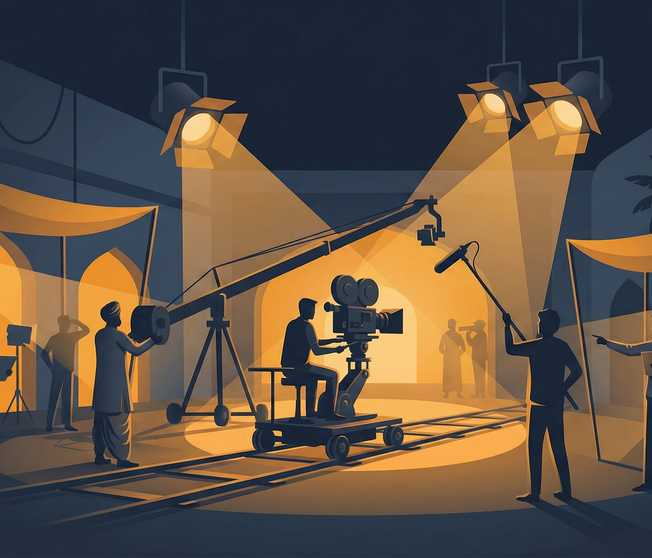
- Hero image: Wide shot of a film set in India (diverse crew visible) — Alt: "Film crew on an Indian film set — filmmaking career after 12th India"
- Comparison table section: Side-by-side stills of FTII campus and a Mumbai production office — Alt: "FTII Pune campus entrance for film students"
- Acting section: NSD Delhi stage performance still — Alt: "NSD acting performance — acting courses after 12th India"
- VFX section: VFX artist at workstation with compositing software visible — Alt: "VFX artist at work in India — VFX career after 12th"
- CTA section: Young person looking at laptop with AIO Cine interface — Alt: "Register on AIO Cine film industry platform India"
Featured snippet targets:
- "Can I join film industry after 12th" — the direct answer in the intro paragraph is designed to pull as a snippet
- Cost comparison table is structured for Google to pull as a featured table
- The "Match Your Interest to Your Path" section H3 headers are formatted for People Also Ask extraction
Readability: Written at approximately Grade 8-9 Flesch-Kincaid level — accessible to 17-year-old readers and their parents without being condescending.
Recommended word count check: Approximately 2,800 words — within the 2,500-3,000 target range.
Related Blog Posts