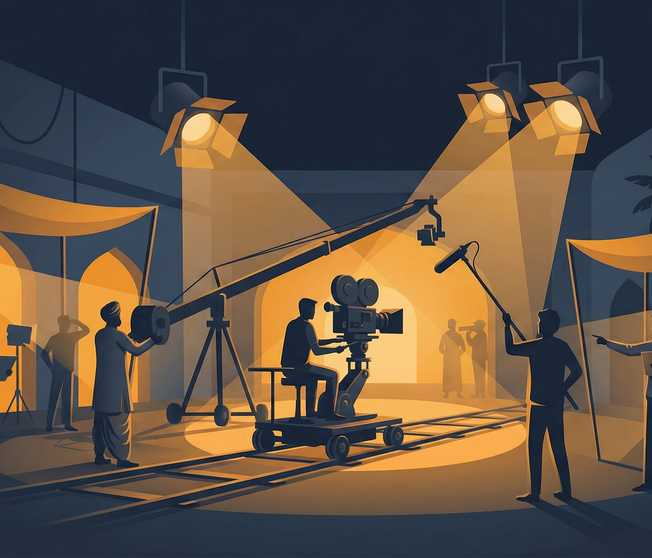
Focus Puller (1st AC) Career in India: The Person Who Makes or Breaks Every Shot
-

Lavkush Gupta
-
May 04, 2026
-
9
What Does a Focus Puller Actually Do?
Let's get brutally honest about the job title first. "Focus puller" sounds almost casual. It is not casual.
Your job, as a 1st AC, is to keep the actor's eyes — or whatever the designated focal point is — in razor-sharp focus throughout every single take, while the camera moves, the actor moves, and the lighting changes. You do this by physically adjusting the focus ring on the lens in real time, often while tracking multiple marks, calculating distances in your head, and anticipating where the actor will be a half-second from now.
That's the focus-pulling part. But the 1st AC role is broader than that.
You are also responsible for:
- Building and preparing the camera before every shoot day — assembling the body, mounting the lens, rigging the follow focus, checking all connections
- Maintaining the camera package throughout the shoot — cleaning lenses, protecting glass, flagging any technical issues immediately
- Marking actors during rehearsals — placing precise focus marks on the floor that correspond to critical distance positions
- Logging all camera and lens information for each shot (for the camera report)
- Communicating with the DP about lens choices, aperture stops, and any optical considerations
- Managing the 2nd AC and ensuring the clapperboard, slates, and lens kit are always where they need to be
On big productions, you are the DP's right hand in the camera department. On smaller productions, you might be doing the 2nd AC's job simultaneously. Either way, the pressure is constant and the tolerance for error is essentially zero.
Why Pulling Focus Is Harder Than It Looks
Here is what civilians don't understand: pulling focus on a moving actor at T1.4 with a 75mm lens is not a technical task. It is a physical skill — closer to a sport than a craft. Your hands need to develop muscle memory that operates independently of conscious thought, because by the time your brain processes "they moved left," your hands need to have already compensated.
Consider the math. At T1.4 on a full-frame sensor, your depth of field might be three to four centimetres. That is the thickness of two adult fingers. Your actor breathes, leans forward by five centimetres, and they are already soft. The camera is on a dolly moving through a curved track. The DP just opened up another half stop because a cloud passed over the practicals. You have a wireless follow focus in your hand, you're watching a high-resolution monitor on a stand four metres from the lens, and you have approximately 0.2 seconds to correct before the take is ruined.
Now do that seventeen times across a morning of shooting. And don't blink.
Digital cinema has made this harder in some ways, not easier. Film was forgiving because of its inherent grain structure — a slightly soft image on celluloid reads differently than a soft image on a 6K digital sensor where a YouTube commenter can zoom in and judge. On modern digital cameras, every missed focus pull is visible, archivable, and undeniable.
This is why experienced focus pullers are deeply respected. They've built something that cannot be faked.
The Camera Department Hierarchy in India
Before you understand the focus puller role, you need to understand where it sits in the camera department's food chain — because this hierarchy is your career roadmap.
Director of Photography (DP / Cinematographer) The creative lead of the camera department. They make all decisions about camera placement, lens choice, lighting approach, and visual language. On large Bollywood or South Indian productions, a DP might be managing two or three camera units simultaneously.
Camera Operator Operates the camera body on the move — on a shoulder rig, a steadicam, a dolly, or a gimbal. On many mid-budget Indian productions, the DP also operates. On larger shoots, these are separate roles. The operator focuses on framing and composition in motion; the focus puller handles sharpness.
1st Assistant Camera (1st AC / Focus Puller) That's you. The technical spine of the camera unit. Responsible for focus, camera preparation, lens management, and department coordination.
2nd Assistant Camera (2nd AC / Clapper Loader) Operates the clapperboard, loads media (or used to load film magazines), manages the lens kit, maintains camera reports, and assists the 1st AC. On film shoots, this role required loading 400-foot or 1,000-foot film magazines in complete darkness — a skill that has largely disappeared but is still tested as a measure of discipline and precision.
Camera Trainee / Camera PA The entry point. You're carrying cases, running for lenses, learning by watching, and demonstrating that you can be trusted with increasingly expensive equipment. This is where virtually everyone starts.
The path from trainee to focus puller typically takes three to five years on active productions. There are no shortcuts that don't eventually come back to haunt you.
Skills You Need to Develop
Becoming a competent focus puller requires a specific combination of skills that span the technical, physical, and interpersonal.
Optics and Depth of Field
You need to understand how focal length, aperture (T-stop for cinema lenses), distance, and sensor size interact to produce a given depth of field. This isn't memorization — it's intuition built through repetition. You should be able to look at a lens choice and aperture setting and immediately know roughly how much latitude you're working with. Apps like pCAM and VirtualDOP are standard tools; understanding why the numbers say what they say is what separates a 1st AC from someone just following a formula.
Measurement and Mark-Setting
You will spend a significant portion of your career with a cine tape measure in your hand, measuring from the front element of the lens to your subject at various positions and translating those measurements into focus marks on your follow focus wheel. Accuracy here is non-negotiable. A mark that's two centimetres off on a tight lens at a wide stop will show up on screen.
Anticipation and Spatial Awareness
Good focus pullers don't react to where the actor is — they anticipate where the actor will be. This requires watching rehearsals with obsessive attention, understanding how individual actors move (some are methodical and consistent; others improvise every take), and reading the rhythm of a scene. You're essentially performing alongside the actor, just off-frame.
Hand Coordination and Muscle Memory
Focus pulling is a physical skill. The movement of your hand on a follow focus wheel needs to become automatic, calibrated, and smooth. This is built through repetition on set over years — and more recently, through dedicated practice with follow focus rigs even when not on a paid shoot.
Equipment Knowledge
You need to be deeply fluent in every major cinema camera system used in India:
- ARRI ALEXA 35, LF, Mini LF — the industry standard for premium Bollywood and South Indian features
- RED V-RAPTOR, DSMC2 series — common on mid-budget features and prestige OTT
- Sony VENICE 2, FX9, FX6 — widespread in advertising, streaming, and documentary work
- Blackmagic URSA Cine, Pocket 6K — dominant in independent film and entry-level commercial work
Each system has different menu architectures, lens mount configurations, and ergonomic considerations. You also need to know cinema lenses deeply — Zeiss Supreme Primes, ARRI Signature Primes, Cooke S7, Leica Summicrons, Sigma Cine, and the various vintage sets that DPs are increasingly pulling from archives.
Wireless Follow Focus Systems
The wireless follow focus has transformed focus pulling — and raised the bar. Systems like the Preston FIZ (Focus, Iris, Zoom), the Tilta Nucleus-M, the ARRI WCU-4, and the Teradek RT allow the focus puller to operate remotely from the camera, which is essential when the camera is on a crane, drone, or tucked into a position the AC can't physically reach.
Preston FIZ is the gold standard on premium Indian productions. Learn it.
Communication
The relationship between the DP and the 1st AC is a professional marriage. You need to be able to communicate clearly and quickly under pressure, raise problems before they become disasters, and know when to speak and when to stay silent. On set, the 1st AC is often the person who diplomatically tells a director "we need five minutes for a lens change" when the DP can't leave the lighting conversation.
Tools of the Trade
A working 1st AC in India typically travels with or manages the following:
- Wireless follow focus system (often production-supplied on larger shoots; some 1st ACs own their own)
- Cine tape measure (essential, always on your person)
- Focus charts and lens testing targets (Siemens star, DSC resolution charts)
- Lens cleaning kit — optical cleaning fluid, lens tissue, blower brush (never compressed air near glass)
- Monitors — you'll be watching a high-res director's monitor or your own dedicated focus monitor to verify sharpness
- Depth of field calculator app — pCAM Film + Digital Calculator is the standard
- Camera report sheets (digital or physical, depending on production)
- Cable ties, gaffer tape, French flags — because 1st ACs also flag lenses against flares and secure rigging
On film shoots — increasingly rare but still happening in India, particularly for prestige productions, passion projects, and directors like Mani Ratnam or Sanjay Leela Bhansali who have shot on film — you'd also be managing film magazines, understanding emulsion stocks, and working with a very different feedback loop (no instant playback to verify focus).
How to Become a Focus Puller in India: The Assistant Ladder
There is no certification course that makes you a focus puller. There is no film school degree that certifies you as a 1st AC. The only path that works in the Indian industry is the assistant ladder — and it demands patience.
Year 0-1: Camera Trainee / PA Start by getting onto sets any way you can. Production assistant, camera department runner, helping with equipment pickup and returns at rental houses like Cinema Bazar, ARRI India, Whitebulb Films (Mumbai), or Cineworks, Moviemade (Hyderabad and Chennai). Your goal at this stage is to be dependable, invisible when needed, and fast. Learn the names of every lens in the kit. Watch the 2nd AC work. Carry the heaviest case without being asked.
Year 1-3: 2nd Assistant Camera The 2nd AC is where you start learning the actual technical language of the camera department. You're managing slates, camera reports, and loading media. You're assisting the 1st AC and watching every single thing they do. This is your classroom. Take the job seriously — a 2nd AC who isn't studying the 1st AC's work every day is wasting the best education available.
Year 3-5: Transition to 1st AC By now you should have significant on-set hours, strong equipment knowledge, and a relationship with at least a few DPs or operators who trust you. The transition to 1st AC typically happens through a combination of smaller opportunities (independent films, ad shoots, music videos) where you get your first official 1st AC credit, and then progressively larger productions as your reputation builds.
Year 5+: Established Focus Puller At this level, DPs call you directly. You have a known reputation for specific strengths — maybe you're exceptional with handheld work, or you have a specific mastery of ARRI systems, or you're the person DPs call for technically demanding shots. This is where the career becomes genuinely sustainable.
The FWICE (Film Writers Association and broader Federation of Western India Cine Employees) covers camera department workers. Getting your FWICE card as a 1st AC gives you access to union productions and formal recognition within the industry. If you're working in Mumbai's Bollywood industry specifically, this card becomes increasingly important as you move up.
Day Rates and What You Can Expect to Earn
All figures below are market estimates based on industry conversations and publicly available references as of early 2026. Rates vary significantly by city, production type, and individual negotiation. Always verify current rates through direct industry contacts or guild resources.
Camera Trainee / Camera PA Rs. 800 – Rs. 1,500 per day. Sometimes unpaid on very small independent projects (which you should increasingly avoid as you gain any experience at all).
2nd Assistant Camera Rs. 1,500 – Rs. 4,000 per day depending on the production scale, city, and format. A 2nd AC on a major OTT series in Mumbai might earn Rs. 3,500-4,000 per day with a reasonable call schedule. A 2nd AC on an independent regional feature might earn Rs. 1,500-2,000.
1st AC / Focus Puller (Entry to Mid Level) Rs. 4,000 – Rs. 8,000 per day. Your first 1st AC credits on independent features and ad shoots will likely fall in the lower half of this range. As you build a track record and develop working relationships with reliable DPs, you move toward the upper end.
1st AC / Focus Puller (Experienced, Established) Rs. 8,000 – Rs. 20,000+ per day on premium productions. A sought-after 1st AC working on a major Bollywood feature or a high-budget OTT series (Netflix, Prime Video India, Disney+ Hotstar originals) can command rates in this range. Big-budget ad films often pay premium day rates above the feature film scale.
Weekly / Monthly Retainers On longer productions with regular shooting schedules, many 1st ACs negotiate a monthly retainer rather than a daily rate. This provides income stability and is the preferred arrangement for established focus pullers on long-form OTT productions.
Keep in mind that focus pullers in India are almost universally freelance — there is no salary structure, no PF, no ESI on most productions. You manage your own taxes, your own insurance, and your own schedule. The rates above need to account for those realities.
City-by-City Opportunities
Mumbai The largest market and the highest rates. Bollywood features, OTT originals, advertising, music videos — the volume of production in Mumbai means a skilled 1st AC can stay consistently busy. The trade-off is cost of living, intense competition, and the reality that breaking in takes time.
Hyderabad Arguably the fastest-growing production hub in India right now. Telugu cinema (Tollywood) is producing massive-budget films, and Hyderabad's Ramoji Film City, Annapurna Studios, and the growing number of production facilities mean real work for camera department professionals. Many DPs working in Telugu cinema also work across Bollywood, creating crossover opportunities.
Chennai Tamil cinema (Kollywood) has a deeply technical film culture and a tradition of strong cinematography. The 1st AC community here is tight-knit and the mentorship culture between experienced and newer camera assistants is genuinely present.
Bengaluru Growing significantly as a hub for OTT productions and advertising. Many streaming productions serving South Indian audiences are based here, and the advertising film industry is robust.
Kolkata Bengali cinema has a strong artisanal tradition, and while budgets are smaller than Mumbai or Hyderabad, the quality of craft expected is high. For focus pullers interested in more literary, character-driven work, Kolkata offers a distinct creative environment.
The Autofocus Debate: Why Pros Still Pull Manually
Sony's latest cinema cameras — the VENICE 2, the FX3 in the right context — have autofocus systems that are genuinely impressive. The question gets asked on every Reddit thread and every film school panel: does the focus puller have a future when AI can track a face at T1.4?
The honest answer from working professionals: autofocus is a tool, not a replacement, and it has significant limitations in cinema contexts.
Autofocus systems struggle with:
- Predictive focus pulls to a position the actor hasn't yet reached
- Selective focus — choosing to hold on the background actor while the foreground lead is soft (a deliberate creative choice)
- Rack focus transitions — the dramatically motivated shift from foreground to background or vice versa
- Low contrast or low light — where contrast-detection AF loses its grip
- Unusual lens choices — vintage glass adapted for cinema often doesn't communicate electronically with the body
- Director-driven focus choices that require human interpretation of intent
On premium productions in India, autofocus is occasionally used as a backup or for specific coverage. It is not the primary workflow. A DP working on a feature film at T1.4 with an ARRI Signature Prime is not handing focus decisions to a machine. They're trusting a person who has spent years developing the craft to serve the story.
The focus puller's job is safe — but only for those who do it exceptionally well.
Focus Pulling Across Formats: Features, Ads, Music Videos, and TV
One thing the camera department conversation in India doesn't discuss enough: the job of a 1st AC changes substantially depending on the format you're working in. The skills are transferable, but the tempo, the pressure, and the workflow are different enough that you need to understand each environment before you walk onto that set.
Feature Films
This is the long game. A Bollywood or South Indian feature might shoot for 60 to 120 days. The pace is deliberate — multiple setups per day, often with two camera units running simultaneously on larger productions. You'll have time for thorough rehearsals, careful mark-setting, and detailed communication with the DP. The shots are designed with precision, and the expectation of technical perfection is correspondingly high.
The pressure on a feature is cumulative. You're not just sharp for one day — you need to be consistently sharp across months of shooting, often across multiple cities and locations. The ARRI ALEXA 35 or an ARRI LF at T1.4 on a feature is not forgiving. Missed pulls on a close-up of the lead actor in a pivotal scene are the kind of thing that follows you.
Advertising Films (Ad Films)
Ad films are where the rates are highest and the schedule is most compressed. A 30-second commercial might shoot in one or two days with a budget that dwarfs an independent feature. The expectation is perfection on a very tight timeline. Directors often want premium lens choices — wide open apertures, very shallow depth of field — because they want the product or face to pop against a beautifully blurred background.
For a 1st AC, ad films are technically demanding because the margin for error is zero and the time to correct is essentially nonexistent. But they're also financially valuable — premium rates, often contracted per day — and they're excellent for building your equipment and technical vocabulary quickly because you're often working with the best gear available.
Music Videos
Music videos in India — whether Bollywood song sequences from a feature, independent music videos for artists, or tracks shot for YouTube or streaming platforms — have their own rhythm. The work is often faster, more stylistically aggressive, and more willing to break conventional technical rules for a visual effect.
You might be working with a DP who deliberately wants a slightly dreamy, almost soft quality on certain shots. The autofocus discussion is more nuanced here — some music video DPs are open to AF for run-and-gun sections while pulling manually for the hero close-ups. Gimbals, car rigs, and creative camera movements are common, which means your wireless follow focus workflow needs to be airtight.
Music videos are also a good entry point for 1st ACs building their first credits, particularly in Bengaluru, Mumbai, and Hyderabad where the independent music video ecosystem is active.
Web Series and OTT Productions
This is where most of the sustained, consistent work lives right now in India. Netflix, Amazon Prime Video, Disney+ Hotstar, Sony LIV, and ZEE5 are all producing original Indian content at volume. An OTT web series might shoot for 80 to 150 days across multiple seasons. The workflow is closer to a feature in terms of technical expectations, but the schedule is often more aggressive — more pages per day, tighter turnarounds between episodes.
The consistent, recurring nature of OTT work makes it attractive for camera department professionals who want a reliable income structure. Many established 1st ACs now prioritize OTT series over features precisely because the seasons create predictable 3-4 month work blocks.
Television (Fiction and Non-Fiction)
General entertainment television in India — the daily soaps, reality shows, game shows — operates at a completely different speed. A daily soap might shoot 20 to 25 minutes of content per day. At that pace, you're not spending an hour on mark-setting for a single shot. You're working fast, accepting a wider depth of field to reduce focus-pulling risk, and often using camera systems that are more ENG (electronic news gathering) oriented than pure cinema.
For camera department professionals building toward feature film or premium OTT work, daily television is typically a stepping stone rather than a destination. The volume of shooting hours is valuable for early-career experience, but the technical precision expected is lower and the habits built on a GEC (general entertainment channel) set don't always translate cleanly to a prestige production.
The Physical and Psychological Demands
Nobody talks about this enough. Focus pulling is physically demanding in ways that accumulate over a career.
You're on your feet for 12-16 hour days. You're carrying equipment worth more than a car. You're working in temperatures ranging from Rajasthan desert heat to the air-conditioned interior of a studio that's been chilled to protect camera electronics. You're frequently crouching, stretching, moving around the camera while staying out of frame, all while keeping your hands steady and your eyes on a monitor.
The psychological pressure is its own category. A missed focus pull on a big-budget shot — with a major star, a large lighting setup, a full cast and crew on location — means wasted money, frustrated talent, and a reputation conversation that starts before you've packed the camera away. The ability to stay calm under that pressure, reset after a mistake without letting it affect the next take, and maintain consistency across a 60-day shoot is not a small thing. It is exactly the kind of professional maturity that separates the people who build long careers from those who burn out.
Career Progression: Where Does a Focus Puller Go?
The focus puller career path, if you want to keep climbing, typically moves in one of two directions.
Camera Operator Many experienced 1st ACs transition into operating — moving the camera rather than managing its optics. This requires a different set of skills (framing, composition, physical control of the camera body) and is a natural evolution for people who have spent years in intimate relationship with the camera.
Director of Photography This is the ultimate destination for many camera department professionals. The path from 1st AC to DP is not automatic or guaranteed, but the technical foundation — deep understanding of lenses, optics, exposure, and how images are actually captured — is an enormous advantage. Some of India's most technically rigorous DPs began their careers as camera assistants.
There's also a third path: camera department specialization. Some 1st ACs become specialists in specific rigs — underwater housings, aerial systems, car mounts, high-speed cameras. These specialists command premium rates and fill a narrow but real market need.
What Makes a Great Focus Puller: The Intangibles
Technical skills can be learned. The intangibles are harder to teach.
The best focus pullers we've seen on Indian sets share certain qualities: they're observant to the point of seeming psychic, they have a sense of calm that doesn't waver when the director is frustrated or the shot is falling apart, and they've made the equipment feel like an extension of their own nervous system.
They also know when to speak and when to stay quiet. The 1st AC who interjects unnecessarily in a creative conversation between the DP and director is a problem. The 1st AC who quietly flags a lens issue before it becomes a continuity disaster in the edit is invaluable.
Reputation in the camera department travels fast. DPs talk to each other. Producers talk to each other. Being the person who is trusted absolutely — who has never let a soft take get into the final cut through carelessness, who always shows up prepared, who treats the equipment with the respect it deserves — that reputation compounds over time into a career that sustains itself.
Your Next Step
The focus puller career is not for everyone. It demands technical depth, physical endurance, psychological resilience, and years of disciplined apprenticeship before the payoff arrives. But for the right person — someone who loves cameras the way some people love instruments, who finds satisfaction in the invisible work that makes visible magic — it is one of the most rewarding technical careers in the Indian film industry.
The demand for skilled 1st ACs is real and growing. OTT production has increased the volume of premium content being shot in India significantly. There are DPs across Mumbai, Hyderabad, Chennai, and Bengaluru who are actively looking for reliable, technically sharp camera assistants to grow with.
We built AIO Cine specifically because finding legitimate crew calls in India — without paying a middleman, navigating a scam, or waiting for a personal connection to show up — was harder than it should be. Every production house and production company on AIO Cine is verified before they can post a crew call. Your focus should be on building the skills, not on figuring out which WhatsApp group has real jobs and which one is going to waste your time.
Register on AIO Cine, build your profile in the camera department, and let verified production houses find you — because the right opportunity should find you based on your craft, not on who you happened to meet at a party.
The shot needs to be sharp. So do you.
SEO & Publishing Notes
Suggested Title: Focus Puller Career in India: The 1st AC Role Explained (2026)
Meta Description: Everything you need to know about a focus puller / 1st AC career in India — job role, salary, skills, career path, camera systems, and how to break in. (Character count: 154 — trim "Everything you need to know about" to "The complete guide to" if needed for 155-char limit)
Target Keywords:
- Primary:
focus puller career India - Secondary:
1st AC film career,camera assistant career India,how to become focus puller India,1st assistant camera India,follow focus puller Bollywood
Internal Link Suggestions:
- "How to Become a Cinematographer in India" (how-to-become-a-cinematographer-in-india.md) — link from the DP career progression section
- "Film Crew Day Rates India 2026" (film-crew-day-rates-india-2026.md) — link from the salary section
- "FWICE Membership Card Guide" (fwice-membership-card-guide-2026.md) — link from the FWICE mention in the assistant ladder section
- "Grip Department Career India" (grip-department-career-india.md) — contextual link in camera department hierarchy section
- "Film Set Etiquette Guide India" (film-set-etiquette-guide-india.md) — link from the on-set behaviour / communication section
Image Placement & Alt Text Recommendations:
- Hero image (above fold): A focus puller's hands on a Preston FIZ handset with an ARRI camera blurred in background — Alt:
focus puller operating Preston FIZ wireless follow focus on film set India - Section: Camera department hierarchy — diagram or illustrated graphic — Alt:
camera department hierarchy India DP operator 1st AC 2nd AC trainee - Section: Tools of the trade — flat lay of follow focus, cine tape, lens cleaning kit, depth of field chart — Alt:
1st AC camera assistant tools follow focus cine tape lens kit India - Section: Career progression — image of a DP looking through viewfinder or monitor — Alt:
cinematographer DP career progression from focus puller India - Section: Salary / day rates — consider a simple illustrated infographic — Alt:
focus puller day rates salary India 2026 market estimate
Content Notes:
- Salary figures are labeled as market estimates throughout with a verification disclaimer embedded in the section header
- FWICE is referenced as the relevant union body — consistent with other posts in this series
- Post pairs naturally with the cinematographer career guide and the film crew day rates post for a camera department content cluster
- New section "Focus Pulling Across Formats" covers features, ads, music videos, OTT, and television explicitly — addresses format-specific workflow differences and entry points per format
- Word count: approximately 3,000 words
Related Blog Posts