Gaffer Career in India: The Chief Electrician Who Paints With Light
-

Lavkush Gupta
-
May 04, 2026
-
8
The first frame of Mughal-E-Azam's colour sequence. The golden hour magic of Lagaan's cricket field. The brutal neon-soaked underworld of Sacred Games. The bone-white interrogation room of Delhi Crime.
None of it happened by accident.
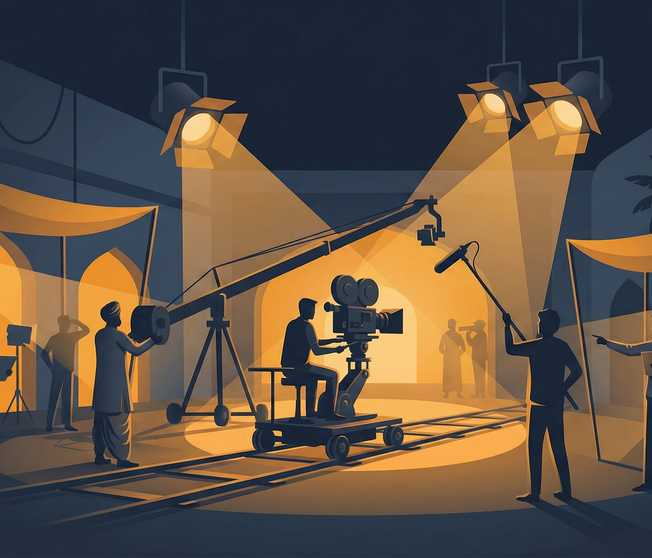
Behind every one of those images, standing somewhere off-camera with a walkie-talkie and a head full of load calculations, was a gaffer — the chief lighting technician who translated the cinematographer's dream into actual photons hitting an actual sensor.
If you work with electricity and you've ever watched a film and thought how did they make it look like that, this is your career breakdown. We built AIO Cine because the Indian film industry needed a platform where crew professionals — not just actors — could find legitimate, verified work. The gaffer role is one of the most technically demanding and creatively rewarding positions on any set. It's also one of the most undersold career paths in Indian cinema.
Let's fix that.
What a Gaffer Actually Does (And What They Don't)
Here's the most common misconception: people think the gaffer just "does the lights." That's like saying a cinematographer "just points the camera." Technically true. Completely wrong.
The gaffer is the chief lighting technician — the head of the electrical department on a film or TV production. Their job starts where the DP's (Director of Photography's) vision ends and reality begins.
The DP tells the gaffer what the scene should feel like. Warm and intimate? Cold and clinical? A single hard source that creates long dramatic shadows? The gaffer's job is to engineer that feeling using electricity, fixtures, modifiers, and physics. They translate aesthetic intent into a practical lighting plan, then execute it with their crew safely and on schedule.
On a typical day, a gaffer will:
- Break down the script with the DP during pre-production, identifying every scene's lighting requirements
- Scout locations to assess available power infrastructure, ceiling heights, window placement, and potential rigging points
- Prepare the lighting plan — which fixtures, how many, where, at what intensity and colour temperature
- Calculate power loads and plan the distribution system (who gets which circuit, where does the genny go, how does power travel from source to fixture)
- Manage and lead the entire electrical department on set — from best boy to the most junior lamp operator
- Troubleshoot in real time when a light blows, a circuit trips, or the DP changes their mind between setups
- Wrap the electrical department safely, accounting for all equipment
The gaffer does NOT operate the camera. They do NOT decide the framing or the story. But without them, the DP's vision is literally in the dark.
The Lighting Department Hierarchy
Every film set runs on a strict departmental hierarchy. The electrical/lighting department in India typically looks like this:
Gaffer (Chief Lighting Technician) The department head. Reports directly to the DP. Makes all creative and technical lighting decisions. Manages the entire department's budget, schedule, and safety.
Best Boy Electric The gaffer's second-in-command and departmental manager. While the gaffer is on the floor working closely with the DP, the best boy handles logistics — equipment orders, rental pickups, crew scheduling, timesheets, and making sure everything is where it needs to be before the gaffer needs it. This is not a junior role. A strong best boy is what allows a gaffer to focus on creative work.
Electricians / Lamp Operators The crew that physically places, cables, powers, and adjusts lighting fixtures on set. On large productions, this team can number 10-20 people. On small independent films, it might be two. They work from the gaffer's lighting plan and respond to real-time instructions from the gaffer or best boy.
Generator Operator (Genny Op) On location shoots that require external power, the genny op runs and maintains the generators. This is a specialised sub-role — knowing how to manage a 200 kVA diesel generator safely under production pressure is its own skill set.
Rigging Gaffer / Rigging Crew On larger productions, a separate rigging team comes in before the main unit to pre-light entire sets. This lets the main unit walk onto a set that's already mostly lit, which saves enormous amounts of time.
The Gaffer-DP Relationship: The Creative Core
If you understand one thing about the gaffer role, understand this: the relationship between the gaffer and the DP is the most important creative partnership below the director on any film set.
It's built on trust, shorthand, and a shared visual language. A DP and gaffer who have worked together for years can communicate with a glance. The DP tilts their head toward a corner of the set; the gaffer already knows they want a subtle eye light in there. That kind of non-verbal efficiency only comes from time and mutual respect.
In India, you'll often find that DPs return to the same gaffer across multiple projects. Names like Ravi Varman, Santosh Sivan, and P.C. Sreeram have long-standing relationships with their lighting teams. That loyalty is earned. The gaffer has to be the DP's most technically reliable partner — and also someone who takes the DP's vision so seriously that they'll find a way to make it work even when the budget, the location, and the weather are all conspiring against it.
This also means that as a career gaffer, your reputation is largely tied to the DPs you work with. Working with respected DPs opens doors. It's a collaborative industry where your relationships define your trajectory as much as your technical skills.
Skills You Need to Become a Gaffer
1. Electrical Knowledge (Non-Negotiable)
You must understand electricity at a practical and theoretical level. This means Ohm's law, three-phase power, load calculations, circuit protection, safe cable management, and the specific requirements of professional film fixtures. In India, where power infrastructure on location can be deeply unreliable, this knowledge is genuinely life-saving.
2. Lighting Design and Colour Theory
Lighting design is an aesthetic discipline. You need to understand the quality of light (hard vs. soft), direction and shadow, colour temperature (measured in Kelvin), colour rendering index (CRI), and how different light sources mix or clash. You should be able to look at a photograph and identify the lighting setup used. Study classical painting — the way Rembrandt sculpted faces with a single source is directly applicable to how you light a close-up.
3. Equipment Knowledge
You need to know every piece of equipment in the rental house catalogue — not just what it does, but when to use it, how it handles power, how it fails, and how it behaves in different temperatures and conditions. (More on specific equipment below.)
4. Crew Management
The gaffer leads a department. That means scheduling, motivating, managing personalities, making decisions under pressure, and keeping the department moving efficiently while also being the calm centre of the operation. The set can be chaotic; your department cannot be.
5. Communication
You are the bridge between the DP's aesthetic vision and the technical crew who execute it. You must be able to translate creative language into technical instructions, and technical constraints into language the DP can work with.
6. Safety Protocols
Electrical safety is not a bullet point — it is a matter of life and death. Every year, there are accidents on film sets globally, including India, caused by improperly managed power. As gaffer, you are legally and morally responsible for the safety of your entire department. FWICE (Film and Television Producers Guild of India) membership and appropriate safety certifications are increasingly expected on professional productions.
Equipment: What a Gaffer Works With
HMI (Hydrargyrum Medium-Arc Iodide)
HMI fixtures produce a daylight-balanced, extremely bright output. They're the workhorses of Indian outdoor production — if you're fighting the sun or creating the appearance of sunlight streaming through a window, HMIs are what you reach for. Common fixtures include the ARRI M-Series and the Joker range from K5600. They require a ballast and a warm-up period.
LED Panels
The LED revolution has fundamentally changed how film sets operate. Modern LED fixtures like the ARRI SkyPanel S60-C, the Aputure 600d, and the Litepanels Gemini offer unprecedented colour control (full RGB+W on high-end units), low power consumption, fanless operation, and wireless DMX control. For Indian productions working in increasingly hot and humid conditions, the reduced heat output of LEDs is a genuine quality-of-life improvement.
Tungsten Fixtures
Fresnels, open-face lights, and PAR cans in tungsten are older technology but still present in many Indian rental houses. Tungsten produces a warm, continuous spectrum light but runs extremely hot and consumes significant power. They're being phased out by LEDs on most productions but remain relevant for specific looks and budget-constrained productions.
Kino Flo
Kino Flo fluorescent fixtures produce a large, soft, flattering light source ideal for interview setups, beauty lighting, and practical interior scenes. They've been a staple of film and TV production for decades and remain in widespread use, particularly in the TV and OTT series space.
Practicals
A practical is any light source that appears within the frame — a table lamp, a hanging bulb, a neon sign. The gaffer manages practicals too, often modifying or replacing them to get the right colour temperature and intensity for the camera while maintaining the appearance of a real practical source.
Grip & Lighting Modifiers
The grip department and electrical department overlap in the use of flags (solid panels that block or shape light), diffusion frames (which soften hard light sources), bounce boards (which redirect natural or artificial light), and gels (coloured or colour-correction films placed over fixtures). A gaffer needs to understand and communicate fluently in the language of grip equipment.
Power Distribution and Generators
On location in India, power from the mains is rarely clean or sufficient. Gaffers work with diesel generators ranging from 20 kVA for small commercial shoots to 200-500 kVA for large-scale film productions. You must understand distribution boxes (distro), feeder cables, head cables, and circuit breaker ratings. You must be able to calculate the total load of your lighting plan and know exactly how much headroom you have before a circuit trips — or worse.
Lighting for Different Genres and Formats
The way you light a Hindi romantic film is nothing like the way you light a Tamil crime thriller. And both are nothing like a 30-second ad for a luxury automobile.
Drama and Romance (Bollywood/mainstream): Warm, flattering, controlled shadows. Skin tones are prioritised. Cinematographers often favour motivated sources (a window, a lamp) that create organic-feeling warmth. The gaffer's job is to create that warmth at scale, even when the actual source is a tungsten fresnel eight metres above the actor's head.
Crime and Thriller (OTT noir): Think Sacred Games, Mirzapur, Delhi Crime. The language here is harder, more directional. Shadows are allies, not problems. Low-key lighting with strong contrast. A single source cutting through darkness. LED fixtures with tunable colour are invaluable here because you can push the colour temperature cold and desaturated to match the tone.
Horror: Motivated low-key with an emphasis on what is not lit. The gaffer's discipline here is restraint — knowing what to leave dark is as important as knowing what to light.
Commercial/Ad Films: The most technically demanding lighting in terms of quality control. Everything must be perfect. Skin, product, and environment must all work simultaneously. Ad film gaffers in Mumbai often command the highest day rates because the expectations are the highest and the turnaround is the tightest.
TV Serial Production: Speed is the priority. A Hindi daily soap might shoot 50-80 setups in a single day. The gaffer's challenge is maintaining consistent, usable quality across that volume. This is where rigging gaffers and pre-lit sets become essential.
How to Become a Gaffer: The 5-8 Year Path
There is no formal gaffer school in India. This is a craft that is learned on set, through years of hands-on work in the industry. Here is the realistic career path:
Step 1: Start as an Electrician or Lamp Operator (Years 1-2) Most gaffers start by getting their hands on set equipment as early as possible. This might mean starting as a set electrician — running cable, setting up basic lights, learning how the department functions from the ground level. In Mumbai, this often means connecting with established gaffers or best boys who are hiring for their crews.
Step 2: Build Technical Knowledge in Parallel While working as a junior crew member, invest in your technical education. Study electrical theory. Get comfortable reading a lighting plan. Learn every fixture in the rental house — go to the rental house and ask questions. They will often let you handle equipment during slow periods. Watch tutorial content from ARRI, Litepanels, and Aputure. Study the work of master DPs and try to reverse-engineer their setups.
Step 3: Best Boy Electric (Years 3-5) As you demonstrate reliability, technical competence, and the ability to manage logistics, you will move into the best boy role. This is where you learn department management — ordering equipment, managing crew, keeping track of a production's electrical budget. It is also where you build your relationship with a working gaffer who will eventually vouch for you.
Step 4: Gaffer (Years 5-8) The move from best boy to gaffer typically happens when you are handed your first production — either because your gaffer recommends you for a smaller project, or because you have built enough of a reputation with a DP to be hired directly. The first few independent gigs are the hardest. After that, your work builds your reputation.
Day Rates and Earnings
Note: All figures below are market estimates based on industry sources as of early 2026. Actual rates vary significantly by production type, budget, city, and individual negotiation. Always verify current rates directly with industry contacts or your union representative.
The Indian film industry pays lighting professionals across a wide range — and the difference between a Rs. 1,500/day lamp operator on a regional TV production and a Rs. 25,000/day gaffer on a big-budget Bollywood feature reflects the enormous range of production scales in this country.
Estimated market ranges (per day, all-in):
- Lamp Operator / Junior Electrician: Rs. 1,500 – Rs. 4,000
- Senior Electrician: Rs. 3,500 – Rs. 7,000
- Best Boy Electric: Rs. 6,000 – Rs. 15,000
- Gaffer (regional/smaller productions): Rs. 8,000 – Rs. 18,000
- Gaffer (mid-level film/OTT): Rs. 15,000 – Rs. 35,000
- Gaffer (top-tier feature film or ad films): Rs. 30,000 – Rs. 80,000+
Mumbai ad film gaffers are at the top of the earning range — a high-budget automotive TVC or luxury brand campaign can see a senior gaffer billing Rs. 50,000-80,000 per day. These rates are not standard; they reflect the extreme quality demands and compressed timelines of premium commercial production.
Productions also typically provide a working vehicle, meals on set, and sometimes accommodation for location shoots.
City-Specific Opportunities
Mumbai: The national epicentre. Bollywood feature films, Hindi OTT productions, national ad campaigns, music videos. The highest concentration of top-tier DPs and gaffers in the country. Competition is intense but so are the opportunities and the rates.
Hyderabad: Tollywood (Telugu) is producing films at extraordinary scale and technical ambition. The infrastructure investment in Ramoji Film City and surrounding studios makes Hyderabad a serious market for experienced lighting professionals. Pan-Indian films shot in Hyderabad often bring budgets that rival Bollywood features.
Chennai: Kollywood (Tamil) has its own strong production ecosystem and a tradition of technically accomplished cinema. The DP culture in Tamil cinema is well-respected — names like A.R. Murugadoss's usual collaborators and directors like Mani Ratnam (known for working with legends like Santosh Sivan and P.C. Sreeram) have set high standards for lighting in Tamil productions.
Pune, Delhi, Bangalore: Growing markets for OTT content, web series production, and corporate/brand films. These cities offer more accessible entry points for early-career professionals who aren't yet ready to compete for work in the big three markets.
The LED Revolution and What It Means for Your Career
Ten years ago, the vast majority of professional film lighting was either HMI (daylight) or tungsten (warm). The arrival of high-quality LED fixtures has restructured the entire discipline.
Today, a single ARRI SkyPanel S360-C can replace a 6K HMI in many situations. LED panels are lighter, cooler, more power-efficient, and infinitely more controllable — with full-spectrum colour tuning, wireless DMX, and precision dimming from 0 to 100% with no colour shift. For a gaffer managing a location shoot in the Indian summer, the reduced heat load alone is transformative.
For your career, this means two things. First, you need to be deeply fluent in LED technology — including colour science, spectral power distribution, and DMX programming — not just mechanically competent with HMIs and tungstens. Second, the LED revolution has raised the ceiling on what is achievable with smaller crews and lower budgets, which means the OTT and independent film space is producing increasingly sophisticated work. That is a career opportunity.
Equipment Rental Companies in India
For a working gaffer, knowing the rental landscape is essential. Major players include:
- Shemaroo Studios (Mumbai): Equipment hire alongside their production facilities
- Prime Focus (Mumbai/Hyderabad/Chennai): Full-service with lighting, camera, and grip
- Reel Studioz (Mumbai): Broad lighting and grip inventory
- Prasad Film Lab facilities (Chennai/Hyderabad): Particularly strong in South Indian market
- Various independent rental houses in Andheri, Film City area (Mumbai), and in the industrial areas surrounding Ramoji Film City (Hyderabad)
Build relationships with rental house managers early. They know every working gaffer in the city, they know which productions are coming up, and they are an invaluable source of information about who is hiring.
Your Next Step: Get Verified, Get Found
We built AIO Cine because India's film industry runs on connections — and for most people starting out, those connections don't exist yet. Every production house on our platform is verified before they can post a crew call. That means when a DP is looking for a best boy or a gaffer for their next feature, the posting is real, the production is legitimate, and your application goes somewhere it will actually be read.
If you are an electrician who wants to move into film, or a lamp operator who is ready to start climbing toward the gaffer chair — register on AIO Cine. Build your crew profile. Make yourself findable to the DPs and production managers who are actively looking for technically skilled lighting professionals.
The light has to come from somewhere. Make it come from you.
SEO Notes
Internal linking recommendations:
- Link "gaffer career" to the film crew day rates post (
film-crew-day-rates-india-2026.md) - Link "FWICE membership" to the FWICE guide (
fwice-membership-card-guide-2026.md) - Link "cinematographer" or "DP" to the cinematographer career post (
how-to-become-a-cinematographer-in-india.md) - Link "grip department" to the grip career post (
grip-department-career-india.md) - Link "focus puller" or "camera department" to the focus puller post (
focus-puller-career-india.md) - Link "ad films" to the ad films career post (
working-in-ad-films-india.md) - Link "film equipment rental" to the equipment rental guide (
film-equipment-rental-guide-india.md) - Link "film crew salary" or day rate references to the salary guide (
film-industry-salary-guide-india-2026.md)
Image placement suggestions:
- Hero image: A gaffer reviewing a lighting plan on a film set with practical fixtures visible in background. Alt text:
gaffer reviewing lighting plan on Indian film set - Section image (lighting hierarchy): An infographic-style diagram of the electrical department hierarchy. Alt text:
film lighting department hierarchy gaffer best boy electricians India - Equipment section: Collage of HMI, SkyPanel, and LED panel fixtures. Alt text:
professional film lighting equipment HMI LED panels used by gaffer India - Career path section: A timeline or progression diagram from lamp operator to gaffer. Alt text:
gaffer career path India from electrician to chief lighting technician
Additional optimisation tips:
- Target featured snippet for "What does a gaffer do?" — the opening definition paragraph is structured to answer this directly. Consider adding a clean one-paragraph definition block at the very top as a pull-quote or info box.
- The day rates section is a strong candidate for a featured snippet table — consider rendering it as an HTML table in the CMS for better Google parsing.
- Secondary keyword cluster: "best boy electric India", "film electrician career India", "HMI lighting film" — these are naturally present in the body copy.
- Post length is approximately 2,900 words — within the 2,500-3,000 target and competitive for the "gaffer career India" keyword cluster where most existing content is thin or generic.
- Schema markup: Consider adding
HowToschema for the "How to Become a Gaffer" section andFAQPageschema if FAQ blocks are added in future. - Internal link anchor text: Use natural, descriptive anchors ("film crew day rates in India") rather than exact match anchors to avoid over-optimisation signals.
Related Blog Posts