Grip Department Career in India: The Invisible Force Behind Every Great Shot
-

Lavkush Gupta
-
May 04, 2026
-
10
What Does the Grip Department Actually Do?
Here's the version most people have heard: grips move stuff on set. That's technically true in the same way that surgeons "cut things." The reality is far more specific.
The grip department is responsible for everything that supports, moves, or stabilizes the camera. They are not electricians (that's the gaffer's world), not camera operators (that's the DOP and AC world), but they are the mechanical and structural backbone that lets camera movement exist at all.
Their domain includes:
Camera Support Equipment Tripods, fluid heads, hi-hats, low-hats, sliding plates, spreaders. The grip team sets these up, levels them, and configures them for each shot. This sounds simple until you're doing it on an uneven rooftop in Hyderabad at 2 AM in 40-degree heat.
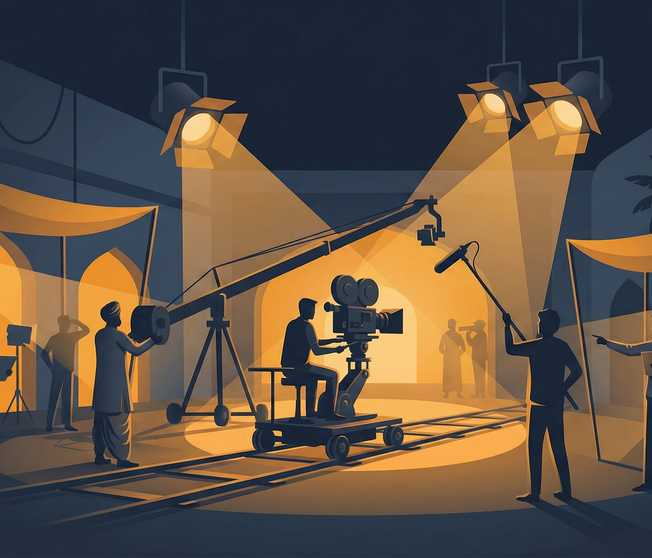
Dollies and Dolly Track A dolly is a wheeled platform that carries the camera (and often the operator and DOP) along a smooth track. Laying that track — getting it perfectly level so the shot doesn't wobble — is a precise, time-sensitive skill. In India, you'll encounter everything from basic tubular track to Mitchell and Elemack systems.
Cranes and Jibs A crane swings the camera through a vertical arc, often revealing or concealing the environment around an actor. A jib is its smaller, lighter cousin. Both require rigging, counterweighting, and real-time coordination with the camera operator during the shot. The grip team builds the crane, operates the boom arm, and manages safety at height.
Car Mounts and Motion Vehicle Rigs When you see a camera mounted to the hood of a car, bolted to the side door, or tracking alongside a moving vehicle on an arm rig — that's grip work. Car mount rigging is high-stakes: a poorly secured mount at 80 km/h is a projectile. This is one of the most specialized areas in the department.
Specialty Rigs Underwater housings on land rigs, cable cam systems, body-mounted camera rigs, motorcycle mounts, boat rigs. Increasingly: gimbal support rigs, remote head systems like MoVI or Ronin setups mounted on larger structures, robotic camera arms. If a camera is moving and it isn't handheld, someone in grip built the system holding it.
Negative Fill and Flags Grips also control unwanted light using flags, cutters, and negative fill panels. This puts them in constant coordination with the gaffer and DOP. A grip who understands light doesn't just control shadows — they actively shape the image.
The Grip Hierarchy in Indian Cinema
Every grip set has a clear chain of command. Understanding it is essential before you step on set.
Key Grip
The department head. On a medium-to-large production, the key grip works directly with the Director of Photography to plan every camera move in advance. They break down the script, budget the equipment needed, hire the team, and own all on-set decisions. In Bollywood, a seasoned key grip on a studio production can command significant authority — they're often the person the DOP trusts most when something isn't working mechanically.
A key grip is also the safety officer for their department. If a rig is unsafe, they stop the shot. Full stop.
Best Boy Grip
Second-in-command. The best boy manages the crew on a day-to-day basis: attendance, scheduling, equipment lists, truck management. If the key grip is the DOP's right hand, the best boy is the key grip's. This is typically the role someone moves into when they're ready to lead but before they're department heads. Excellent organizational skills and people management matter as much as technical knowledge here.
Dolly Grip
A specialized role that exclusively operates the dolly during shots. This sounds narrow, but a great dolly grip is worth their weight in gold. They must develop a physical relationship with the camera and operator — feeling the rhythm of the shot, accelerating and decelerating in sync with dialogue or music beats. On big productions with complex dolly moves, the dolly grip may rehearse a shot 20 times before the camera rolls. Some of the most experienced grips in Mumbai and Hyderabad specialize only in dolly work throughout their careers.
Rigging Grip
Rigging grips work ahead of the main unit, pre-rigging sets and locations so the camera team arrives to a setup-ready environment. They work longer hours than most — often setting up the night before a shoot day and striking after everyone else has gone home. Rigging grips need strong structural instincts and a deep understanding of load-bearing capacity, clamps, and safe working loads.
Grip / Day Player
General crew members who execute the physical work: laying track, moving the dolly, setting flags, pushing carts, assembling rigs under supervision. This is where almost everyone starts. It demands physical fitness, a willingness to learn without ego, and the ability to follow instructions precisely under time pressure.
Why Grips Are Underappreciated (And Why That's Starting to Change)
Ask a civilian to name a film crew role and they'll say director, actor, cameraman. Maybe editor. The grip department doesn't exist in most people's mental model of filmmaking.
Part of this is structural. Grip work happens before the shot — the rig is built, leveled, tested, and ready before the DOP's eye goes to the viewfinder. When the shot works beautifully, the credit flows upward: to the director's vision, the DOP's eye, the actor's presence. The grip's fingerprints are deliberately invisible.
But the grip department is underappreciated even within the industry. In India specifically, technical crew have historically been compensated and credited far below their actual contribution. This is shifting — partly because international co-productions and OTT-backed productions have brought international crew norms to Mumbai and Hyderabad sets, and partly because equipment has become sophisticated enough that the cost of bad grip work (broken gear, blown shots, safety incidents) is now more visible to producers.
If you're joining the grip department in 2026, you're joining at a moment when the value of this work is finally being recognized in real rupees.
How to Become a Grip in India: The Honest Path
There is no official grip training school in India. FTII and SRFTI's technical curricula touch on camera support but don't produce grip department specialists. The path is almost entirely apprenticeship-based, which means the first job is the hardest to get.
Here's what actually works:
Step 1: Get any foothold on a working set. Spot boy, PA, art department helper — it doesn't matter. What matters is that you're physically present on working film sets regularly. Observe the grip department. Learn the names of the equipment. Make yourself useful to grip crew members during breaks or between setups. Ask intelligent questions when there's a quiet moment.
Step 2: Learn equipment names and functions before you touch them. Nothing impresses a key grip faster than a newcomer who already knows what a hi-hat is, can identify a Elemack dolly on sight, and understands why track must be perfectly level. Study equipment. Watch YouTube breakdowns from international grip channels. Read the manuals for common systems.
Step 3: Build physical baseline. This is non-negotiable. Grip work involves moving heavy equipment repeatedly across long shoot days. Dolly track sections weigh 8-12 kg each. Crane counterweights are dense and awkward. A 16-18 hour day on a Bollywood set is not unusual. If you're not physically prepared, you will get injured, you will slow the team, and you will not be called back.
Step 4: Approach grip rental houses directly. Grip rental houses in Mumbai, Hyderabad, and Chennai are an underused entry point. Many of them employ loaders and equipment assistants who learn the gear by handling it every day. Rental house experience gives you equipment knowledge that sets you apart from every other day player who shows up cold.
Step 5: Build department-specific connections. The grip world in India is tight. Key grips build their crews from known quantities — people they've worked with before or people vouched for by someone they trust. Your social network within the department matters enormously. Attend FWICE meetings, connect with experienced grips on set, and make your reliability your reputation.
Skills and Knowledge You Need to Build
Mechanical Aptitude Grip is fundamentally engineering work. You need to understand load-bearing, leverage, balance, and basic physics. You don't need an engineering degree — but if you've never enjoyed solving mechanical problems, this may not be the right department for you.
Equipment Literacy Know these by name, sight, and function: Mitchell plate, baby pin, speed rail, scaffold tubing, C-stand, sandbag, apple box, Euro track, tubular track, Dana dolly, Elemack Cricket, Chapman Hybrid, Technocrane, Fisher 11, Lambda head, slider, cable cam, Supertechno. Yes, that's a long list. Start memorizing.
Safety Protocol Grip work involves working at height, securing heavy loads, operating near moving vehicles, and rigging structures that humans and expensive equipment will depend on. OSHA equivalents don't exist in Indian cinema the way they do on international productions, but the physics of unsafe rigging don't care about local regulations. Know your safe working loads. Know when a rig is wrong. Know how to speak up without creating conflict.
Communication The grip department works in silent coordination with the camera team during a take. Signals, eye contact, and pre-rehearsed choreography replace verbal communication on set. Good grips read the room — and the camera operator — with precision.
Adaptability Indian sets are notoriously fluid. The shot list changes. The location changes. The DOP decides at 11 PM that tomorrow's first shot requires a crane that wasn't in the plan. Grips who panic under this kind of pressure don't last long. Grips who thrive on it become essential.
Day Rates and Salary Ranges (Market Estimates — Verify Locally)
The following figures are market estimates based on informal industry data as of early 2026. Rates vary significantly by production budget, city, and individual negotiation. Always verify current rates with FWICE or working professionals before accepting or quoting.
| Role | Mumbai (per day) | Hyderabad (per day) | Chennai (per day) | |---|---|---|---| | Grip (day player) | Rs. 1,200 – Rs. 2,000 | Rs. 900 – Rs. 1,600 | Rs. 800 – Rs. 1,500 | | Dolly Grip | Rs. 2,500 – Rs. 4,500 | Rs. 2,000 – Rs. 3,500 | Rs. 1,800 – Rs. 3,000 | | Best Boy Grip | Rs. 3,000 – Rs. 6,000 | Rs. 2,500 – Rs. 4,500 | Rs. 2,000 – Rs. 4,000 | | Key Grip | Rs. 6,000 – Rs. 15,000+ | Rs. 5,000 – Rs. 12,000 | Rs. 4,500 – Rs. 10,000 |
Ad film rates are typically 40-60% higher per day than feature film rates, but the work is shorter-duration and often inconsistent. OTT-backed productions tend to have more structured pay and more predictable hours. International co-productions (increasingly common in India) sometimes follow international rate cards, which can be substantially higher for experienced key grips.
Annual income for a working key grip in Mumbai with consistent bookings: Rs. 8-18 lakh (market estimate, highly variable).
Bollywood vs. South Cinema vs. Ad Films: The Grip Landscape by Industry
Bollywood (Mumbai) The biggest productions, the biggest equipment, the most complex rigs. Bollywood grips are exposed to the widest range of equipment and techniques. The downside: the hierarchy is rigid, the politics are real, and breaking in without connections is genuinely hard. The upside: Mumbai is the city where you can go from day player to key grip in 8-12 years if you're exceptional and consistent.
Mumbai-based grip rental houses to know: Savita Cine Equipment, Mumbai Cine Equipment, Film & Television Institute-adjacent rental operations near Andheri and Goregaon.
Tollywood and Hyderabad Productions Telugu cinema has invested heavily in production infrastructure over the last decade. Ramoji Film City is one of the largest studio complexes in the world, and Hyderabad productions — from RRR-scale spectacles to mid-budget web series — have created strong local demand for experienced grip crew. The rates are lower than Mumbai but the cost of living is substantially lower, and the industry is growing faster than Bollywood on a percentage basis.
Grip rental infrastructure in Hyderabad is developing rapidly. Several Mumbai-based key grips have relocated or take long-term bookings there for big-budget productions.
Kollywood (Chennai) Tamil cinema produces a large volume of films and has a strong tradition of technical craftsmanship. Chennai grip crews have a reputation for efficiency and resourcefulness — often achieving complex shots with simpler equipment than their Mumbai counterparts. For someone starting out, Chennai can be an excellent training ground, particularly for action-heavy productions where car mounts and vehicle rigging are common.
Ad Films Advertising productions are where many grips supplement their income. A two-day car commercial in Mumbai can pay a key grip more than a week on a feature film. The trade-off: ad films are often less creatively satisfying, the prep time is compressed, and the client-facing pressure creates a different kind of stress than narrative filmmaking. Most experienced grips work a mix — features for career credibility and creative satisfaction, ad films for income stability.
The Physical Reality of Grip Work
Let's not romanticize this. Grip work is physically demanding in ways that can damage your body if you're not careful.
Long days (14-20 hours) are common on busy productions. You will lift heavy objects repeatedly. You will work in extreme heat — outdoor shoots in Rajasthan, rooftop rigs in Chennai in May, sand dunes in Gujarat. You will sometimes work through the night. Your hands will get calloused. Your back will tell you about every poor lift decision you made in your twenties when you're in your forties.
Experienced grips manage this by lifting correctly (always, every time), wearing proper footwear, staying hydrated, sleeping aggressively on off days, and being honest with themselves about their physical limits. The culture on some Indian sets around crew wellness is improving, but it remains inconsistent. You need to be your own advocate.
Safety Protocols That Cannot Be Optional
Indian cinema has had preventable accidents involving rigging failures, crane collapses, and vehicle rigging incidents. The grip department is often directly involved when something goes wrong.
Non-negotiable safety practices:
- Never exceed the safe working load (SWL) of any clamp, stand, or rigging component — and know the SWL of everything you use
- Always use secondary safety lines on anything suspended above crew or cast
- Conduct pre-shoot rig checks even when the production is pushing you to move faster
- Never allow unauthorized personnel to operate or approach a crane or jib in motion
- Secure all loose cables, sandbags, and equipment before a dolly move begins
- On vehicle rigs, conduct a controlled test run before any camera rolls
If a producer or AD tells you to skip a safety check to save time, that is the moment your professional reputation protects your conscience — and potentially someone's life. Key grips who have a reputation for never compromising on safety get hired precisely because of that reputation.
The Grip Department and New Technology
The landscape is changing fast, and grip professionals who don't adapt will find their skills becoming obsolete.
Gimbals and Electronic Stabilizers The MoVI, DJI Ronin, and similar systems have replaced certain dolly moves on smaller productions. But gimbals need to be rigged, sometimes mounted on sliders or jibs, and operated in coordination with the camera department. Grip professionals who understand both traditional rigging and gimbal integration are more valuable than those who know only one.
Drones DJI and Freefly have made aerial shots accessible to productions that previously couldn't afford helicopters. Grip crews don't typically fly drones — but they do coordinate with drone operators on shot choreography and are often responsible for clearing the set and managing safety during drone operations.
Robotic Camera Arms On big-budget Bollywood and South productions, robotic arms (MRMC, Bolt, Kira) are increasingly used for repeatable high-speed moves. Operating and rigging these systems requires specific training. The key grips who have invested time understanding robotic systems are commanding premium rates.
The Bottom Line The fundamental physics of grip work hasn't changed. Cameras still need to move smoothly and safely through three-dimensional space. The tools evolve; the principles don't. Invest in understanding the principles, and you'll adapt to whatever comes next.
Career Progression: What the Path Looks Like
Year 1-2: Day player. You're carrying track, laying dollies, learning names, building strength. Income is inconsistent. This is the hardest phase — financially and emotionally.
Year 3-5: Trusted day player or regular with one or two key grips. You're getting repeated callbacks. You know the equipment well. You may start operating the dolly on simpler shots.
Year 6-9: Best boy or dolly grip specialist. You're managing crew, calling equipment orders, running truck operations. Your name is known in the department.
Year 10+: Key grip. You're reading scripts, planning shots, pricing production equipment budgets, and building your own crew. This is where the work becomes genuinely creative as well as technical.
The timeline above is compressed for exceptional, well-networked people and extended for those who don't hustle their connections or invest in learning. There is no guaranteed pace — only consistent, competent work that gets you the next call.
Famous Shots That Were Only Possible Because of Great Grip Work
The tracking shot in Dil Dhadakne Do that moves through the ship's corridors and across multiple decks — that's precision dolly work on a confined, moving location. The sweeping crane moves in Baahubali: The Beginning that give the army sequences their epic scale — those cranes were rigged, counterweighted, and operated by grip crews in conditions that make most shoots look comfortable. Every single car chase in every Rohit Shetty film where the camera is inches from the action — car mount rigging done correctly enough that nobody got killed.
Nobody names the key grip in the review. But every DOP who has worked with a great one will tell you: the shot exists because of them.
Where to Find Grip Work in India Today
The traditional path is word-of-mouth and showing up at rental houses. That still works. But the industry is also moving online, and productions — especially OTT-backed shoots and ad film houses — are increasingly using platforms to find verified crew.
We built AIO Cine specifically for this moment. Every production house on the platform is verified before they can post a crew call. That means when you see a grip opening on AIO Cine, it's from a real production, with a real budget, run by people who have been checked. No ghost productions, no commission traps, no "work on spec and we'll pay you after release."
Register your profile, list your equipment knowledge and experience, and let verified production houses find you. It's free to join. The point isn't a quick job — it's building a professional presence in a searchable, trusted space where the right productions can verify you before they call.
Because in a department where your safety record and your reliability are your entire professional reputation, working with verified productions isn't just smart. It's the only way to build a career you can actually be proud of.
Salary and day rate figures in this article are market estimates based on informal industry data as of early 2026. Rates vary by production budget, city, union affiliation, and individual negotiation. Always verify current rates with FWICE or working professionals in your city before accepting or quoting fees.
SEO Notes
Suggested Title: Grip Department Career in India: The Complete Guide (2026)
Meta Description: Everything you need to know about a grip department career in India — roles, day rates, how to break in, Bollywood vs South cinema, and the honest reality of the work. 2026 guide. (153 characters)
Target Keywords:
- Primary:
grip department career India - Secondary:
film grip jobs India,key grip Indian cinema,how to become a grip India,dolly grip Bollywood,film crew grip department
Internal Link Suggestions:
- Link "film crew day rates" mention to
/blog/film-crew-day-rates-india-2026 - Link "FWICE" mention to
/blog/fwice-membership-card-guide-2026 - Link "DOP" or "cinematographer" to
/blog/how-to-become-a-cinematographer-in-india - Link "ad films" mention to
/blog/working-in-ad-films-india - Link "Hyderabad productions" to
/blog/hyderabad-film-industry-career-guide - Link "Stunt" reference near car mounts to
/blog/stunt-coordinator-career-india
Image Recommendations:
- Hero image: Wide shot of a dolly track being laid on a film set — Alt text:
film grip crew laying dolly track on Indian film set - Equipment diagram: Labeled breakdown of common grip equipment — Alt text:
grip department equipment guide India — dolly track jib crane flags - Hierarchy chart: Visual org chart of grip department roles — Alt text:
grip department hierarchy key grip best boy dolly grip India - City section: Aerial or street-level image of Ramoji Film City or Film City Mumbai — Alt text:
Ramoji Film City Hyderabad film production location
Featured Snippet Opportunity: The "Grip Hierarchy" section is structured for a listicle snippet. The salary table is formatted for a table snippet on "grip department salary India" queries.
Content Length: 2,850 words (within brief spec of 2,500-3,000).
Related Blog Posts