How to Become a Cinematographer in India: From Zero to First Paid Gig
-

Lavkush Gupta
-
May 04, 2026
-
9
Suggested Title: How to Become a Cinematographer in India: From Zero to First Paid Gig
Meta Description: A complete, honest guide to the cinematographer career path in India — film schools, the camera department ladder, DOP salary ranges, and how to land your first paid job.
Target Keywords:
- Primary: how to become a cinematographer in India
- Secondary: cinematographer career path India, DOP salary India fresher, camera assistant jobs Bollywood, best film school for cinematography India
The Full Blog Post
You saw a frame that stopped you cold. Maybe it was the golden-hour silhouette in Rockstar. The ice-blue desolation of Drishyam. The terrifying intimacy of a handheld shot in Gangs of Wasseypur. Something in your gut said: I want to make images like that.
That feeling is real. The question is whether you know what it actually takes to get there.
Here is the honest version — not the film school brochure version. The full picture of what a cinematographer does, how the camera department works, what the money looks like, and exactly what you need to do starting this week to build a career behind the camera in India.
What a Cinematographer Actually Does (vs What Everyone Thinks)
Let's kill the myth first.
Most people think the DOP — Director of Photography, also called the cinematographer — is the person who walks on set, peers through the eyepiece, says something poetic, and walks off. That image has been romanticised to the point of uselessness.
Here is what a DOP actually does:
Before the shoot even begins, the DOP reads the script as obsessively as the director. They break it down — not for dialogue, but for light, time of day, emotional temperature, and visual logic. Every scene has a question: What is the audience supposed to feel in their body when they watch this? The DOP answers that question in f-stops and colour temperatures.
Then comes prep: tech recces (location scouts where you are measuring light, not admiring scenery), camera tests, lens tests, meetings with the gaffer (chief lighting technician), the production designer, the colourist. A DOP on a mid-budget feature spends more time in prep than on the actual shoot.
On set, the DOP operates in two modes simultaneously. They are making creative decisions — camera placement, lens choice, lighting scheme — and they are managing a team of four to twelve people who are executing those decisions at speed. If you cannot lead people under pressure, the craft alone will not save you.
After the shoot, most DOPs are involved in the colour grade. The DCP that lands in the cinema — the DOP has put their eye on every frame of it.
This is not a solo art form. It is a collaborative, technical, logistically demanding craft that demands both visual intelligence and real management ability. The sooner you understand that, the faster you will grow.
The Camera Department Career Ladder: How You Actually Get There
In India, the camera department has a clear hierarchy. Nobody skips rungs. Understanding this ladder is not just useful — it is the whole game.
Clapper / Loader (Camera PA / AC3)
This is where everyone starts, no matter where they went to school. Your job: slate every take (yes, you operate the clapperboard), load film magazines or manage data cards, carry equipment, keep the camera report, and stay out of the way while learning absolutely everything.
The salary is low — we will get to numbers shortly. The value is everything. You are on set every day. You see how a DOP solves problems. You see how they communicate with the director. You watch what happens when the light changes unexpectedly and how a great DOP adapts in sixty seconds. You cannot buy this education.
Expect to spend one to three years here on smaller productions. On bigger films, some assistants spend longer.
Focus Puller (First Assistant Camera / AC1)
The most technically demanding job in the camera department. The focus puller is responsible for keeping the image sharp — manually pulling focus on a lens barrel, often without looking through the viewfinder, working entirely from measured distances and instinct.
On a drama with a shallow depth of field and actors moving through space, the focus puller is doing extraordinary precision work at speed. A missed focus on a once-in-a-shoot performance is the kind of mistake that ends careers.
At this level you are also managing the camera package — all the lenses, filters, accessories — and coordinating between the DOP and the rest of the department. You are effectively the DOP's right hand.
Typical time at this level: two to five years on professional productions. This is where you are really learning cinematography, even if your name is not on it.
Camera Operator
Not every production has a dedicated camera operator separate from the DOP — on smaller shoots, the DOP also operates. But on larger films and high-end ad films, the camera operator is the person who physically handles the camera during the shot, executing the DOP's framing and movement.
Great camera operators have an instinct for performance — they anticipate where an actor will move, how they will turn, what the emotion of the moment is, and they move accordingly. It is a deeply intuitive skill layered on top of significant technical knowledge.
Director of Photography (DOP)
You are now leading the department. You are accountable for everything the camera sees. Budget negotiations, hiring your own crew, creative collaboration with directors, and ultimately, the visual language of the film — it all lands on you.
The jump from operator or focus puller to DOP does not happen on a big Bollywood film first. It happens on a short film, a documentary, a low-budget indie, a web series, an ad film. You get your first DOP credit somewhere small, build a reel, and work your way up.
Education Paths: Film School, or No Film School
Let us be direct: film school is not mandatory. Some of India's finest DOPs never attended one. But formal training, done right, compresses your learning curve significantly.
FTII — Film and Television Institute of India, Pune
The gold standard. The cinematography direction programme at FTII is rigorous, shoots on film (not just digital), and produces graduates who have a visceral understanding of light and optics. The alumni network is unmatched — a working relationship with a senior FTII grad can open more doors than a degree from anywhere else.
The entrance exam is competitive, and the programme runs three years. Seats are limited. If you can get in, go.
SRFTI — Satyajit Ray Film and Television Institute, Kolkata
FTII's eastern counterpart, with a strong emphasis on the Bengali and pan-Indian art film tradition. Excellent faculty, smaller batches, and a distinct aesthetic sensibility that sets graduates apart from the more commercially oriented Mumbai pipeline. Strong for students who want to work in regional cinema — Bengali, Odia, or pan-East Indian productions.
Whistling Woods International, Mumbai
More commercially oriented than FTII. The industry connections are stronger and more immediate — internship placements on Bollywood productions, guest lectures from working professionals, and a curriculum that is designed around the current Mumbai industry. If you want to be a commercial DOP working in Bollywood or ad films, Whistling Woods gives you a faster on-ramp.
L.V. Prasad Film and Television Academy, Chennai
Strong pipeline into South Indian cinema — Tamil, Telugu, and Malayalam productions. If your career ambition points south, LVPFTA's networks in Chennai and Hyderabad are genuinely valuable. The technical infrastructure is solid.
The Self-Taught Route
This is real and it works — but only if you approach it with professional discipline, not hobbyist enthusiasm.
The self-taught DOP is not someone who watched a lot of YouTube and shot some videos with friends. They are someone who has shot hundreds of hours of footage across multiple projects, studied the theory of cinematography rigorously (read books, not just watch tutorials), assisted experienced professionals for years, and built a body of work that speaks for itself.
If you are going this route, structure it like a curriculum. Read Blain Brown's Cinematography: Theory and Practice. Study Roger Deakins' online forum posts. Watch films frame by frame, not just passively. Then go and assist. Even without a degree, getting your hands on professional sets as a camera PA teaches you more than any solo self-study ever will.
Essential Technical Skills: What You Must Know Before Anyone Hires You
Being "passionate about cinema" is not a technical skill. Here is what actually is.
Camera platforms: ARRI (ALEXA 35, ALEXA Mini LF), Sony (VENICE 2, FX9), RED (KOMODO, V-RAPTOR), and Blackmagic (URSA Cinema). In India, the ARRI ALEXA Mini LF and Sony Venice 2 dominate high-end features; RED cameras are common in mid-range; Sony FX3/FX6 and Blackmagic appear in indie films, web content, and ad films with tighter budgets. Know the menu systems, the recording formats, the codec choices, and the workflow implications of each.
Lenses: Understand the difference between a spherical and an anamorphic lens — not just what it means but why you would choose one over the other for a specific visual intent. Know your focal lengths by heart. Understand how aperture affects depth of field in practical shooting situations, not just in theory.
Lighting: This is where cinematography lives or dies. You need to understand the physics of light — how it falls off, how it wraps around a subject, how it bounces, how colour temperature changes the emotional quality of a scene. Then you need to know the tools: HMIs, LEDs, tungsten units, practicals, reflectors, silks, flags. Spend time on set learning from gaffers. They will teach you things no camera manual ever will.
Colour science: You need to understand LUTs, log footage, colour grading software (DaVinci Resolve), and how to shoot for a specific grade. On a professional production, you are sending footage to a colourist — but you need to speak their language.
Exposure: Understanding the exposure triangle is entry-level. You need to understand false colour monitoring, waveform and histogram reading, ETTR (expose to the right) technique, and how different sensors handle highlights and shadows differently.
Building Your Cinematography Reel: What to Shoot, How to Present It
Every working DOP has a reel. Your reel is your handshake, your CV, and your pitch deck rolled into three minutes.
Here is what makes a reel work:
Shoot what demonstrates craft. A short film with strong natural light in a beautiful location is always less impressive than a controlled lighting setup where you have clearly made deliberate choices. Shoot drama. Shoot something with low light that you have handled cleanly. Shoot something with movement — a dolly shot or a handheld sequence where your operating is precise.
Quality beats quantity, every time. Twenty-five shots of genuine quality will always outperform two minutes of mediocre footage. If a shot does not make you proud, do not put it in.
Your reel must have music. Cut it to a track that supports the pacing of your images. No music, no reel — this is a film industry standard.
Make a short-form and long-form version. A 90-second cut for Instagram/email outreach. A 3-minute full version for formal pitches. Both should be on Vimeo with clean titles and a contact link in the description.
Label your work. Anyone reviewing your reel wants to know: was this a professional production or a student film? What format did you shoot on? Include a simple shot list or project breakdown in the description.
On what to shoot: start with short films from writers and directors around you. Do not wait for the perfect project — go make content. Shoot music videos (the ad world values this experience). Shoot a documentary if a compelling subject presents itself. Every project that makes it onto your reel was once a project you could have said no to.
The Assistant Years: What You Learn and What You Tolerate
The years you spend as a camera assistant are the foundation everything else is built on. They are also, frequently, hard.
You will carry equipment that weighs more than you expected. You will set up in locations that were never designed for a camera crew. You will work eighteen-hour days. You will eat last and pack up first. You will watch a DOP make a creative decision you disagree with and say nothing, because it is not your call.
And in between all of that, you will learn how to see.
You will watch how a great DOP reads a location when they first walk in — where they position themselves, what catches their eye, what problem they are already solving. You will watch how they communicate with an art director about a colour they need painted differently by tomorrow. You will watch how they recover when the generator dies or the sun goes behind clouds for the rest of the afternoon.
The camera assistant years are a master class in problem-solving under pressure. Tolerate the hard parts. Extract everything from the good ones.
One specific piece of advice: find one senior DOP you respect deeply and work with them as much as they will allow. Depth with one mentor is more valuable than surface-level exposure to twenty different DOPs.
Salary Progression: Realistic Numbers from Camera PA to Senior DOP
These are market estimates based on current rates in Mumbai and the wider Hindi film and ad film industry. Regional markets will vary — expect Tamil Nadu and Kerala to be broadly comparable; smaller regional markets may pay 20 to 40 percent less.
Camera PA / Clapper-Loader (0 to 2 years)
- Feature films: Rs. 800 to Rs. 1,500 per day
- Ad films: Rs. 1,000 to Rs. 2,000 per day
- Monthly take-home: Rs. 18,000 to Rs. 35,000 (assuming consistent work)
Focus Puller / AC1 (3 to 7 years experience)
- Feature films: Rs. 2,000 to Rs. 5,000 per day
- Ad films: Rs. 3,000 to Rs. 8,000 per day
- Monthly take-home: Rs. 40,000 to Rs. 90,000 (again, depending on volume)
Camera Operator (5 to 10 years)
- Feature films: Rs. 4,000 to Rs. 10,000 per day
- Ad films: Rs. 6,000 to Rs. 15,000 per day
DOP — Fresher / First Credited Films (indie/OTT entry level)
- Short films and indie features: Often deferred or Rs. 25,000 to Rs. 75,000 per project
- First OTT series: Rs. 50,000 to Rs. 2,00,000 per episode depending on platform and budget
- Small ad films: Rs. 30,000 to Rs. 1,00,000 per day
DOP — Established (5+ credited projects)
- Mid-budget Bollywood / OTT: Rs. 3,00,000 to Rs. 15,00,000 per film
- National ad campaigns: Rs. 1,50,000 to Rs. 5,00,000 per day
- Regional films: Rs. 50,000 to Rs. 5,00,000 per film depending on the market
Senior DOP (Ravi Varman tier — top 20 in the country)
- Bollywood A-list: Rs. 50,00,000 to Rs. 3,00,00,000+ per film (plus backend)
- International co-productions: Negotiated in USD equivalents
The income is non-linear. The jump from focus puller to working DOP is often the longest plateau in the career — three to seven years of doing good work and building a reputation before the big commissions start arriving. Plan your finances accordingly.
The Ad Film Route: Your Real Income Strategy
Here is something film schools do not teach you and that you need to understand clearly: for most professional DOPs in India, advertising is not the compromise. It is the strategy.
Ad films pay dramatically better than features on a per-day basis. A three-day ad film shoot — a national TV commercial for an FMCG brand, shot on ARRI — can pay a working DOP more than a month on a low-budget feature. The production values are often higher: bigger lighting packages, top-of-the-range camera rentals, professional crew, and time to be precise.
The craft you develop on ad films is directly transferable to feature work. You learn to work fast, make confident decisions, and collaborate with demanding creative directors — all skills a feature director will be grateful for.
The path many working DOPs follow: build the reel on short films and indie projects, pay the bills and build craft on ad films, and take features as they come. The ad film world also has its own prestige — a DOP whose commercial work is known in agency circles becomes a name that brands and production houses request by name.
Do not wait for feature films to find you. Go make yourself indispensable in the ad film world while you are waiting.
Equipment Ownership: When to Buy Your Own Kit
This is a question every camera professional asks eventually, and the wrong answer can set you back financially for years.
Do not buy a camera kit to get work. Get work, then use the income to fund a kit strategically.
The moment to invest in your own camera package is when you can see a clear income stream that the kit enables. If you are a working DOP and clients are specifically asking for a camera system you do not own — and you are renting it repeatedly — it makes sense to buy. If you are still building your career, renting is almost always the smarter choice. Equipment depreciates. A Sony Venice 2 that costs Rs. 25 to 30 lakh today will be worth significantly less in three years when the next generation arrives.
When you do invest, lenses hold their value better than camera bodies. A set of quality prime lenses — Zeiss CP.3s, Sigma Cines, or secondhand vintage glass rehoused for cinema — will serve you for a decade and rent well in between your own projects.
Start with accessories that make your rental kit more complete: a good fluid head, a monitor, a focus system. These signal professionalism without the capital exposure of a full camera purchase.
Indian DOPs Who Should Be on Your Radar
Three names, three completely different careers, one lesson: there is no single path.
P.C. Sreeram started his career in the Tamil film industry and built his reputation through an extraordinary mastery of light in the pre-digital era. His work on Nayakan (1987) is a study in using available and practical light with intention. He crossed over into Bollywood — Devdas (2002) remains one of the most visually ambitious Hindi films of its generation. Sreeram's career teaches you that technical mastery built over time becomes a signature that transcends industry boundaries.
Santhosh Sivan is arguably India's most celebrated DOP internationally — he shot The Terrorist (1998) and Dil Se (1998) in the same year, demonstrating a range that moved from intimate political drama to large-scale Bollywood spectacle. His handheld work is visceral and precise. What Sivan's career demonstrates is the power of a distinct visual identity — you know a Santhosh Sivan frame when you see one, and that recognisability is a career asset that no budget can manufacture.
Ravi Varman represents the contemporary benchmark for visual poetry in mainstream Indian cinema. Barfi! (2012), Tamasha (2015), Brahmastra (2022) — each a masterclass in using light and lens choice to deepen emotional storytelling. What is less talked about is Varman's background in still photography and advertising, which gave him a visual discipline that purely film-trained DOPs sometimes lack. His career is an argument for the value of cross-disciplinary visual training.
Study their filmographies. Not just by watching — by pausing, rewinding, and asking: Why did they choose this lens? What is the source of that light? Why is the camera here and not six inches to the left? That analytical habit is how you absorb craft from masters without ever meeting them.
Your Next Step: Build Your Professional Presence Now
The cinematography career ladder is long. The industry is relationship-driven. The gap between "aspiring DOP" and "working DOP" is measured in years, not months.
But there is one thing you can do right now — today — that puts you in the right rooms faster: create your professional profile where the industry is actually looking.
AIO Cine is India's film industry job board and talent marketplace, built specifically for the Indian film and media ecosystem. Every production house that posts on the platform is verified before they can list. No fake crew calls. No "opportunity" that dissolves when you call the number. Just legitimate productions, casting calls, and crew requirements from productions that are actually happening.
Create your cinematographer profile on AIO Cine. Upload your reel link. List your equipment experience. Specify whether you are available as a camera assistant, operator, or DOP. Production managers and DOPs looking to hire their camera department search this database.
The camera is waiting. So is your first paid gig — but it finds you faster when the right people know you exist.
[AUTHOR BIO PLACEHOLDER — AIO Cine Editorial Team]
SEO Notes
Internal linking suggestions:
- Link "film crew day rates India" to the existing day rates blog post
- Link "FWICE membership" to the FWICE guide post when discussing union affiliation for camera crew
- Link "fake casting calls" to the scam guide post when mentioning the importance of verified productions
Image suggestions and alt text:
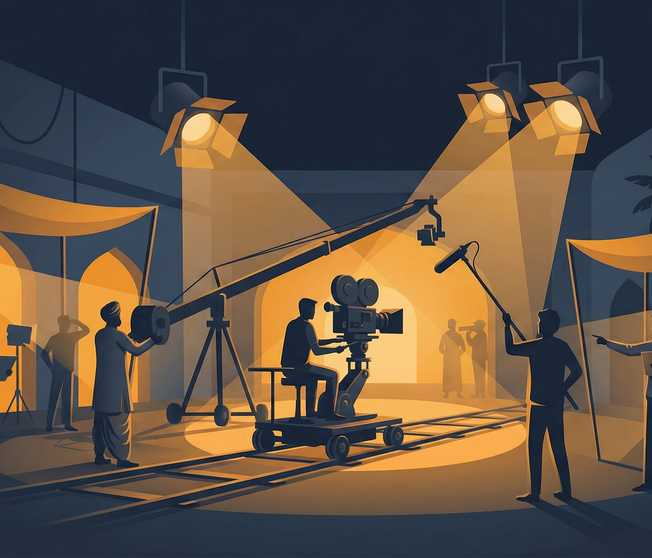
- Hero image — a DOP at work behind an ARRI camera on set. Alt text: "Cinematographer on film set in India working with ARRI camera"
- Career ladder infographic — the 4-rung hierarchy. Alt text: "Camera department career ladder India — from clapper loader to DOP"
- Film school logos/campus — FTII Pune. Alt text: "FTII Pune cinematography programme India"
- Salary table screenshot or designed card. Alt text: "DOP salary India progression from camera assistant to senior cinematographer"
- Reel screenshot (generic Vimeo UI). Alt text: "Cinematography showreel example for Indian DOP portfolio"
Featured snippet opportunity: The career ladder section (Clapper → Focus Puller → Camera Operator → DOP) is structured to pull into a Google featured snippet for "camera department hierarchy India" and related queries. Keep the H3 subheadings exactly as written.
Schema recommendation: Add FAQ schema for the following questions that appear naturally in the post:
- "What does a DOP do in India?"
- "How long does it take to become a DOP in India?"
- "What is the salary of a camera assistant in Bollywood?"
- "Which is the best film school for cinematography in India?"
Additional SEO tip: Add a target keyword cluster around "focus puller India salary" and "AC1 camera assistant Bollywood" — these are high-intent searches from readers who are already in the camera department and want to know their earning potential. The salary section covers this naturally.
Optimal publish time: Saturday morning IST, 9–10 AM — aligns with when film industry aspirants browse career content.
Word count: Approximately 2,900 words (body content, excluding SEO metadata block).
Related Blog Posts