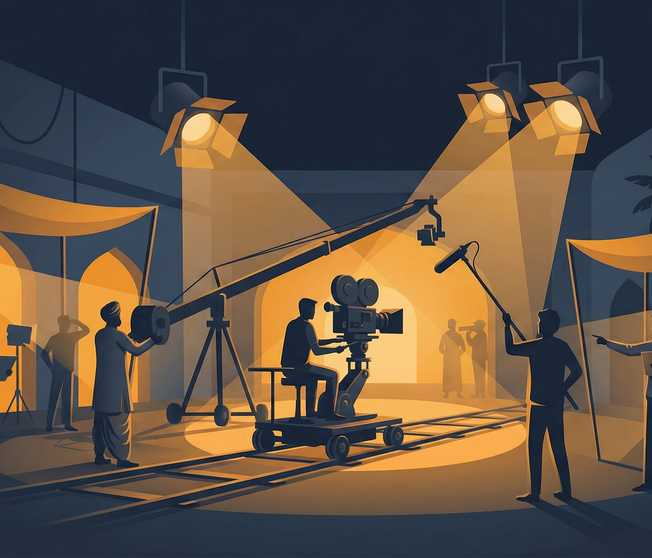
How to Become an Assistant Director in Bollywood: The Real Path Nobody Talks About
-

Lavkush Gupta
-
May 04, 2026
-
9
It's 2:14 AM on a Mumbai film set somewhere near Goregaon. The generator just threw a fault, the leading actor's vanity van has locked from the inside because the food was cold, and there are 200 background artists sitting in the dark who need to be on camera in forty minutes. The director is nowhere near any of this chaos.
You know who is?
The First AD.
If you've spent more than twenty minutes researching a career in filmmaking, you've heard the advice: "Start as an AD." What you probably haven't heard is what that actually means — what you'll do every single day, how little you'll earn for the first three or four years, what it costs your body, your relationships, and your twenties, and why — despite all of that — it remains the most direct path from nobody to director that Indian cinema has ever produced.
This is that conversation. Pull up a chair.
Why the AD Path Is Both the Most Common and the Most Misused
Ask any working director in Bollywood how they got there and roughly half will say some version of: "I assisted." The AD pipeline produced Rohit Shetty, Kabir Khan, Farah Khan, Raj Kumar Gupta, Anees Bazmee, and dozens of directors currently at the top of the industry. It is, without question, the most proven training ground Indian cinema has.
It is also grotesquely misunderstood.
Most people who enter it think "AD" means you're directing. You're not. For the first two to three years, you are logistics, crowd control, call sheet management, and ego mediation — all at the same time, often at 4 AM. The creative conversations you came for? They happen, eventually. But you earn them. And the timeline is longer than anyone on YouTube is going to tell you.
The AD path is not a shortcut. It is a slow-burn apprenticeship dressed up in a job title that sounds more glamorous than it is. The people who succeed at it aren't the most talented film enthusiasts. They are the most operationally disciplined humans in any given room.
The AD Ladder in India: What Each Rung Actually Looks Like
Indian film sets run on a strict rank structure. This is not a creative industry in the sense that everyone gets to contribute equally — it is a hierarchy, and that hierarchy is enforced. Here's what each level actually does.
4th AD / Production Assistant (PA)
Realistic timeline: 6–18 months. Possibly longer.
This is where you start. No exceptions. The title changes — some sets call it 4th AD, some call it PA, some call it "runner." The job is the same: you carry stuff, you relay messages, you manage the background artists queue, you make sure water bottles reach the right department heads, and you do not speak unless spoken to.
On any given day, a 4th AD might spend three hours counting background artists for a dance number, two hours standing at a crowd barrier so extras don't wander into shot, one hour running scripts between departments, and the remaining hours doing whatever the 3rd AD or 2nd AD tells them to do.
There is no creative input. There is no seat near the monitor. Your job is to make the floor run, and you do that by being invisible and efficient.
What you're actually learning: Set grammar. The language of a working set — what each department does, how instructions flow, what a "lock up" means, why you never stand in an eyeline, how a shot builds from blocking to final take. This invisible language takes six months minimum to absorb. The ones who absorb it fastest are the ones who advance.
3rd AD (Floor AD)
Realistic timeline: 1–2 years at this level.
The 3rd AD is the floor manager. You are the person who makes the physical set function. You manage the background — their positioning, their energy, their reactions, their continuity. You relay the director's instructions to the crowd. On a song set with 300 backup dancers and 150 background artists, you are the reason any of that looks coordinated on camera.
You also start managing extras logistics more formally: their entry and exit from set, their meal breaks, their costume changes, their sign-in sheets. You work directly under the 2nd AD and you are in constant communication with the director — not about story, but about readiness. "Are we ready on the floor?" That's your question.
What you're actually learning: Crisis management under Indian conditions. A Bollywood song set is organized chaos at industrial scale. Keeping 200 people calm, coordinated, and in position while directors change their minds and lighting takes three times longer than scheduled is a skill that no film school teaches. You learn it here or you don't learn it at all.
2nd AD
Realistic timeline: 2–3 years at this level.
This is where the real administrative weight lands. The 2nd AD owns the paperwork that makes a film shoot function. You prepare the daily call sheet — the single most important document on any shoot, listing every person, vehicle, prop, costume, and location required for each day's filming. A wrong call time in a call sheet doesn't just inconvenience people; it costs the production lakhs.
The 2nd AD manages the artist roster: who's on call, who's traveling, who needs to be prepped by hair and makeup, who has a costume change between scenes. You coordinate with the production office, the line producer, and the various department heads. You are the organizational backbone of the shoot.
You also start managing talent more directly — principal actors' schedules, their assistants, their onset requirements. This is where soft skills become as critical as operational skills. Actor ego management is not listed in any job description. It is a core 2nd AD competency.
What you're actually learning: Production infrastructure and stakeholder management. You now understand how a film gets made from a logistical standpoint end to end. You understand budget pressure, schedule pressure, and the art of keeping everyone aligned when both are going wrong simultaneously.
1st AD
Realistic timeline: 3–5 years before you're a 1st AD on a significant project.
The 1st AD is the director's right hand and the floor's commanding officer. You are the person who holds the schedule together when everything is falling apart — which, on an Indian film set, is most of the time.
Your job: convert the director's creative vision into a functioning daily schedule. You analyze the script, break it into scenes, assess the complexity of each (crowd size, stunts, VFX, location access), and construct a shooting schedule that is physically achievable. Then, during the shoot, you run the floor. You call the shots — not creatively, but operationally. "Rolling! Action! Cut!" That's your voice.
You manage the entire crew's energy and attention. You mediate between department heads when they have competing needs. You push back against directors who want to do twelve more takes of a scene that's already perfect when you have six more setups to cover before the golden hour light dies. You are simultaneously the director's advocate and the production's enforcer.
The best 1st ADs in Bollywood are treated as co-architects of the shoot. They earn that relationship over years of proving they can manage chaos without losing their heads.
Total timeline from PA to established 1st AD on big-budget films: 7 to 12 years. Anyone telling you it's faster is either extraordinarily lucky or not telling the truth.
The Money Reality: What Nobody Puts in Writing
Let's talk about what you will actually earn, because the industry's silence on this is partly what makes fresh entrants so vulnerable.
Phase 1: The Unpaid or Near-Unpaid Phase (6–18 months)
It exists. It is widespread. It is not legal under Indian labor law in any clean interpretation of the word — but the film industry has its own logic, and that logic is: you observe before you earn.
Most 4th ADs and PAs working on their first or second production in Mumbai earn somewhere between Rs. 0 and Rs. 500 per day. Some get meals and travel allowance only. Some get absolutely nothing and are expected to show up because the credit and the experience are the compensation.
How do people survive this phase? Almost universally, one of three ways: family support (the most common), a parallel income stream (freelance work, tutoring, content creation on the side), or extremely cheap shared accommodation in Andheri or Malad with three to five other people from the same film school batch who are all doing the same thing.
This is the phase that filters out the people who are testing the idea of filmmaking from the people who have decided it regardless of cost. It is brutal and it is real.
Phase 2: Floor AD Income (3rd AD level)
Rs. 500 – Rs. 2,000 per day, depending on the production scale. On a major Bollywood production with a large budget, a 3rd AD might earn Rs. 1,500 to Rs. 2,000 per shoot day. On smaller regional or independent productions, expect Rs. 500 to Rs. 800.
Work is project-based. Between projects, income is zero. This is the phase where financial planning begins to matter enormously.
Phase 3: 2nd AD Income
Rs. 2,500 – Rs. 8,000 per day on mainstream Bollywood productions. Annual income at this level, accounting for typical downtime between projects, lands roughly between Rs. 4 lakh and Rs. 12 lakh depending on how consistently you're working.
This is the level where, for the first time, a reasonably ambitious person can live in Mumbai independently without subsidy. Barely, in most cases. Comfortably, only if they're working consistently.
Phase 4: 1st AD Income
Rs. 15,000 – Rs. 1,00,000+ per day on major productions. A working 1st AD on a mid-budget Bollywood film might take home Rs. 20,000 to Rs. 35,000 per shoot day. On a YRF or Dharma-scale production, established 1st ADs earn Rs. 50,000 to Rs. 1,00,000 per day. OTT productions — particularly international co-productions and web series — have pushed these rates higher.
A consistent 1st AD working back-to-back projects can earn Rs. 30 lakh to Rs. 80 lakh per year. The best in the business earn significantly more.
When can you expect consistent income? Realistically, at the 2nd AD level — which means year three or four at the earliest, if your trajectory is clean. For most people, it's year five.
What Actually Makes a Great AD in Indian Conditions
Being a great AD in Bollywood specifically is different from being a great AD anywhere else in the world. Here's what the Indian film industry demands that you will not find in any international AD manual.
Crisis management under chaos. Indian sets run hot. Schedules slip, stars arrive two hours late, locations fall through, it rains on the outdoor shoot day. The great ADs don't try to prevent chaos — they've accepted it as baseline. They build buffer, they pre-solve problems, and when things break anyway, they adapt in real time without the crew seeing them sweat.
Managing 200-person crowds on song sets. Bollywood song productions are some of the most logistically complex shoots in world cinema. Hundreds of background dancers, costume continuity across three-day shoots, choreographer direction flowing simultaneously through the floor, lighting resets between takes — the AD who can manage this without losing the energy of the crowd is worth their weight in gold.
Principal actor ego management. No film school will teach you this. Indian stars — particularly the A-listers — travel with entourages, have specific onset protocols, and operate on a social hierarchy that the AD must navigate without ever making the actor feel managed. The best ADs build genuine rapport with leading actors. They understand that a calm, respected actor gives better performances, and that a resentful one creates delays that cost the production crores.
Multi-lingual communication. On a typical Mumbai set, you might be giving directions in Hindi to background artists, English to the American DOP, Bhojpuri to the spot boys, Tamil to the second unit crew, and Marathi to the local location manager — all within the same hour. The ADs who are multilingual have a structural advantage that compounds over time.
The 1st AD to Director Pipeline: How It Actually Works
Rohit Shetty assisted Kuku Kohli. Kabir Khan assisted Vidhu Vinod Chopra and then worked as a documentary filmmaker for years before his debut. Farah Khan was a choreographer before she directed, but her on-set experience mirrors the AD pipeline in many ways. Raj Kumar Gupta, director of Aamir and No One Killed Jessica, came through the AD ranks.
The pipeline works like this: you spend years as a 1st AD, developing a relationship with a director whose work you respect. You watch how stories get constructed on the floor. You start developing your own material — scripts, story ideas — in whatever time you can steal. You build a reputation as someone producers trust to run a complex set. And then, when the moment arrives, you already have the infrastructure credibility that allows a producer to say: "Yes, I'll bet on you. I've seen how you work."
The AD path does not automatically produce directors. What it produces is the skill set that gives you a fighting chance when you finally make the ask. The narrative instinct — what makes a story worth telling — you have to develop separately, in parallel, on your own time.
AD vs Production Manager: The Distinction That Matters
These roles are frequently confused by people outside the industry. They are genuinely different career tracks.
The Production Manager (PM) works for the production company. They manage budget, logistics, contracts, vendor payments, location permissions, and the administrative machinery of the entire production. Their loyalty is to the line producer and ultimately to the studio. They rarely have creative ambitions.
The Assistant Director works for the director. Their job is to make the director's vision physically realizable on a daily basis. They manage crew, floor, talent, and schedule — but always in service of the creative output. Many ADs have deep directorial aspirations.
Both roles are critical. They intersect constantly. But if you want to direct, the AD path is yours. If you want to run productions operationally and have no particular interest in creative authorship, the PM track is cleaner and often more financially stable earlier.
The Physical and Mental Toll: What Nobody Calculates in Advance
A Bollywood feature shoot runs 60 to 120 shoot days, typically six days a week. Days start before sunrise for most departments and end when the director says they're done — which often means 10 PM, 11 PM, or 2 AM. The AD is always the first on set and always the last to leave.
That is a 16–18 hour day, six days a week, for months.
The physical effects compound. Chronic sleep deprivation, poor nutrition (set food is functional, not healthy), minimal exercise, and zero routine. The mental effects are harder to quantify but just as real: the pressure of holding an entire production's schedule in your head, managing interpersonal conflicts on the floor, absorbing frustration from directors and stars while projecting calm to your crew.
Relationships suffer. There is no way to be present for a partner, family, or close friendships when you are unreachable for months at a time and arrive home too exhausted to speak. The film industry has some of the highest rates of relationship breakdown and social isolation of any creative profession in India. The people who manage this long-term are not superhuman — they are deliberate. They protect the relationships that matter with the same intentionality they bring to a shot breakdown.
Shoots fall on Diwali, Eid, Christmas, Holi, and every other occasion that means something to the people who love you. There is no holiday shoot premium in the AD world. You are there because the schedule says you are there.
This is not written to discourage. It is written because knowing the cost in advance lets you make a real decision, not a romanticized one.
Why 90% Quit by Year Two — And What the 10% Do Differently
The attrition rate in the early AD years is not a secret. Every established 1st AD you talk to will tell you they came up with fifteen other people who are no longer in the industry. By year two, the financial pressure, the personal cost, and the gap between expectations and reality creates a breaking point for most.
The ones who don't quit are not necessarily more talented. But they share a few patterns.
They detach from the timeline. The people who burn out fastest are the ones measuring themselves against where they thought they'd be. The 10% accept that the timeline is what it is and focus on the quality of work inside each project rather than the speed of ascent.
They build institutional memory. Every production is a chance to learn how a specific director thinks, how a specific studio operates, how a specific genre gets constructed. The ones who survive treat this as a database they're building, not time they're serving.
They find a mentor before a title. The AD world runs on relationships. A 1st AD who vouches for you, brings you along across multiple productions, and shows you how they think is worth more than any film school certificate. The people who find this relationship early are the ones who make it.
They stay out of the politics. Indian film sets have more political dynamics than most workplaces — senior crew protecting territory, rivalries between departments, favoritism, nepotism. The 10% learn to navigate without participating. They are professional, neutral, and relentlessly competent. That reputation compounds.
They never stop writing. If directing is the goal, the 10% are writing in whatever gaps exist. On the bus to set. On Sundays. Between projects. The AD path gives you deep production knowledge but no time to develop your creative voice unless you actively protect that time.
How to Get Your First AD Opportunity
The honest answer: through somebody who already has one.
The film industry is a network industry. Your first AD opportunity will almost certainly come through a connection — a film school batchmate, a senior who knows your work ethic, a production company that's been recommended your name. Cold applications to production houses are rarely the path in.
That said, here's what actually works for people without existing industry connections:
Film school matters less than most people think, but the network it gives you matters enormously. FTII Pune, Whistling Woods, Symbiosis Film School, and a handful of others put you in rooms with people who become your early network. The education is secondary; the relationships are the product.
Production house assistantships are the cleaner cold entry. Some production companies — particularly OTT production partners and regional studios — run structured PA programs. These are more accessible than cold-walking onto a Dharma set and infinitely more legible than the unstructured freelance approach.
Social media presence around set knowledge gets noticed. This sounds counterintuitive, but ADs and directors do look at people who post substantive content about set craft. Not behind-the-scenes fluff — actual knowledge about scheduling, breakdown methodology, shot design. It signals that you're serious.
Put yourself on searchable platforms. Productions now actively list AD crew calls online. Being discoverable — with a clear profile, an honest credit list, and references — means opportunities can find you rather than requiring you to cold-pitch every time.
Find Your First AD Crew Call on AIO Cine
This is where the path moves from reading to doing.
AIO Cine is India's verified film industry job board, built specifically for crew — including AD positions across Bollywood, OTT, regional cinema, and commercial productions. Every production house on the platform is verified before they can post. No fake casting calls, no deposit scams, no "pay for a portfolio shoot" bait. Just real productions looking for real crew.
If you're at the PA or 3rd AD stage, search for floor AD and production assistant listings across Mumbai, Hyderabad, and Chennai. If you're at the 2nd AD stage, look for 1st AD team openings on mid-scale productions — that's where the next step usually comes from.
Register free at aiocine.com. Build your profile with your credits, the sets you've worked on, and the names of senior crew who can vouch for your work ethic. Because the production company running its next search will look at that profile before they call you.
The path is long. The work is real. The opportunities — for the people who show up prepared — are there.
The film industry doesn't owe you a career. But it does reward the people who learn its language, pay their dues without bitterness, and stay long enough to matter. The AD path is still the most honest route to the chair. Now you know what the chair actually costs.
SEO Notes:
- Internal links to suggest: Link "film crew day rates India" to the existing day rates blog post; link any mention of "film industry jobs" or "crew calls" to relevant AIO Cine search results pages; link "FWICE membership" reference (if added) to the FWICE guide post.
- External links to suggest: FTII Pune official site (for film school section); FWICE official site (for union/membership credibility); Wikipedia or verified source for Rohit Shetty / Kabir Khan filmographies (for the director pipeline section).
- Image suggestions:
- Hero image: Behind-the-scenes shot of an AD with a headset and clipboard on a busy Indian set. Alt text: "Assistant director on a Bollywood film set managing the floor crew" - Inline image after the AD ladder section: A simple infographic showing the 4-step AD hierarchy with titles and timelines. Alt text: "Bollywood AD career ladder from production assistant to first assistant director" - Inline image near the salary section: A rate table visual (can mirror the data in the post). Alt text: "AD salary range in Bollywood by rank — from 4th AD to 1st AD per day rates"
- Featured snippet opportunity: The "AD vs Production Manager" section is formatted cleanly enough to pull into a Google snippet for the query "what is the difference between AD and production manager in film."
- Schema recommendation: Add FAQ schema to questions implied in the headings — "How long does it take to become a 1st AD in Bollywood?", "What does an assistant director do in Indian films?", "How much does an AD earn in Bollywood?" — these are high-search-volume long-tail queries.
- Meta title suggestion (under 60 chars): How to Become an AD in Bollywood: The Honest Guide
- Word count: ~2,900 words
Related Blog Posts