Indian Cinema Year in Review: Trends That Shape Film Industry Careers
-

Lavkush Gupta
-
May 04, 2026
-
9
Every December, two kinds of film industry professionals exist in India.
The first kind scrolls through year-end listicles — "Top 10 Blockbusters!" "Biggest Flops!" — nods along, and goes back to hustling the same way they always have.
The second kind reads the same numbers and asks a completely different question: what does this mean for what I do next?
We built AIO Cine because we've always been in the second camp. We've watched careers stall not from lack of talent but from lack of context — professionals who were grinding hard in a direction the industry had already quietly turned away from. This post is our attempt to hand you the map.
Use it every year. Update it every year. The specific numbers will change. The framework will not.
How to Use This Review
This isn't a one-time read. It's a template. Every year, before you set your career goals for the next twelve months, work through each section below with the current year's data in mind. Some trends will confirm what you already sensed. Others will blindside you. Both are valuable.
We'll use recent patterns in Indian cinema as examples throughout — but the analytical questions are the ones you should carry forward permanently.
Box Office Performance: Reading the Numbers Behind the Numbers
The annual box office report is always framed as a drama — hero films, villain flops, shock comebacks. Ignore the drama. Look at the structure.
The question to ask: Which budget segments are actually profitable?
In recent years, Indian cinema has produced a fascinating bifurcation. At the very top — Rs. 100 crore+ productions with pan-Indian release strategies — certain films have delivered extraordinary returns. At the mid-budget Rs. 20-60 crore range, the story is messier. These films carry significant production costs but compete against both the big spectacles and the lean, hungry streaming originals.
What this tells you is where production investment is actually flowing. When big-budget films dominate the profitable tier, production houses shift more capital upward — meaning more department-head roles on large productions, more VFX, more elaborate art direction, more logistics crew. When mid-budget films struggle, that entire tier starts producing less. Crew who've built careers in mid-budget Hindi cinema need to be paying attention to where the next tier of opportunity is forming.
What this means for your career: Before you chase any production opportunity, look at who's financing it and at what scale. A production house that primarily operates in a bracket under financial stress is not the place to build long-term stability right now. Follow the capital.
Genre Dominance: The Industry is Telling You What It Wants to Make
Every year has a genre story. Action-thriller. Mass entertainer. Pan-Indian mythology. Content-driven drama. Horror. Comedy revival.
The mistake most professionals make is treating genre trends as entertainment gossip. They're not. They're hiring signals.
The recent pattern worth noting: Action and mythological epics have commanded enormous resources — and therefore enormous crew rosters — while intimate drama has migrated predominantly to OTT. This isn't a temporary blip. It's a structural shift in what theatrical audiences are willing to leave their homes for.
For actors: If theatrical is where you want to build your career, the physicality requirement has gone up. Action training, movement work, and the ability to sustain energy across long shooting days on large-scale sets is increasingly non-negotiable. The "intense drama" lane remains robust — but largely on streaming.
For crew: Genre affects department size. A mythological epic has an art department three times the size of a content drama. A large-scale action film needs stunt coordinators, VFX supervisors, and drone operators in numbers that smaller films simply don't. Align your specialisation with the genres that are actually getting greenlit at scale.
Regional Cinema: The Most Underreported Career Story of the Decade
If you're still thinking about "Bollywood" as the centre of gravity for Indian cinema careers, you are operating with an outdated map.
Telugu, Tamil, Malayalam, and Kannada cinema have collectively reshaped the industry's geography in ways that are still not fully absorbed by professionals from Hindi cinema backgrounds. A Telugu production house today may be managing budgets that rival major Hindi productions from five years ago. Malayalam cinema consistently punches above its budget weight on quality and OTT returns. Tamil cinema maintains a vast infrastructure of studios, post-production facilities, and trained crew.
What the regional shift means practically:
- Hyderabad has become a genuine production hub with world-class studio infrastructure. RK Studios replacement at the national level has, in many ways, happened in Hyderabad first.
- Chennai retains deep craft traditions in music, sound design, and certain technical departments that Hindi cinema still draws from.
- Kochi is emerging as an interesting base for content-driven productions, particularly for OTT.
- Pune and Pune-adjacent locations are quietly growing as alternative shooting destinations for Hindi productions priced out of Mumbai.
The career opportunity most people are missing: If you have a skill that's genuinely portable — sound design, editing, VFX, line production, specific craft skills — and you've only ever worked in one language industry, you are leaving significant work on the table. Productions are actively seeking crew who can work across language industries. The pay arbitrage is real, and the experience diversification is invaluable.
OTT vs Theatrical: Stop Picking Sides
The "OTT killed theatres" take is tired. So is "theatrical is back." The reality is more interesting and more useful.
Theatrical and streaming have differentiated into distinct content ecosystems with distinct production requirements. Theatrical demands spectacle, scale, and the communal experience. Streaming demands intimacy, character depth, and the kind of storytelling that works on a 6-inch screen at 11 PM.
The production volume reality: In terms of sheer number of productions, OTT has massively expanded the total output of the Indian film and series industry. More productions mean more jobs — but not evenly distributed. The individual budgets per OTT project are often smaller than theatrical. The volume compensates, but it means shorter shooting schedules, tighter departments, and a premium on professionals who can work efficiently.
For your career planning: Don't position yourself as exclusively theatrical or exclusively OTT. Position yourself as excellent at what you do — and understand the different rhythms of each. Theatrical crew relationships are built over long shoots. OTT relationships are built over many shorter engagements. Both are worth cultivating. Neither is going away.
The area to watch: Theatrical exclusivity windows, platform acquisition strategies, and hybrid release models are still in flux. The professionals who understand both ecosystems will navigate the next few years better than those who've only inhabited one.
Production Volume Changes: When More Is Made, Someone Has to Make It
Total production volume is one of the most direct signals of aggregate crew demand, and it's consistently underanalysed.
When production volume rises, the industry faces a talent supply problem. There simply aren't enough trained, experienced professionals to fill every department on every production simultaneously. This is the moment when mid-level crew get elevated to senior roles ahead of schedule, when newcomers get their first substantive credits, and when the value of a strong reputation and an active professional network compounds fastest.
When volume contracts — which happens during economic uncertainty, a post-pandemic correction, or a strike — the industry becomes more conservative and more relationship-driven. Studios and production companies consolidate around trusted crew.
The annual review question: Is production volume in your primary industry (Hindi, Telugu, Tamil, etc.) expanding, contracting, or plateauing? And is the expansion or contraction happening at the budget level where you work?
These two data points — volume and budget distribution — tell you more about your near-term career prospects than any amount of networking advice.
Crew Demand Patterns and Salary Direction
Here's something we hear often at AIO Cine from production managers who use our platform: certain specialisations are chronically undersupplied.
VFX — specifically compositing and environment work — has been undersupplied relative to demand for several years running. Production design, particularly Art Directors who can work at scale on large sets, is another persistent gap. Sound recordists with experience on multilingual productions are actively sought. Digital Imaging Technicians remain rare relative to the number of productions that need them.
Salary direction as a signal: When a specialisation is undersupplied, day rates rise — sometimes dramatically and quickly. When a specialisation is oversupplied (background dance, junior scripting, certain PA roles), rates stagnate or decline in real terms even as nominal figures hold.
How to track this yourself: Pay attention to how quickly crew calls in your area of expertise get filled on platforms like AIO Cine. If crew calls in your specialisation are getting filled in under 48 hours, you're in a demand-heavy market. If they're sitting open for a week, supply may be outpacing demand in that niche.
The salary trend to understand: Production cost inflation — equipment costs, location costs, labour costs in high-demand cities — has been pushing productions toward leaner crews who can do more across department lines. This rewards versatility, but it also means that niche specialists need to make a stronger case for their value than they did five years ago.
Technology Adoption: The Skills the Industry Is Willing to Pay a Premium For
Three technology shifts are reshaping crew hiring right now, and each one represents a career opportunity if you move early.
Virtual production and LED volume work is no longer experimental in Indian cinema. It's operational. Studios with LED volume infrastructure exist in Hyderabad and Mumbai. The crew requirements are specific and unusual — you need DoPs who understand how to light for a volume environment, Art Directors who can prepare digital assets, and Technical Directors who bridge physical production and real-time rendering. This skillset barely existed in India five years ago. It is genuinely undersupplied today.
AI-assisted production tools are entering the workflow at the pre-production and post-production ends. Script breakdown tools, virtual scouting, AI-assisted colour grading, and generative tools for concept visualisation are being adopted by forward-thinking production houses. You don't need to be a developer to benefit from this shift — you need to be conversant enough with these tools to use them faster than the crew member who isn't.
Drone cinematography has matured from a novelty into a standard production tool. The differentiator has moved from "can you fly a drone" to "can you design a drone shot that serves the story, execute it safely within DGCA regulations, and deliver footage that integrates seamlessly with the rest of the DP's visual grammar." The technical barrier has lowered. The craft barrier remains high. That's where you build your advantage.
Our recommendation: Pick one technology shift that's adjacent to your existing work. Learn it properly — not just enough to claim it on a resume, but enough that you can genuinely add value on set. That's the investment that pays off in the next twelve months.
International Co-Productions and the Festival Circuit
Indian cinema's international ambitions have grown beyond individual superstar crossovers. Co-productions with European partners, UK production houses, and increasingly with East Asian studios are creating new infrastructure and new crew requirements.
The festival circuit — MAMI, IFFI, Busan, Cannes, Tribeca, Sundance — continues to serve as a credibility accelerator for emerging Indian filmmakers and a platform for international co-production deals. What's less discussed is what this means for crew: internationally co-produced films often bring international technical crew alongside Indian crew, and the resulting knowledge exchange is genuinely valuable for those who participate in it.
For your career: If you have any appetite for international work, the co-production route is more accessible than trying to break directly into Hollywood. A project with Indian lead producers and a European co-producer gives you an international credit without requiring you to relocate or navigate an entirely foreign industry structure.
The festival strategy for emerging professionals: Submitting short films or independent projects to international festivals is no longer just an artistic exercise — it's a career signal that travels. A Sundance selection or a BAFTA nomination creates a resume line that production companies in Mumbai understand, even if they've never attended those festivals themselves.
New Talent Breakouts: What They're Actually Doing Differently
Every year produces a handful of genuine breakthrough stories. An actor from a regional industry who crosses over. A debut director who announces themselves with a film that punches far above its budget. A DP whose work on a mid-budget OTT film gets talked about by the whole industry.
These stories matter not because of the individuals — though we should celebrate them — but because of the patterns they reveal.
The common thread in recent breakouts: They almost universally had a portfolio of smaller work that demonstrated their capabilities before the big opportunity arrived. They didn't emerge from nowhere — they emerged into visibility from years of work that was partially visible if you knew where to look.
What this means for you: Your "breakout moment" doesn't exist in isolation. It's preceded by a body of work that makes the right people comfortable enough to take a chance on you. Are you building that body of work? Is it findable? Does it demonstrate the specific thing you want your next opportunity to be about?
Industry Policy and Union Developments
The regulatory and organisational landscape of Indian cinema shifts slowly — but it does shift, and the shifts have real career consequences.
FWICE member union agreements, guild negotiations, and government policy on entertainment taxation all affect the conditions under which you'll work. The Maharashtra government's periodic interventions around shooting permissions, the DGCA's evolving drone regulations, and the Ministry of Information and Broadcasting's content certification processes are all worth monitoring if your work is affected by them.
What most professionals miss: Union affiliation and guild membership create a floor for your working conditions and a ceiling on the exploitation you're legally exposed to. If you're working consistently in the industry and haven't formalised your union relationship, you're accepting unnecessary risk. See our FWICE membership guide for the practical steps.
What Flopped, and Why It Matters More Than the Hits
The year's flops are always more instructive than its successes.
Box office failures generally cluster around a handful of causes: a mismatch between the film's aspirations and its execution quality, release timing errors, marketing that misread the audience, or a genuine content problem. Understanding which cause applied in which case tells you something about where the industry's judgment failed — and where your own judgment should be applied more carefully.
The pattern worth watching: When multiple high-profile productions fail in the same genre in the same year, production investment in that genre contracts sharply the following year. This affects which productions get greenlit, which scripts get developed, and which crew specialisations are in demand.
The hard question to ask yourself: Are any of your career bets concentrated in a genre or format that the market just punished? If so, is your confidence in that bet based on evidence, or on the sunk cost of the skills you've already invested in?
Emerging Career Opportunities for Next Year
Every industry review should end here: with an honest, specific list of where the new work is forming.
Based on persistent structural patterns in Indian cinema, these are the opportunity areas that tend to grow year-on-year regardless of which specific films succeed or fail:
Post-production and VFX: Indian productions are spending more on post than ever before, and the trained workforce hasn't kept pace. This is a multi-year opportunity.
Content development and script development: OTT platforms are commissioning at volume and need development executives, script readers, and writers' room participants. This role barely existed in Indian cinema five years ago.
Production finance and co-production structuring: As Indian films seek international funding, the professionals who understand both Indian and international deal structures are increasingly valuable.
Regional language content: Malayalam, Marathi, and Punjabi cinema are all in productive phases. If you can work in these industries, the competition for crew roles is lower than in Hindi or Telugu.
Technical training and on-set mentorship: As production volume rises, experienced professionals who can train the next tier of crew are genuinely needed. This is a career path that most people don't consider until they're already senior — consider it earlier.
Your Personal Annual Career Review: A Framework
The industry review is only useful if you apply it to yourself. Here's how to do that honestly.
Step 1 — Audit your year. List every project you worked on. What was the budget range? What was your role? What did you learn? What did you wish you'd done differently?
Step 2 — Map your trajectory. Are your credits moving upward in terms of budget, responsibility, and visibility? Or are you working at the same level you were two years ago? Neither answer is automatically wrong — but you should know which is true.
Step 3 — Identify your skill gap. Based on the industry trends above, what's one skill you don't currently have that would meaningfully improve your position next year? Not three. One. The one that would move the needle most.
Step 4 — Assess your network. The Indian film industry still runs on relationships. Who in your network has grown in the past year? Who is working on the kinds of productions you want to work on next year? Are you genuinely in touch with them, or just connected on Instagram?
Step 5 — Set one specific goal. Not "work on bigger projects." Not "get better at my craft." One specific, measurable thing: a particular type of role, a particular industry segment, a particular skill to develop, or a particular relationship to build.
The Year Ahead: What We're Watching
We'll be honest about what we don't know. No one accurately predicted the specific films that would dominate the box office this year — and anyone who claims certainty about next year is selling you something.
What we can say with reasonable confidence:
The total volume of Indian content production is likely to remain high or grow. The premium on verified, reliable crew will increase as production companies try to manage risk on larger budgets. Regional cinema will continue to punch into national consciousness. OTT will continue to expand. Technology will continue to create new specialisations faster than the industry can train people for them.
And the professionals who will win in that environment? They'll be the ones who did the review — who asked hard questions of the industry and harder questions of themselves — and set specific, evidence-based goals for the year ahead.
Find Your Next Opportunity Where the Industry Can Find You
We built AIO Cine because we knew that talent alone was never the problem. The problem was connection — specifically, the lack of a verified, trustworthy place where production houses and film professionals could find each other without the noise, the exploitation, and the fake listings that have plagued this industry for decades.
Register on AIO Cine where every production house is verified before they can post crew calls — because your career deserves a foundation built on legitimate opportunity, not one that might vanish when the wire transfer bounces.
The industry is moving. Make sure you're moving with it.
Published by AIO Cine Productions | aiocine.com — India's verified film industry job board and talent marketplace
SEO Notes
Primary keyword: "Indian cinema industry review" — used in title, H2s, opening paragraphs, and conclusion. Density is natural.
Secondary keywords:
- "Bollywood year review" — integrated in genre and box office sections
- "film industry trends India" — woven through OTT, regional, and technology sections
- "Indian film career opportunities" — anchors the emerging opportunities section
- "OTT vs theatrical India" — section heading and body copy
Internal link suggestions:
- Link "FWICE membership guide" anchor to
/blog/fwice-membership-card-guide-2026 - Link "fake casting calls" reference (if added) to
/blog/fake-casting-calls-india-field-guide - Link "AIO Cine" CTA to
/register - Link "drone cinematography career" section reference to
/blog/drone-cinematography-career-india - Link "virtual production" reference to
/blog/virtual-production-led-volume-india - Link "film industry salary guide" reference (salary section) to
/blog/film-industry-salary-guide-india-2026
Image suggestions:
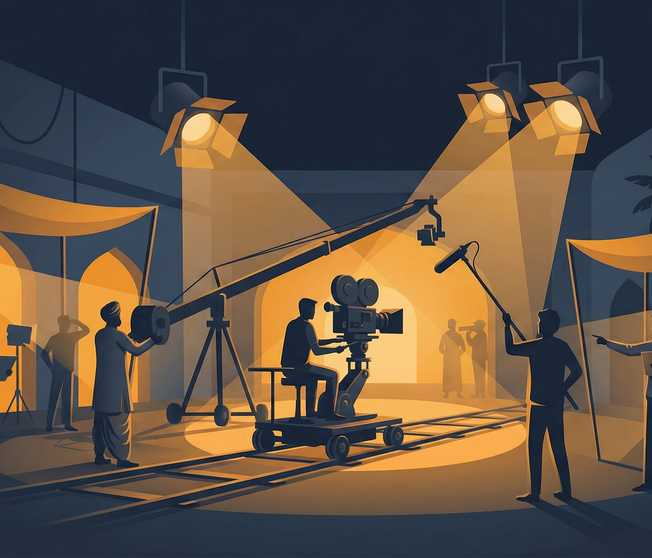
- Hero image: Indian film set wide shot (production in progress) | Alt: "Indian cinema production set showcasing 2025 industry trends"
- Box office chart or infographic | Alt: "Indian box office performance trends by genre"
- Regional cinema map of India | Alt: "Regional Indian cinema industry hubs — Hyderabad, Chennai, Mumbai, Kochi"
- Technology on set (LED volume or drone) | Alt: "Virtual production LED volume technology on Indian film set"
Featured snippet opportunity: The "Your Personal Annual Career Review: A Framework" section (Steps 1-5) is structured for Google to pull as a featured snippet for queries like "how to do a film industry career review" or "film career planning framework India."
Content length: ~2,800 words — within the 2,500-3,000 word brief and competitive for long-tail informational queries in the Indian film industry niche.
Publishing recommendation: Publish in early January for maximum relevance. Update the specific year references in the title and meta description annually to maintain freshness signals. The body content is intentionally written as a durable framework — no specific years are mentioned in the body, only "recent" and "current" — so the post ages well and can be updated with minimal effort each year.
Related Blog Posts