Indian Film Industry Glossary: 200 Terms Every Film Pro Must Know
-

Lavkush Gupta
-
May 04, 2026
-
12
Walk onto any Indian film set without knowing the language and you will spend half your day looking confused while everyone else moves at 100 kilometres per hour. The AD calls for a "pack up." Someone yells "playback chalao!" A spot boy sprints past with a bouncer. The DIT is hunched over a monitor whispering about LUTs. The gaffer is arguing about HMI placement. And you are standing there, nodding, understanding absolutely nothing.
We built AIO Cine because we watched too many genuinely talented newcomers waste their first year in the industry burning through anxiety that a good glossary could have eliminated. No film school covers this vocabulary completely. No YouTube tutorial explains what "wild track" means in the context of a real shoot. And on a working set, nobody has time to be your dictionary.
So here it is. Two hundred terms, organized by department, written the way a senior who actually likes you would explain them. Not textbook definitions. Practical ones.
Bookmark this page. Screenshot the sections relevant to your department. Send it to the batch-mate who just got their first floor job and looks perpetually terrified.
Why Vocabulary Is a Professional Signal
Knowing set language is not a trivia game. It is competence made visible. When you respond correctly to "reset for another take" without asking what "reset" means, you telegraph that you belong. When you hand the right reflector because you know the difference between a bounce and a flag, you earn trust. In an industry where first impressions are made in the first hour of your first day, speaking the language is the fastest way to be taken seriously.
Indian film sets also run on a uniquely blended vocabulary — English technical terms, Hindi slang, colonial-era film industry lingo passed down across generations, and regional words that have crossed industry borders. No single source captures all of it. This one tries.
Section 1: Production
The language of logistics. Without these terms, you cannot follow a conversation in the production office, understand a call sheet, or know what anyone is asking you to do.
Call Sheet — The daily document issued by the production office (usually the night before) listing every person required on set, their individual call times, the scenes being shot that day, location details, and special requirements. If your name is not on the call sheet, you are not needed. If it is, be there fifteen minutes before your listed time.
Call Time — The specific time you are expected to be at your station, ready to work. Not the time you leave home. Not the time you walk through the gate. The time you are at your position with everything you need.
Wrap — The official end of shooting, either for the day (day wrap) or for the entire film (picture wrap or final wrap). "It's a wrap" is among the most emotional sentences a film unit ever hears together.
Pack Up — The Indian set's everyday equivalent of wrap for the day's specific location or session. When the AD calls "pack up," every department begins dismantling, cabling, and loading vehicles simultaneously. Move fast or become the bottleneck that delays 200 people.
Outdoor — Any shoot location outside a studio — a real street, building, field, beach, or mountain. "Going outdoor" means the unit is traveling to a practical location and all the associated logistics that involves.
Indoor — Studio shooting on a constructed set inside a sound stage. Controlled environment, immune to weather, but expensive to build. Most song sequences and large interior scenes in Bollywood shoot indoor.
Schedule — The master plan for the entire production: which scenes shoot on which days, at which locations, in what order. Built by the line producer and enforced by the first AD. A schedule is a living document that changes constantly and never quite holds.
Recce — Short for reconnaissance. A location scouting visit where the director, DOP, production designer, and key department heads visit a potential shoot site before the schedule to assess it: sunlight, power access, crowd control, acoustics, and logistical feasibility. A good recce saves days of problems later.
Look Test — A pre-production session where the costume, hair, and makeup assembled on an actor are photographed or filmed so the director and DOP can approve the total visual package before principal photography begins. Different from a screen test, which tests performance.
Script Breakdown — A systematic scene-by-scene analysis of the screenplay listing every element required: cast, locations, props, costumes, stunts, animals, vehicles, and special effects. The breakdown sheet is how every department builds its budget and understands its workload.
Production Report — A daily document compiled at the end of each shoot day recording what was accomplished: scenes shot, pages completed, hours worked, problems flagged, and daily costs. The paper trail of the entire production.
Unit — The collective term for everyone working on a production — cast and crew together. "The unit moves to Rajasthan next week" means every department travels. A "second unit" shoots supplementary material (stunts, inserts, establishing shots) separately from the main cast and director.
Shift — A working day on set. Indian productions officially work 8-10 hour shifts. In practice, 12 to 16 hours is common. A double shift means two consecutive shifts with minimal rest. It is as brutal as it sounds.
Pre-Production — The phase before cameras roll: script development, casting, location scouting, scheduling, set construction, and budgeting. The phase where a film is won or lost before anyone switches a camera on.
Principal Photography — The main shooting period. When someone says "the film is in production," they mean it is in principal photography.
Post-Production — Everything after the final take: editing, sound design, music, VFX, color grading, and delivery. Where the story gets its final shape.
Section 2: Camera
The visual language. Know these terms before you set foot near a camera department.
Setup — One specific camera position with a defined lens, framing, and lighting configuration. Every time the camera moves to a new position or the lens changes, it is a new setup. The number of setups completed in a day tells you how efficient — or how painful — that day was.
Take — A single recorded attempt at a setup. Take 1 is the first try. Take 23 is where you begin quietly questioning life choices. Each take runs from "action" to "cut."
Angle — The direction from which the camera sees the scene. Low angle, high angle, eye level, Dutch angle (tilted for unease) — every choice carries emotional and psychological meaning. Angle is a directorial decision dressed up as a technical one.
Track — A camera movement along rails (literally a metal track) laid on the floor, enabling smooth, controlled lateral or forward-backward movement. "Let's put a track on this" means a railway system is being built for the shot.
Jib — A counterbalanced camera arm that allows vertical sweeping movements without a full crane — used for high-to-low or low-to-high arcs, particularly common in song sequences.
Steadicam — A body-mounted camera stabilization rig worn by the operator that produces smooth, fluid movement through space. The signature look of complex corridor sequences, long pursuit shots, and intricate action choreography.
Magic Hour — The 20-40 minute window immediately after sunrise or just before sunset when natural light is warm, golden, and cinematically extraordinary. DOPs plan their most visually ambitious shots around it. Wasting magic hour with a slow setup is a serious offense.
DIT (Digital Imaging Technician) — On digital productions, the DIT manages all footage: offloading from cards, making multiple backups, maintaining quality control, and applying on-set LUTs (color preview looks) so the director and DOP can see an approximation of the final graded image. The guardian of everything shot that day.
DOP (Director of Photography) — The head of both the camera and lighting departments. The person who translates the director's visual intent into actual images. Also called the cinematographer. The DOP's eye is the audience's eye.
Focus Puller (First AC) — The first assistant camera operator. Their job is to keep the lens focused on the subject throughout every take, adjusting manually or by remote as actors move. An invisible art when done correctly; catastrophic when missed.
Clapper / Second AC — Operates the clapperboard, manages camera media (cards or magazines), and maintains the camera report. The clapperboard sync is the foundation on which the editor builds the cut.
Clapperboard (Slate) — The iconic hinged board marked with scene, take, roll, camera, and date information. The "clap" at the start of a take creates a visible and audible sync point that the editor matches in post. The most recognized symbol of filmmaking for a reason.
Prime Lens — A fixed focal length lens (35mm, 50mm, 85mm, etc.). No zoom capability. Produces sharper, faster images than zoom lenses and forces intentional framing decisions. Preferred by most DOPs for narrative shooting.
Zoom Lens — A variable focal length lens. Flexible and quick to adjust without moving the camera. Common in documentary and run-and-gun production; used more selectively on premium narrative projects.
LUT (Look-Up Table) — A color transformation matrix applied to footage either on set (for preview) or in post (for final grading). When the DIT shows the director what the film "will look like," you are seeing it through a LUT.
Coverage — The full set of camera angles and shots captured for a scene beyond the master shot: close-ups, medium shots, over-the-shoulder angles, reaction shots. Coverage gives the editor choices. Insufficient coverage is the editor's nightmare.
Golden Hour — See Magic Hour. Used interchangeably in professional contexts.
Section 3: Sound
Sound is half of what the audience feels, and the half most newcomers underestimate until it is too late.
Sync Sound — Audio recorded live on set simultaneously with picture. The clapperboard provides the synchronization point. Sync sound production is more demanding — every plane, every vehicle, every bird call is a problem — but delivers a naturalism that post-dubbed dialogue cannot replicate. South Indian productions and OTT content increasingly require sync sound.
Playback — Pre-recorded audio played on set during the filming of a song sequence so performers can lip-sync and dance to the final track. When you hear "playback chalao" on a song shoot, the music starts and everything locks to it.
Wild Track — Audio recorded without an accompanying picture take — ambient sounds, effects, additional dialogue — captured separately for use in the edit. "Let's do a wild track of the crowd" means recording only sound, no camera.
Room Tone — 30-60 seconds of "silence" recorded at the top or tail of shooting in every location. Not actually silent — it captures the specific ambient hum of that space. Editors use it to fill gaps between dialogue cuts and maintain sonic continuity. Never skip room tone. Editors have long memories.
ADR (Automated Dialogue Replacement) — Re-recording dialogue in a post-production studio when on-set recordings are unusable — due to noise, technical failure, or performance changes. Actors watch their on-screen performance and re-record the lines in precise sync. Also called dubbing when performed for language versions.
Foley — The art of creating and recording everyday sound effects in a post-production studio, synchronized to picture: footsteps on specific floor types, fabric rustling, doors, objects being set down, glass clinking. A skilled Foley artist performs these sounds while watching the film.
Mix — The final stage of audio post-production: all elements — dialogue, music, sound effects, and ambience — are balanced, placed spatially, and blended into the complete film soundtrack delivered for theatrical or digital release.
Sound Recordist — The head of the sound department on set. Responsible for monitoring, capturing, and ensuring the quality of all audio recorded during the shoot.
Boom Operator — Holds the boom pole — a long arm with a directional microphone at the end — over or around actors during sync sound recording. The goal is to get the mic as close as possible to the performer without entering the camera frame. Physically demanding, technically precise.
Atmos / Ambience — The background sound texture of any environment. Separate from specific sound effects. The low rumble of a city street, the hum of an office, the silence of a desert — atmos is what surrounds dialogue in the final mix and makes locations feel real.
Section 4: Direction
The language directors use to build scenes and guide performance. Whether you are an actor, AD, or crew member, knowing this vocabulary makes you a better collaborator.
Master Shot — A wide shot covering the entire action of a scene from beginning to end, showing all characters and the complete geography of the space. Shot first in most productions. Provides the editor a complete version of the scene while coverage fills in emotional and narrative detail.
Coverage — See Camera section. Worth emphasizing: a director who does not shoot enough coverage leaves the editor without options. The editor's job is to sculpt; they need material to work with.
Blocking — The planned physical movement of actors within a scene. Before the camera is positioned, the director and actors work out who enters when, who moves where, who sits, who stands, and why every movement is motivated by character intention.
Continuity — The consistency of every visual element across takes and shooting days: which hand holds the glass, how full the glass is, which button is undone, where the actor's weight is. The script supervisor tracks continuity. Its breakdown is what audiences laugh at in "movie mistakes" compilations.
Cut — Both the director's command to end a take ("cut!") and the editor's fundamental action of joining two shots. When the director says "cut," everything on set stops immediately.
Print — An approval. Historically, approved takes were "printed" from the negative. Today the negative is gone but "print it" or "that's a print" survives as the director's verbal confirmation that a take is approved for use.
Retake — Shooting the same setup again after previously approving it — usually triggered by a technical discovery in post or a creative change of mind. Expensive in time and sometimes in talent fees. Nobody celebrates a retake.
Action — The director's command to begin a take. Preceded by "camera" (camera rolls) and "sound" (sound rolls). The sequence matters: sound first, camera second, action third.
AD (Assistant Director) — The director's operational right hand. The First AD runs the floor, manages the shooting schedule, coordinates all departments, and creates the conditions in which the director can focus entirely on story and performance. A great First AD is one of the most valuable people on any production.
Floor — The active shooting area. "On the floor" means actively working during a shoot. "Hit the floor" means begin shooting. "Clear the floor" means non-essential people leave the set.
Rehearsal — Running through blocking and performance before rolling camera. Underfunded productions routinely cut rehearsal to save time — and then spend far more time on retakes as a result.
First Look — The first promotional image from a film released publicly — typically an actor in character, carefully composed. A marketing event as much as a creative one.
Narration — The oral pitch of a story. In Indian cinema's development culture, narrations are still how most major decisions get made. A writer or director narrates the story to a producer or star. A great narration can greenlight a film. A weak one can kill a great script.
Section 5: Art Department and Production Design
The world the camera photographs is built entirely by these people. Without them, there is nothing to shoot.
Set — Any environment constructed or dressed for filming, from a full studio-floor build to a real location modified to serve the story.
Property (Prop) — Any object an actor physically handles or interacts with during a scene. A phone, a letter, a weapon, a pen — if an actor picks it up, it is a prop. Props are the property master's domain.
Standby (Art) — The prop or costume team member stationed on set during shooting, ready to make real-time adjustments between takes: replacing a broken prop, checking a set element for continuity, resetting a dressing after the take.
Breakdown (Art Department) — The art department's scene-by-scene analysis of the script identifying every set, prop, set dressing element, and special construction requirement. The document from which all art department budgets and schedules are built.
Strike — Dismantling a set or location after shooting is complete. "Strike the set" means take it apart, remove everything, and restore the space. Crews work fast during a strike to free the studio floor for the next production.
Set Dressing — The furniture, decor, and background objects that make a set look inhabited and real. Distinct from hero props that actors handle — set dressing is everything that populates the world of the scene.
Art Director — Works under the production designer to supervise the practical construction and execution of sets. Manages carpenters, painters, and the day-to-day reality of building what the production designer has conceived.
Production Designer — The creative head of the entire visual world of the film: sets, locations, color palette, props, and the constructed reality the camera inhabits. Reports to the director.
Hero Prop — A specially crafted, higher-detail version of a prop intended to be photographed closely. The hero gun, the hero phone, the hero letter — built with more precision than background equivalents.
Practical — A functioning element within a set: a practical light source that actually produces light visible in the shot, a practical sink with real running water. The opposite of decorative.
Section 6: Editing and Post-Production
Post is where the story receives its final shape. Editing, sound, color, and VFX are all post-production disciplines, and the professionals who work in them have their own precise vocabulary.
Rough Cut — The editor's first complete assembly of the film using selected takes in script order. Always too long, never seen by anyone outside the core team. The rough cut is where you learn what you actually have.
Fine Cut — A substantially refined version of the rough cut with tightened pacing, trimmed dialogue, and sequence restructuring completed. The director is deeply involved here. The fine cut is approaching something an audience could watch.
DI (Digital Intermediate) — The stage in post-production where the final picture is color graded, VFX shots are composited, and the master file is created for delivery to all formats. Every film released in Indian theatres and on OTT goes through DI.
Color Grading — Adjusting the color, contrast, saturation, density, and tone of every shot to create a consistent, intentional visual style across the entire film. The colorist is the artist who performs this work. Good grading is invisible; bad grading is all you see.
VFX (Visual Effects) — Any image element that could not be photographed on set: digital environments, de-aging, creature creation, fire and water simulation, digital doubles, invisible wire removals. India's VFX industry is among the world's largest and most technically capable.
Comp (Composite) — A single VFX shot that combines multiple visual elements — live action footage, CGI, matte paintings, atmospheric effects — into one seamless image. Compositing is the art of making elements from entirely different sources look like they belong in the same reality.
Render — The computational process of generating the final image from VFX or animation software. Complex shots can take hours or days per frame to render. When VFX artists say "it's rendering," they mean the computer is doing the work and no human can speed it up.
Picture Lock — The point at which the director and editor agree the cut is final and no further editorial changes will be made. Every downstream department — sound, VFX, color — begins their final work only after picture lock. Undoing picture lock is expensive and miserable for everyone involved.
Online Edit — The final technical assembly of the film at full resolution, incorporating all agreed changes post-picture lock, prepared for DI and delivery.
Rushes / Dailies — Raw, unedited footage from each day of shooting. Reviewed by the director, editor, and DOP to assess what was captured. Dailies viewings used to be actual film screenings; today they are digital file reviews. The ritual of watching dailies keeps everyone honest about what is and is not working.
Section 7: Acting and Casting
The craft and business of performance, from the first audition to the final dubbing session.
Audition — A formal performance evaluation where an actor demonstrates their suitability for a specific role, in front of a casting director, director, or both. The audition is not just about performance — it is about how you enter the room, how you take direction, and how you hold yourself under observation.
Callback — An invitation to return for a second or subsequent round of auditions. A callback means you cleared the initial filter and are being seriously considered. Prepare harder for callbacks than for first rounds.
Look Test — A pre-casting or pre-production session where an actor is photographed or filmed in character makeup, costume, and hair so the director and DOP can evaluate the total visual package. Distinct from a screen test, which evaluates performance.
Self-Tape — A video audition recorded by the actor and submitted digitally. Post-pandemic, self-taping is now the standard first round for most major Bollywood and OTT productions. Quality of your self-tape setup directly affects your chances.
Sides — The specific pages from the script provided to actors for audition purposes. Not the full screenplay — just the scenes being tested. Study the sides carefully because the casting director will have read the full script and will notice if you have not considered the character's larger arc.
Monologue — A self-contained solo speech performed without scene partners. More common in theatre auditions and formal training contexts than in mainstream film casting, but still used in certain drama school entrance contexts and some indie casting processes.
Cold Read — Performing material you have never seen before with zero preparation time. Tests instinct, adaptability, and whether your performance impulses are authentic rather than rehearsed. Some casting directors use cold reads specifically to see an actor under pressure.
Character Breakdown — The casting notice describing a specific role: age range, physical type, personality, backstory, and any special skills required. Posted by casting directors when beginning the search for talent.
Improv — Improvised performance without a script. Used in some auditions to assess how an actor thinks in the moment and whether their natural behaviour is compelling. Also used in rehearsals and on set by directors who want to find unexpected moments.
Section 8: Business and Rights
Understanding how the money moves and the film reaches audiences separates professionals from people who get taken advantage of.
Box Office — The revenue generated by theatrical ticket sales. Box office figures are public, scrutinized obsessively, and directly impact everyone's next project. Opening weekend numbers land within 72 hours of release and set the entire commercial narrative.
Distributor — The company or individual that acquires a film from the producer and manages its theatrical release: booking cinemas, managing release strategy, overseeing collections, and handling territorial logistics.
Exhibitor — The cinema hall owner or operator who screens the film for audiences. PVR INOX, Cinepolis, and tens of thousands of single-screen theatres across India are all exhibitors. The producer-distributor-exhibitor relationship determines how revenue is split.
Satellite Rights — The rights to broadcast a film on television, sold separately from theatrical and digital rights. Star, Zee, Sony, and Colors Networks have historically provided significant satellite deal guarantees that help producers recoup investment independent of box office performance.
Digital Rights / OTT Rights — The rights to stream a film on platforms like Netflix, Amazon Prime Video, JioCinema, Disney+ Hotstar, or ZEE5. Since 2020, OTT rights have become a critical financial pillar for Indian films — sometimes worth more than the theatrical run for mid-budget productions.
MG (Minimum Guarantee) — The upfront payment a distributor or platform makes to a producer to acquire rights, regardless of how the film ultimately performs. The distributor recoups the MG from collections first; profits are shared afterward. MGs from OTT platforms have financed a generation of Indian mid-budget films.
Territory — A geographic region for which rights are sold separately. Indian films are routinely sold territory by territory — Maharashtra, Delhi-UP, East, South, and multiple overseas territories (US, UK, Gulf, Australia). A territorial release strategy allows for differentiated marketing and pricing.
P&A (Prints and Advertising) — The total cost of releasing a film: producing digital cinema packages for theatrical delivery plus all marketing spend. A Rs. 50 crore production can have a Rs. 25 crore P&A budget. The real financial exposure is negative cost plus P&A combined.
Negative Cost — The total cost of producing the film from development through delivery of the master file, before any P&A spending. The number producers and distributors negotiate over.
Co-Production — A film financed and produced jointly by two or more production companies, often from different regions or countries, sharing investment, creative involvement, and rights. Pan-Indian productions and India-Hollywood collaborations typically involve formal co-production structures.
Section 9: Indian-Specific Terms
Nowhere else in the world film industry will you encounter this vocabulary. These terms are uniquely and specifically ours.
Muhurat Shot — The ceremonial first shot of any Indian film. Performed after a puja and in the presence of invited guests and press for high-profile productions. The muhurat shot is rarely used in the final film — it is a ritual of auspicious beginning. No major Bollywood production skips the muhurat.
Puja — The religious ceremony performed before the muhurat, and often repeated at the start of any new outdoor location, any particularly difficult sequence, or at the beginning of a new production week. Coconut, flowers, incense, prayers. A film unit takes its rituals seriously regardless of the religious backgrounds of individual members.
Vanity Van — The private trailer or vehicle assigned to lead actors for rest, makeup, wardrobe changes, and privacy at outdoor locations. The size and quality of a star's vanity van is an informal but universally understood indicator of their billing and bargaining power. A-listers get buses; supporting cast gets smaller vehicles.
Unit — See Production section. Worth repeating: in Indian film culture, "the unit" is used with real warmth. People speak of their unit loyally, like a family assembled temporarily for a common purpose.
Shift — See Production section. The Indian shift culture is also specifically worth noting: the expectation of unlimited hours is both a norm and a serious ongoing labour rights issue being addressed by industry bodies including FWICE.
Spot Boy — A set assistant who handles basic floor logistics: fetching water, managing small props, running errands between departments. One of the most genuinely entry-level positions in Indian film production and, for many prominent crew members today, the actual beginning of their career journey.
Junior Artist (JA) — A background performer or extra. Junior artists who work formally are registered through CINTAA (Cinema & TV Artists Association) or regional equivalents. They appear in crowd scenes, background action, and large set pieces. Not to be confused with small supporting speaking roles.
Body Double — A performer who substitutes for an actor in specific shots where their face is not visible — hand shots, body shots, or scenes requiring a physical skill or attribute the actor does not have.
Dupe — Short for duplicate. In Indian film industry slang, the universal term for stunt double. "Call the dupe" means bring in the stunt performer to execute the dangerous sequence. Also used as a noun: "He's been working as a hero's dupe for fifteen years."
Naka — The informal daily labour market where freelance crew members — electricians, light boys, spot boys, and art department workers — gather near major studio districts (particularly in Goregaon and Andheri in Mumbai) early in the morning hoping to be hired for that day's shoot. The naka is how much of the working-class film labour force survives between regular attachments.
Section 10: Set Slang and Informal Language
The vocabulary that tells you whether someone has actually spent time on Indian film sets. You will not find these in any textbook.
"Ready ho jao" — Get ready. The AD's most-used phrase, delivered at increasing urgency as the crew approaches the setup.
"Thoda adjust karo" — "Move a little" or "adjust slightly." Used for both people and equipment. On Indian sets, "adjust" carries additional cultural weight: be flexible, compromise, make it work without complaining.
Bouncer — A large silver or white reflective panel used to redirect sunlight onto a subject. Not the security kind. When a spot boy is told to "bouncer laao," they bring the reflector.
Sun Gun — A powerful, portable, battery-powered light used on location when rigging a full electrical setup is impractical. Fast, mobile, bright.
"Shoot band hai" — "Shooting has stopped." Whether due to technical failure, weather, a star who has not arrived, or any of the hundred things that can halt a production. The three words that drain morale faster than anything else.
"Cheque cut ho gaya?" — "Has the cheque been processed?" The question every freelancer on an Indian film set eventually needs to ask. Getting paid on time and in full remains one of the industry's most persistent structural problems.
"Packet mila?" — "Did you get your cash?" Daily wage workers are often paid in cash packets at the end of a shift. The packet system is how a significant portion of the Indian film labour force operates.
Chai Break — The sacred mid-morning and mid-afternoon tea break. Non-negotiable on any well-run Indian set. Delay the chai break and watch morale dissolve visibly.
Refresh — The formal meal break. On Indian sets, the refresh (lunch) is a scheduled stop, often with catering arranged by production. When someone asks "refresh kab hai?" they are asking when lunch is.
"Okay hua" — "It's been okayed." The take has been approved. Three syllables that determine whether you are moving forward or doing another take.
"Ek baar aur" — "One more time." The director wants another take. How frequently you hear this phrase in a day tells you everything about how the day is going.
Dubbing Sitting — A scheduled ADR session where an actor attends a post-production studio to re-record lines. Actors are called for "dubbing sittings" after principal photography, often weeks or months after the original shoot.
"Pack up time kya hai?" — "What time is pack up?" Asked optimistically every afternoon. Rarely answered accurately. Treat pack up time as aspirational fiction until proven otherwise.
Chamcha — Someone who curries favour with the director or star through flattery rather than competence. Not a professional identity. Everyone knows who they are.
Mass Entry — A scene specifically designed to generate a collective audience reaction in the cinema hall — applause, whistles, emotional response. Engineering a mass entry moment is a deliberate craft in mainstream Indian commercial cinema.
Junior — Informal for junior artist. "Juniors ready?" means "Are the background performers in position?"
"Light lag gayi" — "The light is set." Lighting is ready. The camera department can now position and the director can begin blocking.
Item Number — A standalone song-and-dance sequence, often featuring a guest performer, designed as an audience-pleasing set piece with high energy and visual spectacle. The term has evolved in usage and cultural acceptance, but the format remains commercially relevant.
A Final Word: Language Is the Beginning, Not the End
A glossary gives you the vocabulary. Sets give you the experience. These 200 terms will make you a better communicator, a faster learner, and a more confident presence in any department from day one — but they are not a substitute for the actual work of showing up, paying attention, and doing the job well over and over until it becomes instinct.
The barrier that keeps most newcomers off Indian film sets is not talent or knowledge. It is access — knowing where legitimate crew calls are posted, finding productions that are actually hiring, and having a reliable way to distinguish real opportunities from the scams and time-wasters that flood every WhatsApp group and Facebook page targeting film aspirants.
Register on AIO Cine, where every production house is verified before they can post crew calls. Whether you are looking for your first AD attachment, your first camera trainee position, your first background performing job, or your first production office internship — every listing on the platform comes from a verified source.
Because knowing the language is step one. Getting on a real set is step two. We built AIO Cine to help you with both.
Create your free profile at aiocine.com
Quick-Reference Index
| Department | Key Terms Covered | |---|---| | Production | Call sheet, wrap, pack up, outdoor, indoor, schedule, recce, look test, script breakdown, unit, shift, pre/principal/post-production | | Camera | Setup, take, angle, track, jib, steadicam, magic hour, DIT, DOP, focus puller, clapperboard, prime/zoom lens, LUT, coverage | | Sound | Sync sound, playback, wild track, room tone, ADR, Foley, mix, sound recordist, boom operator, atmos | | Direction | Master shot, coverage, blocking, continuity, cut, print, retake, action, AD, floor, rehearsal, narration | | Art/Design | Set, prop, standby, breakdown, strike, set dressing, art director, production designer, hero prop, practical | | Post-Production | Rough cut, fine cut, DI, color grading, VFX, comp, render, picture lock, online edit, rushes/dailies | | Acting | Audition, callback, look test, self-tape, sides, monologue, cold read, character breakdown, improv | | Business | Box office, distributor, exhibitor, satellite rights, digital/OTT rights, MG, territory, P&A, negative cost, co-production | | Indian-Specific | Muhurat shot, puja, vanity van, spot boy, junior artist, body double, dupe, naka | | Set Slang | Bouncer, sun gun, chai break, refresh, dubbing sitting, mass entry, item number, chamcha |
Published by AIO Cine Productions — India's verified film industry job board and talent marketplace. aiocine.com
SEO Notes
Primary Keyword Placement:
- "Indian film industry glossary" — appears in H1 title, meta description, and is structurally reinforced by the entire content format
- "Bollywood terms explained" — natural placement throughout body copy where Bollywood-specific terminology is introduced
- "Film set terminology India" — embedded in section headings and contextual descriptions
Featured Snippet Optimization:
- The Quick-Reference Index table at the bottom is formatted specifically for Google's table snippet extraction on queries like "Indian film industry terms list" or "film terminology India by department"
- Each term follows a consistent bold-term + plain-English definition format aligned with Google's definition snippet structure
- Section headers follow an H2 structure that allows Google to extract individual sections for specific department-level queries (e.g., "Indian film sound department terms")
Internal Linking Recommendations:
- "Spot boy" term — link to
/blog/spot-boy-guide-entry-point-india - "Junior artist" — link to
/blog/film-extra-junior-artist-india - "ADR / dubbing" — link to
/blog/dubbing-artist-career-india - "DIT" — link to
/blog/how-to-become-a-cinematographer-in-india - "VFX" — link to
/blog/how-to-become-vfx-artist-india-2026 - "Color grading" — link to
/blog/colorist-di-career-india - "Production designer" — link to
/blog/production-design-career-india - "Script supervisor / continuity" — link to
/blog/film-script-supervisor-career-india - "CINTAA" — link to
/blog/cintaa-membership-guide-actors - "FWICE / shift labour rights" — link to
/blog/fwice-membership-card-guide-2026 - "Fake casting scams / scam warning context" — link to the fake casting calls awareness post
External Linking Recommendations:
- CINTAA (cintaa.net) when mentioning junior artist registration
- FWICE (fwice.com) when mentioning crew labour rights and shift norms
- Optional: CBFC reference in any future expansion covering certification terms
Image Recommendations:
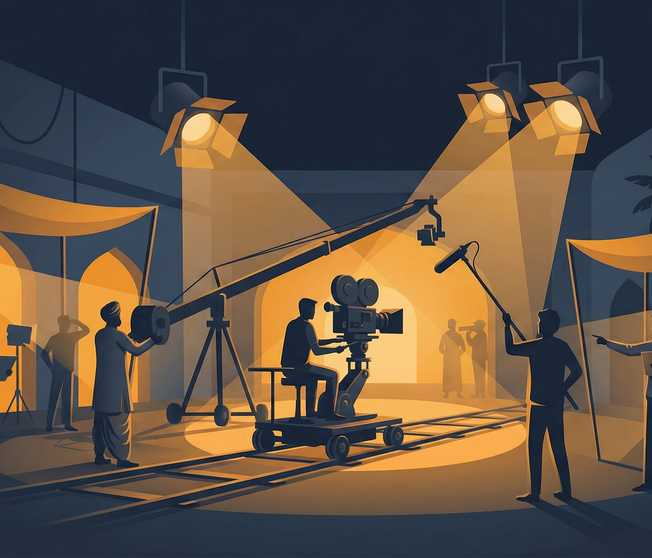
- Hero image: Wide shot of an active Indian film set showing multi-department crew at work. Alt text:
Indian film crew on set during principal photography — film set terminology India - Section divider: Clapperboard close-up. Alt text:
Film clapperboard showing scene and take number — Indian film industry glossary - Sound section: Boom operator at work. Alt text:
Boom operator recording sync sound on Indian film production - Post section: Colorist at DI grade suite. Alt text:
Film colorist performing color grading in DI suite for Indian film - Casting section: Actor in audition setup. Alt text:
Actor recording self-tape audition for Bollywood casting
Distribution Recommendations:
- Send to film institute WhatsApp groups and Telegram channels with "share this with your batch" framing
- Pinterest infographic version of the Quick-Reference table performs well for this content type
- YouTube companion: "10 Indian film set terms explained in 60 seconds each" — high-intent keyword video play
- Add a jump-navigation anchor menu at the top (linking to each H2 section) to improve time-on-page and signal content depth to Google
Word Count: Approximately 2,900 words (within the 2,500–3,000 target range)
Readability Target: Grade 7–8 on Flesch-Kincaid. Short definition paragraphs, bold term anchoring, and the table structure maintain scannability for mobile readers using this as a reference document on set.
Related Blog Posts