How to Make a Short Film in India Under ₹1 Lakh: Complete Production Guide (2026)
-

Lavkush Gupta
-
May 04, 2026
-
12
Meta Description: Step-by-step guide to making a short film in India on a budget under Rs. 1 lakh — budget breakdown, crew, equipment, festivals, and distribution.
Here's the truth no film school puts in its brochure: the most important short film you'll ever make will cost less than a decent secondhand motorcycle.
Not because short films are cheap. Because when you're starting out, constraints are the best creative brief you'll ever get. A tight budget doesn't shrink your story — it sharpens it. Some of the most celebrated Indian short films of the last decade were made for what a Mumbai wedding spends on flowers. The directors who made them are now running feature budgets ten times the size, pitching to OTT platforms, and winning at MAMI.
This guide is for you — the first-time director sitting on a script, a second-hand laptop, and approximately zero connections. We're going to break down exactly how to make a short film in India in 2026 for under Rs. 1 lakh, from the first draft to the festival circuit, with actual numbers and zero vague advice.
Why Short Films Still Matter in 2026 — More Than Ever
Before we talk money, let's talk stakes. Because "why bother" is a legitimate question when the internet is drowning in content and attention spans have been cut to pieces.
Here's why short films remain the most powerful entry-level tool in the Indian film industry right now.
Festival circuit = industry credibility. Getting into MAMI, IFFK, or BIFFes isn't just a line on your CV. It's proof to producers, cinematographers, and actors that someone with taste looked at your work and said yes. That proof opens doors that a reel or a thesis project often doesn't.
OTT platforms are actively hunting short films. Netflix India, Amazon miniTV, MX Player, and YouTube Originals have all, at various points, acquired or commissioned short film content. More importantly, their content discovery teams watch festival circuits. A strong short film at the right festival is a calling card that circulates in rooms you're not in.
It's a proof-of-concept engine. Several major Indian features started as short films or proof-of-concept videos that convinced producers to back the full story. If you have a feature script you believe in, making a short film in the same world — same characters, same tone — is the fastest way to raise money for the big version.
It's the portfolio that pays off. Directors, DPs, editors, sound designers, production designers — every single one of them needs a body of work before they get paid work. Short films are how you build that body. And in 2026, with the volume of OTT content being produced in India, the demand for experienced short-film collaborators has never been higher.
One Rs. 1 lakh short film, made well, can change your trajectory. That's not motivation-poster talk. That's the documented career arc of several Indian directors you've already heard of — and we'll get to them later.
The Complete Budget Breakdown: Rs. 1 Lakh, Accounted For
Let's get into the actual numbers. This breakdown is built for a 10-15 minute short film shot over 3-5 days with a skeleton crew of 5-8 people. Every rupee is accounted for.
| Category | Minimum (Rs.) | Maximum (Rs.) | Notes | |---|---|---|---| | Pre-Production | 0 | 5,000 | Script, location recce, casting calls | | Equipment Rental | 15,000 | 25,000 | Camera, sound, lights (3-5 day shoot) | | Crew | 10,000 | 15,000 | Skeleton crew, mostly credit + food | | Locations | 0 | 10,000 | Free vs. rented locations | | Food & Transport | 8,000 | 12,000 | Catering + local travel for entire shoot | | Post-Production | 15,000 | 25,000 | Edit, colour, sound mix, original music | | Festival Submissions | 5,000 | 10,000 | 10-15 festivals via Filmfreeway + direct | | Contingency | 3,000 | 8,000 | Because something always breaks | | Total | 56,000 | 1,10,000 | Target: stay under Rs. 1,00,000 |
Pre-Production: Rs. 0 to Rs. 5,000
Pre-production is free if you're disciplined. Your script costs nothing. Location scouting costs only your auto fare. Casting via film school boards, AIO Cine, and Instagram costs nothing.
The only real spend here is printing (sides, call sheets, location agreements), any props you need to source, and travel for the director and AD to scout locations. Keep this under Rs. 5,000 by scouting digitally first — Google Street View, Instagram location tags, and DMs to location owners before you physically visit.
Write a lean, location-efficient script. Every location change costs you money. A 12-minute film that takes place in two or three locations is dramatically more executable than one that needs seven.
Equipment: Rs. 15,000 to Rs. 25,000 for a 3-5 Day Shoot
This is where most first-time directors overspend or under-think. Here's the reality of the Indian camera rental market in 2026.
A mid-range cinema camera package — something like a Sony FX3, Canon EOS C70, or Blackmagic Pocket Cinema Camera 6K — rents for Rs. 2,500 to Rs. 5,000 per day in Mumbai, Hyderabad, and Bengaluru. For a 5-day shoot, that's Rs. 12,500 to Rs. 25,000 for camera alone.
The premium option — ARRI Alexa Mini, RED Komodo — starts at Rs. 5,000 to Rs. 8,000 per day and can go much higher. For a first short film on a Rs. 1 lakh budget, you don't need this. The DPs shooting the best work at Indian festivals aren't choosing cameras based on brand prestige. They're choosing based on sensor quality, dynamic range, and how well they can light the scene.
Basic sound package (boom pole, Sennheiser MKH416 or similar shotgun mic, a simple recorder like a Zoom H5 or H6): Rs. 1,000 to Rs. 2,000 per day rental. For a 5-day shoot, plan Rs. 5,000 to Rs. 8,000.
Basic lighting — two LED panels, a reflector kit, maybe a small HMI for an exterior — runs Rs. 1,500 to Rs. 3,000 per day depending on the city. Budget Rs. 5,000 to Rs. 10,000 for your full shoot.
The smartphone option is real in 2026. If you're shooting a story that works in natural light — urban, intimate, handheld — the iPhone 15 Pro and Samsung Galaxy S24 Ultra shoot 4K ProRes footage that has screened at international film festivals without anyone guessing the camera. Pair it with a decent gimbal (rent one for Rs. 500 to Rs. 800 per day), a clip-on lav mic for dialogue, and your camera costs drop to near zero. Directors have been shortlisted for MAMI with smartphone-shot films. The question isn't whether you can — it's whether the story demands something else.
Crew: Rs. 10,000 to Rs. 15,000
On a Rs. 1 lakh short film, most of your crew will work for credit, experience, and your food budget. This is the honest reality of the short film ecosystem in India — and it's not exploitative as long as everyone enters with clear expectations.
Your skeleton crew for a short film should be:
- Director (you)
- Director of Photography — film school student, emerging DP, or a senior cameraperson who wants to experiment
- Assistant Director — handles call sheets, keeps the shoot on schedule, manages the set
- Sound Recordist — the most undervalued person on your set and the one who makes or breaks your film in post
- Production Assistant (1-2) — handles logistics, props, continuity
Optional but useful: a clapper/DIT if your DP is also operating camera. A makeup/hair person if your film has any period or stylized elements.
Cash outflow here goes to: a nominal token payment or travel stipend for your key crew members who are giving up paid days, and a meaningful cash payment to your sound recordist (bad sound cannot be fixed in post — this is the one role you must not cut corners on).
Locations: Rs. 0 to Rs. 10,000
The best short films are often made in the director's own home, a friend's apartment, a rooftop, a chai stall, a park. These are free locations. Write your script around what you have access to.
For locations you need to request — a shop, a stairwell, a community space — ask honestly, offer a credit, and in many cases you'll get it for free. In markets and public spaces, you technically need a shooting permit, but many short film crews operate with a stripped-down footprint (no lights, no massive crew) that doesn't attract attention.
Rented locations — studios, controlled interiors, specific private spaces — run Rs. 2,000 to Rs. 5,000 per day in most Indian cities. Budget for a maximum of two location rental days.
Food and Transport: Rs. 8,000 to Rs. 12,000
Feed your crew properly and they will go to war for you. This is not a line item to cut. A bad meal kills set morale faster than any other variable.
Budget Rs. 300 to Rs. 500 per person per day in meals. For 8 people over 5 days, that's Rs. 12,000 to Rs. 20,000 at the upper end. Keep it closer to Rs. 8,000 by combining home-cooked dabbas for lunch with vendor chai breaks and simple dinners on shorter shoot days.
Transport covers crew pickups on early morning or late night shoots, equipment transport, and location-to-location movement during a split shoot day. In most Indian cities, Ola/Uber plus one rented tempo for equipment runs Rs. 1,500 to Rs. 2,500 per shoot day.
Post-Production: Rs. 15,000 to Rs. 25,000
This is where your film gets made a second time.
Editing: Rs. 0 to Rs. 8,000. DaVinci Resolve is free. Completely free. The same software used in professional grading suites worldwide, available as a full-featured free download. If you can edit, your editing cost is zero. If you need an editor, a film school grad or emerging editor will often cut your short for credit and a token payment of Rs. 3,000 to Rs. 8,000.
Color grading: Rs. 0 to Rs. 6,000. Again, DaVinci Resolve handles this inside the same software. A DP who color-grades their own work costs nothing extra. A standalone colorist for a short film runs Rs. 3,000 to Rs. 6,000 for a 10-15 minute project.
Sound mix and design: Rs. 5,000 to Rs. 10,000. This is the post-production category where you should spend. A proper sound mix — cleaning the dialogue, adding ambient beds, sound design, mixing the final track — makes a Rs. 1 lakh film sound like a Rs. 10 lakh film. Emerging sound designers charge Rs. 5,000 to Rs. 10,000 for a short film mix. Don't skip this.
Music: Rs. 0 to Rs. 5,000. Original music composed by a film music student costs almost nothing — they need the credit as much as you need the score. Alternatively, use Creative Commons licensed music (ccMixter, Free Music Archive) or compose something minimal yourself if you have even basic music knowledge. Never use commercial music without a license — this will get your film rejected from every major streaming platform and some festivals.
Festival Submissions: Rs. 5,000 to Rs. 10,000
Festival entry fees range from free to Rs. 2,000+ per submission depending on the festival and the submission window (early bird is always cheaper). For your first short film, target 10-15 festivals strategically.
Filmfreeway (filmfreeway.com) is the primary submission platform globally. Most Indian and international festivals have moved here. Budget Rs. 500 to Rs. 1,000 per paid submission, and target a mix of free Indian festivals and a selective list of paid international ones.
Finding Crew Who Will Work on Your Short Film
This is the question every first-time director asks and gets the most useless answer to. "Just post on Facebook groups" doesn't cut it anymore.
Here's where the actual crew is in 2026.
Film school networks. FTII, SRFTI, Whistling Woods, LV Prasad Film and TV Academy, Satyajit Ray Film and Television Institute — every one of these institutions has students who need short film credits, are learning at a professional level, and are actively looking for projects. Email the department heads. Post on the student notice boards. Show up to their screenings. These are your people.
AIO Cine. India's film industry job board with verified production houses and active crew listings. Post your project as a crew call, be transparent about it being a short film on a credit-plus-expenses basis, and you'll find emerging professionals actively building their portfolios. The verification system matters here — crew members know the production is real, which makes responses faster and more serious.
Instagram and LinkedIn. DPs, editors, sound designers, and production designers in your city are posting their work right now. Look at the hashtags. Look at who's shooting the kind of work you admire. Reach out with a specific, respectful message — your script, your vision, the format, the timeline, and what you're offering (credit, food, a copy of the finished film). A well-written DM converts better than a vague "collab?" comment.
Your own city's film community. Every major Indian city has an active film club, short film meetup group, or indie film WhatsApp community. Pune has its FTII alumni and emerging director network. Hyderabad has the Ramoji ecosystem. Chennai has Kodambakkam and the Tamil short film circuit. Bengaluru has a surprisingly active indie film scene. Find these spaces. Show up to screenings. Relationships built in person close faster than cold DMs.
The Legal Basics Nobody Tells You
Most first-time directors skip the paperwork and then get surprised. Here's the minimum you need.
Location permissions. For public spaces — parks, streets, government buildings — you technically need a shooting permit from the local municipal body or the police. In practice, most short film crews operate minimally enough that this rarely becomes an issue. For private locations, get written permission from the owner, even if it's just a WhatsApp message confirming they've agreed. If anything goes wrong during the shoot, you want a paper trail.
Actor agreements. A simple one-page agreement stating the actor's name, the film's working title, the dates of shoot, that they're working without payment (or for a stated token amount), and that they grant you the right to use their likeness in the film for festival and non-commercial distribution. This protects both parties. A basic template costs nothing — many are freely available online, and film lawyers in Mumbai and Hyderabad offer free first consultations.
Music rights. Use original music, royalty-free music, or Creative Commons licensed tracks. If you use a commercial song without a license, you cannot upload the film to YouTube without it being muted, cannot submit to many international festivals, and cannot ever sell the film to a platform. There is no workaround. Plan your music before you shoot.
Release forms. Any identifiable person who appears in your film needs to have signed a release form. For extras in a public location, this is harder to enforce — but for any speaking role or featured face, get it in writing before the shoot ends.
Festival Strategy: Where to Submit Your Short Film
Not all festival wins are equal. Here's a strategic breakdown of where to focus.
Indian Festivals to Target First
MAMI (Mumbai Film Festival) — The most prestigious film festival in India. Highly competitive, but a selection here is a career-defining credit. Accepts Indian and international short films. Submission typically opens six months before the October festival.
IFFK (International Film Festival of Kerala) — Kerala takes cinema seriously in a way no other Indian state does. The short film competition here is competitive and respected, with a film-literate audience that gives genuine feedback.
BIFFes (Bengaluru International Film Festival) — Strong short film program, growing international profile, and more accessible for first-time filmmakers than MAMI.
NFDC Film Bazaar (Goa) — More of a market and co-production forum than a pure festival, but it's where producers, distributors, and financiers gather during IFFI. Getting your short in front of people here can open feature funding conversations.
National Film Awards (Short Fiction category) — This is a government award, but a National Award win changes how the industry looks at you overnight. The category is underrated in terms of competition difficulty at the top level.
CIFF (Chennai International Film Festival) and Jio MAMI short film category also deserve submissions if your film is a strong fit.
International Festivals Worth the Submission Fee
Once you've built your Indian festival run, selectively target:
- Sundance (Short Film Programme) — The single most influential short film programme in the world. Extremely competitive. But a film that plays Sundance gets industry-wide attention.
- Clermont-Ferrand (France) — The largest dedicated short film festival in the world. Surprisingly accessible to Indian films.
- Oberhausen (Germany) — One of the oldest short film festivals globally, with a strong track record of discovering world cinema.
- TIFF (Toronto) and Tribeca — Both have strong short film programmes that feed into industry attention.
- Palm Springs ShortFest — One of the Academy-qualifying short film festivals, meaning a win here makes your film eligible for Oscar consideration.
Use Filmfreeway for everything international. Create an account, upload your film with proper metadata, and use their deadline tracker to manage submissions. Most major international festivals are on the platform.
Distribution After the Festival Run
Your film doesn't die when the festival circuit ends. Here's the distribution chain.
YouTube is still the largest short film audience in the world. Upload your film in full once your festival exclusivity window is over (typically 6-12 months after your first screening). A strong title, thumbnail, and description with relevant keywords can bring in views for years.
Vimeo is the professional portfolio platform. If you're a director or DP, your film lives here for industry viewers. The quality of the Vimeo player and the professional reputation of the platform make it essential for your industry reel.
Instagram and YouTube Shorts — Cut a 60-90 second highlight reel from your film and release it as a teaser. This drives people to the full film and builds your following as a filmmaker.
OTT short film sections — Amazon miniTV, MX Player, and several regional OTT platforms have short film acquisition arms. Once your film has a festival run, reach out directly to their acquisition teams with your festival credentials. The ask is simple: non-exclusive streaming rights in exchange for a modest flat fee or revenue share. These deals won't make you rich, but they build your public profile.
Short film collectives and curated channels — Channels like Film Companion Short Films, Culture Machine, and regional language film channels on YouTube actively curate short films from emerging directors. Getting featured here adds both visibility and a curatorial endorsement.
5 Indian Short Films Made on Tiny Budgets That Changed Their Directors' Careers
Real proof that this path works.
Rima Das — "Man With The Binoculars" (and her Village Rockstars journey). Rima Das made her early short films in rural Assam with a prosumer camera, no crew to speak of, and a budget that wouldn't cover two days of Mumbai craft service. Her discipline and visual clarity in those early projects directly led to Village Rockstars (2017), which won the National Award for Best Film and screened at Toronto. She is now one of India's most internationally recognized filmmakers.
Mozez Singh — Early short films before "Zubaan." Before his Hindi feature Zubaan (2016) premiered at TIFF, Singh built his visual language and his production network through short film work that cost a fraction of any feature. The short film period was his proving ground.
Devashish Makhija — "Agli Baar" and the Oonga series. Makhija made short films for years before his feature Ajji (2017) entered the international festival circuit. His short film work — stark, socially visceral, formally precise — is directly traceable in the DNA of his feature filmmaking.
Gitanjali Rao — "Printed Rainbow" (2006). Made on an independent animator's budget for what was effectively next to nothing in materials and time, Printed Rainbow screened at Cannes and dozens of major festivals worldwide. Rao went on to make Bombay Rose (2019), India's first animated film to screen in competition at Venice. The short film was the proof that everything else followed from.
Avinash Arun — short film work before "Killa." Arun's debut feature Killa (2014) — a luminous, devastating Marathi-language film that won the National Award for Best Children's Film — emerged from a filmmaker who had spent years building his visual craft through smaller work. Killa itself was made on a micro-budget that would look modest even by short film standards.
The pattern is identical in every case: a filmmaker who used small-format work to develop craft, build relationships, and prove to the industry that they had something to say — before anyone offered them a big budget to say it.
The Most Important Advice This Guide Can Give You
Make the film that only you can make.
Not the film you think will win festivals. Not the film that copies the aesthetic of whatever won Sundance last year. Not the film that's commercially safe or thematically broad. The film that comes from something you have personally witnessed, felt, or understood — shot in the world you actually live in, with the people you actually have access to, about something that genuinely keeps you up at night.
Indian short films that break through almost always do so because they contain a specificity — of place, of character, of feeling — that can't be faked. That specificity is free. It's the one thing no budget can buy and no connection can substitute for.
Rs. 1 lakh is enough. Your script is enough. The crew is out there. The festivals are waiting.
Make the film.
Find Your Crew on AIO Cine
The right short film crew doesn't fall into your lap. You have to find people who are hungry, talented, and building their own careers at the same time as you. That's exactly who's on AIO Cine.
Post your short film as a crew call on AIO Cine — India's film industry platform where production houses are verified before they can post, and crew members can find genuine projects from filmmakers who are serious about their work. Register free, post your project, and start building the team that makes your first film the one that opens every door after it.
Because the film that changes your career is probably the one you're trying to talk yourself out of making right now.
SEO Notes:
- Primary keyword ("how to make short film India low budget") should appear in the H1, first 100 words, and at least two H2 subheadings.
- Featured snippet opportunity: The budget breakdown table is structured for Google to pull as a featured snippet for queries like "short film production cost India" and "short film budget breakdown India."
- Internal links to add: Link to the Film Crew Day Rates post (for crew payment context), the Film Portfolio guide (for post-production portfolio building), and the OTT platform jobs post (for distribution section).
- External links to add: Filmfreeway.com (submission platform), DaVinci Resolve download page (free software), MAMI official site, IFFK official site, Filmfreeway's Indian festivals list.
- Image suggestions:
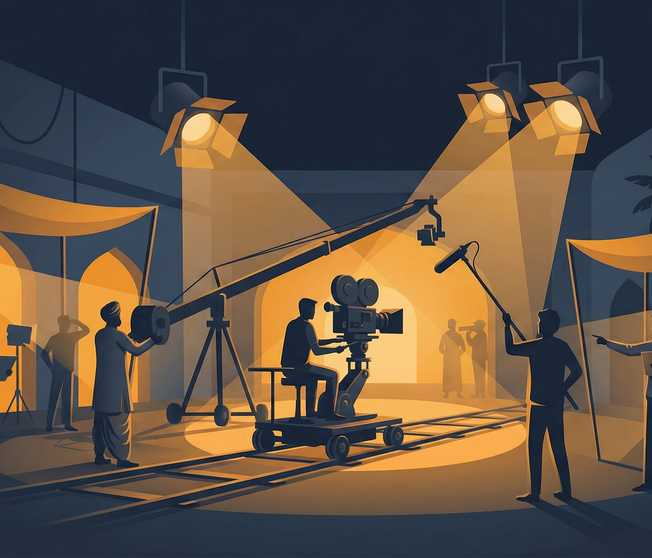
- Hero image: Behind-the-scenes of a small Indian film crew on a rooftop or street location. Alt text: "Short film crew shooting on location in India on a low budget" - Budget breakdown table screenshot (for social sharing). Alt text: "Short film budget breakdown India under Rs. 1 lakh" - Festival logos block (MAMI, IFFK, BIFFes). Alt text: "Indian short film festivals — MAMI, IFFK, BIFFes submission guide"
- Recommended content length: At ~2,800 words, this post is in the optimal range for the target keyword cluster. Short film how-to content tends to rank well at 2,500-3,000 words — comprehensive but not padded.
- Schema markup: Add HowTo schema for the budget breakdown steps and FAQ schema for the "where to find crew" and "which festivals to submit to" sections.
Related Blog Posts