The Mental Health Crisis Nobody in Indian Cinema Wants to Talk About (2026)
-

Lavkush Gupta
-
May 04, 2026
-
12
There is a particular kind of loneliness that only people in this industry understand.
You are surrounded by hundreds of people on a set in Andheri or Film Nagar. You are part of a crew, a cast, a unit. There is chai being passed around, someone is cracking a joke at the gaffer's expense, the AD is yelling something into his walkie-talkie. And somewhere inside all of that noise, you are quietly drowning.
You haven't worked in six weeks. Or you have worked every single day for six weeks straight and you cannot remember what it feels like to sleep past 6 AM. Your family is calling to ask when you're coming home. Your feed is full of people your age booking their first lead roles and signing brand deals. You are forty-five minutes into hour seventeen of a shoot that was supposed to wrap by noon. You are smiling at the right people and performing okayness with the same craft you bring to everything else — because in this industry, not being okay is the fastest way to stop getting called.
This is the mental health crisis that Indian cinema is not talking about. Not loudly enough, anyway.
Why the Film Industry Is Uniquely Hard on the Mind
The Feast-Famine Cycle Is Psychological Warfare
Ask anyone who's been freelancing in this industry for more than two years and they will describe the same pattern: months of nothing, followed by three projects landing simultaneously, followed by more nothing.
In almost every other profession, income is predictable enough to plan around. In film, even the most experienced professionals — ADs with fifteen years of credits, DPs with national award nominations, casting directors with a full roster — will tell you that every project could be their last. Not because they aren't good. Because that is simply how this industry is structured.
That chronic financial uncertainty does not just affect your bank account. It rewires how you think. You begin to hoard work — saying yes to projects that drain you because turning anything down feels like professional suicide. You start every good period with the low-grade terror of it ending. And during the gaps, even a few weeks of quiet can spiral into catastrophising: I'm done. Everyone has moved on. I had my shot and I missed it.
This is not weakness. This is what the feast-famine cycle does to a nervous system over time.
The Comparison Trap Has Never Been More Vicious
Instagram has turned the film industry's natural social hierarchy into a 24-hour highlight reel. You see your batchmate from the same film institute posing on a set in Prague. Someone who was sweeping floors in the art department three years ago just got an OTT credit that's trending. A peer who you know — genuinely know — does mediocre work just landed a major brand deal because they have 80,000 followers.
What you don't see: the projects that fell through. The months of no pay. The panic attacks backstage. The relationship that broke under the pressure. Nobody posts about that. So your feed becomes a curated gallery of everyone else's wins, set against the unedited reality of your own struggle — and that gap, experienced daily, is genuinely damaging.
A 2023 NIMHANS study on creative professionals in India found significantly elevated rates of anxiety and depressive episodes compared to general population averages — and reported social media comparison as one of the most frequently cited triggers. The film industry, which runs entirely on image and visibility, sits at the sharpest end of that problem.
You Can Be Completely Isolated Inside a Crowd City
Mumbai. Hyderabad. Chennai. These cities are enormous. They are expensive, fast, and built for people who already have a foothold. If you've relocated from Lucknow or Vizag or Patna or Thrissur to pursue this career — and thousands do, every single year — the loneliness can be staggering.
You are too busy or broke to cultivate friendships outside the industry. Inside the industry, everyone you meet is also a competitor. You cannot fully relax with your unit because you're always performing competence. You go home to a PG or a shared flat and you are alone with your thoughts in a city of twenty million people.
That isolation compounds everything. The anxiety has no outlet. The self-doubt has no check. The bad days have nobody to absorb them.
Family Pressure From the Outside
Most people in the Indian film industry — particularly crew members, junior artists, and people in non-glamour technical roles — did not get into this with their family's enthusiastic blessing. They got in because they wanted it badly enough to override the disapproval, or to outlast it.
But the disapproval does not disappear. It reshapes into something subtler: the persistent question of when it's going to "pay off," the comparison to a cousin who is an engineer, the implication that this was always a phase, the financial bail-outs that come with conditions. Family love and family pressure can coexist, and navigating both while trying to build a career that has no predictable milestones is exhausting in a way that is very hard to explain to people who are not living it.
The Hierarchy's Emotional Toll on Juniors
Indian film sets run on a strict hierarchy. That hierarchy serves real logistical purposes — film sets are genuinely complex operations and a clear chain of command prevents chaos. But hierarchy has a shadow side that nobody in the industry talks about.
Junior assistants — third ADs, fourth ADs, production assistants, spot boys, junior costume and makeup assistants — routinely absorb the stress of the people above them. When a director is under pressure, someone below takes the heat. Yelling is normalised on many sets. Dismissiveness from seniors is expected and is not considered worth mentioning. The junior who objects or pushes back gets quietly written off as "difficult" or "sensitive," which in industry language means unreliable.
What this creates is a culture where emotional suppression is not just common — it is professionally required. You learn to not react. You learn to take it. You learn that your discomfort is not relevant to the work getting done. And you do this for years, through your formative professional years, while you're trying to build the self-belief you need to eventually lead a team of your own.
That takes a toll that shows up years later — in the form of perfectionism that paralyzes, anger that has nowhere to go, or a numbness to your own emotional signals that makes it very hard to know when you're not okay.
Substance Use on Set: The Conversation Nobody Is Having
Alcohol. Cannabis. In certain circles, harder substances. They are present on Indian film sets in a way that is acknowledged privately and ignored publicly. They function, as they do in every high-stress industry, as the most socially acceptable coping mechanism available at 2 AM when you're still on set and you've been awake for sixteen hours.
This is not a moral judgment. It is an observation that this industry creates conditions — extreme stress, irregular hours, a culture of "the show must go on," easy access, peer normalisation — that make substance dependency a predictable outcome for a not-small percentage of people working in it. And then the industry's response to that dependency, when it becomes visible, is often to quietly stop calling that person. Not support. Removal.
Why the Industry Doesn't Talk About It
The answer is simple and it is devastating: in the film industry, your most bankable asset is your reliability. Directors and producers cast and hire based on track records and reputation. Being seen as someone who is struggling — psychologically, emotionally, personally — is understood, whether fairly or not, as a signal that you might not show up. That you might not deliver. That you are a risk.
So people don't talk. The veteran AD who is in the grip of severe anxiety will manage it invisibly. The young actress who has not eaten properly in three weeks because of what her production was saying about her body will say she's fine. The unit production manager running on four hours of sleep for the fifteenth straight day will project energy he does not have. Because the alternative — being seen — feels worse than the suffering.
This creates a peculiar industry-wide conspiracy of performance wellness. Everyone is managing something. Nobody is saying so. And each person's silence makes the next person more certain they are the only one.
What Is Slowly Changing
The conversation is opening up. Haltingly, imperfectly, but it is opening.
Sushant Singh Rajput's death in 2020 cracked the industry's silence open in a way nothing had before. The public conversation that followed — about depression, about industry politics, about isolation — was messy and often misdirected, but it was real. It gave people permission to name things they had not been naming.
Since then, several initiatives have emerged. The Film and Television Producers Guild of India has begun internal conversations about set wellness protocols, though enforcement remains inconsistent. Some larger production houses — primarily those with international co-production experience, where on-set mental health provisions are more standard — have begun to build support systems into larger productions. iCall, the counselling platform run out of TISS Mumbai, has seen a significant increase in clients from the creative industries since 2021.
Slowly, the conversation about therapy is shifting from shameful to simply sensible, particularly among younger industry professionals who grew up with a more normalised discourse around mental health. A 25-year-old assistant director today is meaningfully more likely to seek help than their equivalent was fifteen years ago.
This is progress. It is not enough yet, but it is real.
Practical Resources: Save These Before You Need Them
Do not wait until you are in crisis to find these numbers.
iCall — TISS (Tata Institute of Social Sciences) Helpline: 9152987821 Available Monday to Saturday, 8 AM to 10 PM. This is staffed by trained counsellors, not automated responses. Many are graduate students specialising in psychotherapy who bring real care to the work. Sliding scale fees for continued therapy. Based in Mumbai, with deep understanding of urban professional stress.
Vandrevala Foundation 24/7 Helpline Helpline: 1860-2662-345 (toll-free, 24 hours, 7 days) Free. Available around the clock. Particularly useful if you are in crisis outside of business hours — which in this industry, where the bad nights tend to happen very late, matters.
iMind (NIMHANS Digital Academy) Available via app. Provides self-assessment tools, guided mental health exercises, and crisis resources in multiple Indian languages. Useful as a first-step self-check when you're not sure whether what you're experiencing warrants formal support.
Wysa An AI-powered mental health app (Indian company, used widely across South Asia) that offers CBT-based exercises, mood tracking, and connection to licensed therapists. The anonymity is often what makes it accessible to people in industries where being known for struggling feels dangerous. Available on Android and iOS.
YourDOST Online counselling platform with therapists who work with professionals. You can self-schedule sessions, choose your counsellor, and access support without physically visiting a clinic — which matters when you're working irregular hours or traveling between shoots.
Peer Support This is underrated. There are informal WhatsApp groups and Discord servers for film professionals in Mumbai and Hyderabad specifically centred on mental health support and peer connection. Ask within your circles — they exist, and they are genuinely useful because the people in them understand the industry's specific pressures in a way that even good therapists sometimes don't, at first.
Practical Survival Strategies for Film Professionals
Managing the Feast-Famine Cycle Psychologically
The financial anxiety is real and it needs real financial solutions (emergency funds, income diversification, FWICE registration for welfare access). But the psychological layer needs its own attention.
The single most useful reframe: treat the gap periods as a phase of the cycle, not as evidence about your worth. The industry is project-based. Gaps are structural, not personal. Every working professional you admire has had gaps, most of them longer and scarier than yours.
Create a "non-negotiable floor" during gaps — three things you do every day regardless of how work is going. It could be a walk, a phone call with someone who knew you before you were in this industry, thirty minutes of a creative project that has nothing to do with your career. The floor keeps you tethered to yourself when the work that usually provides structure disappears.
Setting Boundaries on Set Without Burning Bridges
This is genuinely hard in a hierarchical environment. The honest answer is that full protection from a toxic set culture requires seniority that most people are still building. But there are things you can do without professional consequence.
Name what is happening to yourself, privately and immediately, rather than suppressing it: "This person just humiliated me in front of the unit and that was not okay." You don't have to say it out loud to the aggressor. But naming it to yourself prevents the slow drift into believing it was normal or that you deserved it.
Find one person on each set who is safe — not necessarily a confidant, but someone whose energy is steady and decent. Human anchors matter in difficult environments.
Document things that cross into genuine misconduct. This is not tattling. This is how patterns get interrupted.
When to Push Through, When to Take a Break
The industry will always tell you to push through. That is its default instruction. So you need your own internal metric.
Push through when you are tired but functional, when the thing you're resisting is discomfort rather than depletion, and when the cost of stopping is genuinely high.
Take a break when you notice that your judgment is impaired — when you are making errors you don't usually make, snapping at people you don't want to snap at, or feeling the kind of flatness that makes everything feel pointless. That flatness is not laziness. It is your system telling you something important.
The film industry confuses depletion with weakness and calls both by the same name. They are not the same thing. Depletion is physiological and correctable. Weakness is a story people tell to keep you working past your limits.
Build a Life That Is Not This Industry
This is the advice that sounds soft and is actually structural.
The film industry will, if you let it, become your entire identity, your entire social world, and your entire source of self-worth. That is a dangerous configuration because the industry is genuinely unpredictable. When it's going well, everything is great. When it isn't — and it won't always be — you have nothing to stand on.
Cultivate friendships outside the industry. Maintain a hobby that has no professional application. Stay connected to the city or town you came from, and to the people who knew you before this career. Not because the industry isn't worth your passion — it is — but because the people who last longest in this industry are the ones who are not entirely destroyed when a project falls through or a year goes quiet.
A rich life outside the work actually makes you better at the work. It gives you material, perspective, and the psychological stability to take creative risks. It is not a concession. It is a professional asset.
A Note on Asking for Help
There is a version of this article that ends with a rousing paragraph about how asking for help is the bravest thing you can do. You have read that paragraph. You know it is true.
So instead: asking for help in this industry will feel like walking against a current. The culture will push back against it, sometimes loudly, more often just through the ambient signal that people who are struggling are to be managed around rather than supported. That pressure is real, and acknowledging it is more useful than pretending it doesn't exist.
But here is what is also true: the people who have navigated this industry for twenty, thirty years — the ones who are still working, still creating, still themselves — almost universally describe some version of the same turning point. A moment when they stopped performing okayness and started actually tending to themselves. The good ones say it made them better at their craft. All of them say it made them survive it.
You are not a camera. You need maintenance. And you deserve it.
Finding Work Without the Anxiety Spiral
One specific and practical thing: a lot of the mental health stress in this industry flows directly from how opaque and unreliable the job search process is. Fake productions. Unpaid trials. Connections that don't exist. Waiting on a WhatsApp message from someone who has already moved on.
AIO Cine exists to remove that specific source of anxiety. Every production house on the platform is verified before they can post a crew call or casting notice. The database is current, the listings are real, and you can search without the background dread that you're being set up for disappointment or worse. Register free at aiocine.com — because finding your next opportunity should be straightforward, not another thing you have to survive.
You are not too sensitive for this industry.
The industry is too numb to its own people. Those are not the same thing.
Take care of yourself with the same seriousness you bring to your craft. Find the resources above before you need them. Build the life outside the work. Say the difficult thing to the safe person. And know that the fact that you care this much — about the work, about doing it well, about lasting in it — is the same thing that is making this hard.
That's not a character flaw. That's the cost of loving something difficult.
Resources mentioned in this article:
- iCall TISS: 9152987821 (Mon-Sat, 8 AM-10 PM)
- Vandrevala Foundation: 1860-2662-345 (24/7, toll-free)
- iMind: NIMHANS Digital Academy app
- Wysa: Available on Android and iOS
- YourDOST: yourdost.com
SEO Notes
- Internal linking suggestions: Link to "Freelancing in the Indian Film Industry," "Film Crew Day Rates India 2026" (for context on feast-famine income), "Why Bollywood Assistants Quit in Year Two," and "Film Set Etiquette Guide India" (for set hierarchy context).
- External linking suggestions: Link to iCall TISS website (icallhelpline.org), Vandrevala Foundation (vandrevalafoundation.com), NIMHANS Digital Academy, Wysa app store page. These authoritative external links on a sensitive topic signal content trustworthiness to search engines.
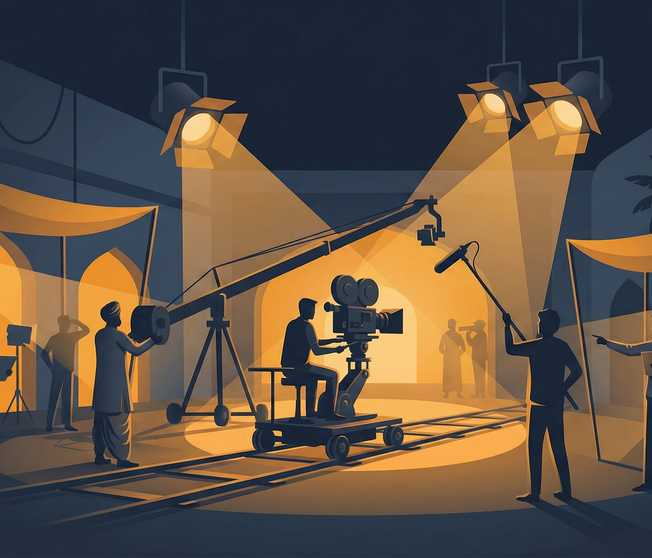
- Image placement suggestions: Hero image above the fold (alt text: "film crew working on Indian film set, long hours, mental health in Bollywood"). Suggest an image of an empty film set at night for the isolation section (alt text: "empty film set at night representing isolation in the Indian film industry"). Resource section could use a simple infographic listing helpline numbers (improves dwell time and shareability).
- Featured snippet opportunity: The "Practical Resources" section with helpline numbers is structured to be pulled as a featured snippet for queries like "mental health helpline for film industry India" — keep that section's formatting clean and list-based.
- Content length: 2,750 words — sits well within the optimal range for a sensitive, long-form informational post. Google treats mental health content with additional care (Your Money Your Life — YMYL category); authoritative sourcing and a clear editorial voice help here.
- Schema: Consider adding FAQ schema for the "When to push through vs. take a break" and "Why doesn't the industry talk about mental health" sections. These are direct question-and-answer formats that Google frequently surfaces.
- Social sharing angle: The opening section and the closing line are both designed for screenshot-sharing on Instagram Stories and LinkedIn — high emotional resonance, quotable format.
Related Blog Posts