Working on Music Album Videos vs Film Songs: Two Different Worlds, Same Industry
-

Lavkush Gupta
-
May 04, 2026
-
10
There are two types of music productions in the Indian film and media industry. Both involve cameras, playback tracks, choreography, lights, and a song someone recorded months ago. Both end up on YouTube, where your grandmother will watch them on loop at 7 AM. And yet, if you have ever worked on both — or tried to — you already know they are as different as a one-day schedule and a six-week shoot.
We are talking about music album videos and film songs. Two formats, two industries, two completely different sets of rules.
Most people entering the music production space in India do not know this until they are already on set, confused about why the DOP is taking direction from the film's director and not the music video director, or why the label called at 9 PM asking why the rough cut isn't ready yet. So let us lay this out clearly — the budgets, the timelines, the creative dynamics, the career opportunities, and the paths between the two worlds.
What We Are Actually Comparing
Before we get into it: let's be precise about what these two formats are.
A film song is a song sequence that exists within a feature film. It might be a romantic number shot during principal photography, a title track filmed separately, or an item number that is essentially a short commercial for the film. The director of the film controls it (or delegates it to a second unit director). It is funded by the film's production budget. And it exists to serve the narrative — or, at minimum, the marketing — of the film.
A music album video (or standalone music video) is a visual production made for a song that exists independently of any film. It might be released by a major label like T-Series, Speed Records, Desi Music Factory, or Zee Music Company. It might be funded by an independent artist who has saved up for a year. It might be a brand-sponsored release with a celebrity. But it lives on its own terms, it has its own production team, and it is not answerable to a film's director or producer.
These two formats co-exist in the same industry. They share equipment rental houses, some crew members, and the same YouTube homepage. Beyond that, the similarities thin out fast.
Budget: The First Honest Conversation
Let us talk numbers, because the budget is where the difference between these two worlds becomes unmistakably real.
Film Song Budgets
A film song does not have a standalone budget in most cases — it draws from the film's overall production budget. On a mid-budget Hindi film (Rs 5 crore to Rs 20 crore), the song sequences might collectively account for Rs 50 lakh to Rs 3 crore of that budget, depending on how many songs there are, whether they require elaborate sets or foreign locations, and how big the stars involved are. A single item number for a major Bollywood release — the kind that gets its own mini-trailer — can cost Rs 1.5 crore to Rs 4 crore when you factor in the star's fees, elaborate sets, large background dancer contingents, and the post-production investment.
On smaller Hindi films and most regional language productions, song budgets are significantly tighter. A Tamil or Malayalam film song sequence might be executed on Rs 15 lakh to Rs 60 lakh. A Bhojpuri film song sequence might be done for Rs 5 lakh to Rs 20 lakh.
These are market estimates based on industry conversations and publicly available production disclosures. Individual productions vary significantly — verify current rates with working line producers before planning any budget.
Album Video Budgets
Music album videos operate on a cleaner, more legible budget spectrum because the full cost is visible as a standalone production:
- Independent / newcomer artist: Rs 2 lakh to Rs 15 lakh (market estimate)
- Emerging Punjabi or Haryanvi artist on a regional label: Rs 10 lakh to Rs 35 lakh (market estimate)
- Mid-tier label release (T-Series second tier, Desi Music Factory, Speed Records): Rs 30 lakh to Rs 80 lakh (market estimate)
- Established Bollywood single or item number released as a standalone video: Rs 60 lakh to Rs 1.5 crore (market estimate)
- Top-tier Punjabi international crossover or celebrity-led video: Rs 1 crore to Rs 2.5 crore (market estimate)
These figures reflect production budgets — what reaches the set — and are market estimates subject to significant variation based on location, talent fees, and label negotiation. Verify with active producers before quoting or planning.
What this means practically: album video budgets are transparent and negotiable. Film song budgets are buried inside a larger production and often opaque to everyone except the line producer and the director.
Creative Freedom: Who Actually Calls the Shots
This is the difference that matters most if you are a director.
On a Film Song Set
The creative authority on a film song belongs to the film's director. Full stop. If you are the music video director brought in to handle a song unit, you are executing someone else's vision — the film's overall visual language, the aesthetic choices that have already been locked, the star's image requirements, and whatever the film's producer has decided is commercially necessary.
This is not a criticism. It is the nature of the job. Film song sequences exist within a larger creative contract, and every department head on that song set is operating within constraints that were set before they arrived.
What this means for a young director: you do not direct a film song unit unless you are already deep enough in the industry to be trusted with a star and a significant budget. The path in is as an associate director, a second AD, or a member of the choreography team. You are learning, not creating.
On a Music Album Video Set
An album video director has genuine creative authority — especially on independent productions and mid-tier label releases. The label wants a video that performs well on YouTube and feels fresh. They are not managing a franchise or protecting a story arc. They want views, shares, and an artist image that connects with an audience.
That is a brief a creative director can actually work with.
On an independent artist's video, the director often has near-total creative control. The artist trusts the director's vision, the budget is agreed upfront, and beyond that it is your set. On a label production, there is more oversight — a label executive may have approval rights on the final cut — but the day-to-day creative decisions are still largely the director's to make.
For a director who wants to build a visual identity and a distinctive reel, album video production is where it actually happens. Film songs are where you execute someone else's identity.
Timeline and Shooting Schedules: A Reality Check
Film Song Timelines
A film song sequence, even a simple romantic number, rarely gets less than two to four shooting days when you factor in setup, lighting, choreography rehearsals on set, and the time required to work with stars whose schedules are not built around a single song. A large-scale number — an item song with a set, a full background dancer contingent, and complex choreography — can run five to ten shooting days.
Then add pre-production: location scouting, set design and construction, choreography rehearsals (often two to four weeks ahead of the shoot), costume fittings, and the administrative complexity of coordinating around a lead actor's existing commitments. Post-production for a film song sequence typically runs alongside the film's overall post schedule — meaning the song might be graded and edited months before it is actually released.
Total timeline from choreography prep to final delivery: three to six months, in most cases.
Album Video Timelines
Here is where album video production earns its reputation for intensity. A standard music album video is shot in one to three days. A tight, well-planned Rs 25 lakh Punjabi video with two to three locations and moderate choreography: two days. A Rs 5 lakh indie video for an independent artist with a single concept location: one day, possibly one night shoot.
Pre-production is compressed accordingly. Location scouting, wardrobe, crew hiring, and concept finalisation typically happen in two to four weeks for a mid-tier production. For an independent artist who called you Tuesday and needs the shoot to happen next weekend: you work with what you have.
Post-production is equally tight. Rough cut in 48 to 72 hours. Label feedback turnaround in 24 hours. Final grade and delivery in a week to ten days. The YouTube release date is already booked and the social media teaser campaign is already planned. There is no slack in the timeline.
This is the content factory model in action — high volume, fast turnaround, and a clear expectation that you deliver on deadline without excuses. It is intense. It is also exactly the kind of training that makes a director genuinely good.
Team Size: Who Is on Set
Film Song Crew
A Bollywood song sequence runs with a full film crew — sometimes an expanded one. You have the full camera department, a large art department (because the set or location is usually elaborate), a choreographer and their assistant team, a full background dancer management team, the star's personal entourage (hair, makeup, personal assistant, sometimes a personal DOP), and the film's regular crew who are continuing their normal roles.
On a larger item number, the set crew can exceed 100 people. This is a full production, with all the logistics that implies.
Album Video Crew
A mid-tier album video runs on eight to twenty people depending on the production scale. A well-run Rs 30 lakh Punjabi music video might have:
- Director + one assistant director
- DOP + one camera assistant / focus puller
- Gaffer + two lighting assistants
- Art director + one set dresser
- Choreographer + their assistant
- Hair and makeup (one to two artists)
- Costume stylist
- Playback operator
- Line producer / production manager
- Two to four production assistants
That is fifteen to eighteen people doing the work of a full department in a film. It requires crew members who are versatile, self-directed, and willing to solve problems without waiting to be told what to do. On a good album video set, it feels electric. Everyone is pulling the same direction. On a bad one, the gaps in experience show up fast.
Day Rates: What Are You Actually Getting Paid
Day rates in music video production versus film song production differ substantially — and not always in the direction you would expect.
Director:
- Film song (second unit): Rs 25,000 to Rs 1.5 lakh per day depending on scale and experience (market estimate)
- Album video director: Rs 15,000 to Rs 75,000 per day for indie/mid-tier; established directors negotiate project fees of Rs 3 lakh to Rs 25 lakh per video (market estimate)
DOP / Cinematographer:
- Film song DOP: Rs 30,000 to Rs 2 lakh per day (market estimate; senior DOPs on major productions earn significantly more)
- Album video DOP: Rs 8,000 to Rs 80,000 per day depending on production tier and the DOP's credits (market estimate)
Choreographer:
- Film song choreographer: Rs 50,000 to Rs 5 lakh per song sequence depending on scale and star association (market estimate)
- Album video choreographer: Rs 10,000 to Rs 1 lakh per project for most indie and mid-tier productions (market estimate)
Editor:
- Film song edit: Usually absorbed into the film's post-production budget; Rs 20,000 to Rs 80,000 per song for standalone edit agreements (market estimate)
- Album video editor: Rs 10,000 to Rs 50,000 per video on mid-tier productions; top editors on premium Punjabi and Bollywood singles earn Rs 75,000 to Rs 2 lakh per video (market estimate)
Colorist:
- Film song color: Integrated into the film's DI; Rs 20,000 to Rs 1 lakh per song as a standalone rate (market estimate)
- Album video colorist: Rs 15,000 to Rs 1 lakh per video depending on production scale (market estimate)
All day rates and project fees above are market estimates gathered from industry sources. They vary significantly based on geography, individual negotiation, union affiliation, and the specific production. Verify current rates with FWICE-affiliated production associations or working department heads before quoting.
The practical upshot: film song rates are higher per day, but album video work is more plentiful and often more accessible for those building their careers. A colorist who does three album videos a week earns more than one who waits six months for a film song credit.
The Label vs The Film Production House: Who You Are Actually Working For
Understanding your client changes everything about how you approach the job.
Working with a Film Production House
A film production house has a hierarchy. There is the director at the top of the creative chain. There is the producer, who controls money and scheduling. There is the production manager, who coordinates everything operational. When you are part of a film song unit, you report to this chain. Decisions get escalated. Changes require approvals. The system is slow because it is managing enormous complexity across an entire film.
The upside: when a major production house puts your name in the credits of a successful film, that credit carries weight. It is a specific, traceable piece of professional history. Working on film songs builds industry relationships that are slow to develop but lasting when they solidify.
Working with a Music Label
T-Series, Desi Music Factory, Speed Records, Zee Music Company — these labels operate more like media companies than traditional production houses. Their primary interest is content volume and platform performance. They want videos that hit a visual quality threshold, launch on schedule, and perform on YouTube.
This means decisions get made faster. A label A&R or creative executive can approve a concept in 24 hours. A location change can be cleared by text message. The downside: the same speed that makes label work efficient also makes it volatile. Labels reprioritise releases, switch directors without notice, and change creative briefs mid-production. Being adaptable is not optional — it is the job.
The upside for career building: label credits accumulate fast. If you do ten videos for a major label in a year, you have a real body of work and a real professional relationship with that label's creative team.
The Punjabi and Haryanvi Boom: Where the Volume Is
If you want to understand where the album video industry is actually growing in India right now, look north.
The Punjabi music video industry centred in Chandigarh, Mohali, and Patiala — with production arms operating out of Mumbai and, increasingly, overseas — is the highest-volume, fastest-growing segment of the standalone music video market. Labels like Speed Records and T-Series Punjabi produce content at a pace that no other regional music scene matches. Desi Music Factory has built a content operation that rivals the output of mid-size film studios.
Haryanvi music is running a similar playbook. Artists like Sapna Choudhary and the broader Haryanvi music scene have created a consistent demand for visually high-energy music videos that feel distinct from the Punjabi aesthetic — more earthy, more rural-coded, often shot on locations that evoke a specific regional identity.
For a director, DOP, or crew member based in North India, this is the most accessible high-volume market in the country. You do not need Mumbai proximity to work here. You need a strong reel, a reliable crew, and the ability to make something look expensive on a tight budget.
Delhi and Chandigarh are the primary production hubs for this segment. Mumbai handles the bigger label releases and anything involving Bollywood crossover artists. Hyderabad is the hub for Telugu music videos, which have their own distinct visual vocabulary and are growing rapidly on the back of pan-Indian Telugu cinema's global expansion.
How YouTube Changed Both Industries
YouTube did not just change how music videos are distributed. It changed what they are for.
Before YouTube, a film song was a promotional asset for a film. A standalone album video existed primarily to get the song on music television channels like MTV or Channel V. The audience was whoever happened to be watching when the video aired.
After YouTube, everything is addressable data. A video that hits 10 million views in its first week tells a label exactly how much an artist's fanbase has grown since the last release. A video that has 80% watch time tells a director that their visual pacing is keeping viewers engaged. A video with a high click-through rate from the thumbnail tells the editor that the visual hook is working.
This data-driven reality has changed what labels want from directors. It is no longer sufficient to make something beautiful. You need to make something that performs. The first five seconds of a music video are the most important creative real estate on the entire project — because that is when YouTube's algorithm decides whether to keep serving it, and when the viewer decides whether to keep watching.
Smart directors who understand this — who think about thumbnail composition during the shoot, who build hook moments into the first cut specifically to prevent skip-aways — are the ones getting repeat commissions from labels. It is a different creative skill than pure filmmaking, and it is worth developing deliberately.
YouTube analytics has also created a new form of career validation. A music video director with a publicly trackable body of work — videos with 5 million, 20 million, 50 million views — has proof of their commercial effectiveness that a film director pitching their first feature does not. Labels and production houses can see exactly what your work does in the market. Make that visibility work for you.
Career Entry Points: Where to Start
Both worlds offer real entry points, but they require different approaches.
Breaking Into Film Song Production
The path into film song units runs through the assistant directing chain or through specific departments with strong set presence. The most direct route for a young director is as a third or second AD on a film that has song sequences, where you will observe the song unit in operation and build relationships with the choreographer, the DOP, and the director. Over time, you earn the trust required to be handed a second unit responsibility.
For cinematographers, working as a camera assistant or focus puller under an established DOP on film productions — including song units — is the apprenticeship model that still dominates the industry. It is slow. It is hierarchical. It is also the path that produces the most technically comprehensive cinematographers.
For choreographers specifically, film song work is the highest-status and highest-paid application of your craft. The path in is through established choreography studios — working as a background dancer, then as a junior choreographer's assistant, then as an associate choreographer on your own productions.
Breaking Into Album Video Production
The album video industry is more accessible from the outside. A director with a strong three-minute reel and a clear visual identity can pitch directly to a label's creative team. An editor with fast turnaround and clean technical work can find their first commission through a production company referral or through direct outreach to a music video production house.
The key differentiators for breaking in:
- A reel that is specifically curated for the music video format (not a general filmmaking reel)
- The ability to name a clear concept for an artist's song before you are asked
- Speed and reliability — delivering on time, every time, without excuses
- Relationships with an independent artist community — your first commissions will likely come through the music ecosystem, not through labels directly
Cities with the strongest album video production ecosystems right now: Mumbai (for Bollywood-adjacent work and major label productions), Chandigarh and Delhi (for Punjabi and Haryanvi music), Hyderabad (for Telugu music), and Chennai (for the growing Tamil independent music scene).
The Crossover: When Music Video Work Leads to Film
The path from music video director to film director is well-documented in Indian cinema history, even if it is not often discussed in those terms.
Directors who built technical fluency and visual confidence on music video sets before transitioning to feature films include figures across Bollywood and regional cinema whose early credits were in advertising and music video production. The pattern is consistent: the compressed timeline and high-volume nature of music video work produces directors who are decisive, technically fast, and comfortable managing creative pressure. These are the qualities that film producers look for when they are taking a chance on an emerging director.
The transition requires deliberate strategy. Your music video reel demonstrates visual craft and production management. What it does not demonstrate is narrative storytelling — which is what feature film producers actually need to see before they invest crores in your directorial vision. The bridge is a short film: a real story, real performances, festival-worthy execution. Make the short film while you are actively working in music videos. Do not wait for the film career to materialise on its own.
The two careers are not sequential. The best emerging directors are running both simultaneously — maintaining music video income and building their film credentials in parallel. That is the model that works.
Where AIO Cine Comes In
We built AIO Cine because this industry — music video production included — has a serious information problem. The work exists. The budgets exist. The productions are happening, in Mumbai and Chandigarh and Delhi and Hyderabad, every single week. What is broken is the connection layer between those productions and the skilled crew and directors who want to work on them.
A label in Mumbai is looking for a DOP who has shot Punjabi music videos and knows how to work fast. A production house in Chandigarh needs a colorist they can trust to turn around a grade in 48 hours. An independent artist in Delhi is looking for a director who will take their vision seriously on a tight budget. These are real, active requirements — and without a verified platform connecting them, they get filled through WhatsApp groups and personal referrals that exclude anyone who hasn't already cracked the network.
Every production house and label on AIO Cine is verified before they can post crew calls. That is not a small thing in an industry where unverified productions and no-pay situations are a known hazard for crew members and directors alike.
If you are building a music video career — as a director, DOP, editor, colorist, choreographer, or any department head — register your profile on AIO Cine. The listings are live, the productions are real, and the platform is free to join.
Register on AIO Cine, where every production house is verified before they can post crew calls, and where a music video credit you actually get paid for is worth more than ten you are still chasing.
The Bottom Line
Film songs and music album videos are not the same job wearing different clothes. They are genuinely different industries — different creative dynamics, different client relationships, different timelines, different crew cultures, and different career trajectories. Understanding which world you are entering, and what the rules of that world actually are, is the difference between a career that builds and one that stalls.
The music album video industry in India is one of the most active, accessible, and genuinely exciting creative economies in the country right now. The Punjabi music boom is not slowing down. The Telugu music scene is growing. Independent artists across every regional market are investing in visual production at a scale that was not possible five years ago, because YouTube has made every view count and every good video findable.
The film song world offers prestige, scale, and lasting industry relationships — but it is slower to enter and harder to navigate without the right connections.
You do not have to choose between them. The smartest careers in Indian music production right now are built in both.
SEO Notes
Meta Description (148 characters): Music album video vs film song production in India — different budgets, timelines, creative freedom, and careers. The honest insider comparison you need.
Primary Keyword: music video production career India
- Placed in: opening paragraph, career entry points section, budget section headers, CTA section
Secondary Keywords:
- film song vs album video — addressed directly in the opening comparison and budget sections; strong featured snippet candidate for this exact search
- music video director India — integrated into creative freedom section, crossover section, and career entry points
- Punjabi music video industry jobs — covered in dedicated Punjabi/Haryanvi boom section with city hubs named explicitly
- album video vs Bollywood song production — addressed in the "What We Are Actually Comparing" section and throughout the budget/timeline comparisons
Internal Link Suggestions:
- Link "music video production" in the opening to:
music-video-production-career-india.md(existing post — directly adjacent topic) - Link "choreographer" career references to:
choreographer-career-indian-cinema.md - Link "colorist" references to:
colorist-di-career-india.md - Link "cinematographer" references to:
how-to-become-a-cinematographer-in-india.md - Link "FWICE" reference in day rates section to:
fwice-membership-card-guide-2026.md - Link "Punjabi cinema" references to:
punjabi-cinema-pollywood-career-guide.md - Link "film editor" references to:
how-to-become-film-editor-india-2026.md - Link "day rates" section to:
film-crew-day-rates-india-2026.md
External Link Suggestions:
- T-Series YouTube channel (authoritative label anchor for budget/volume claims)
- Speed Records YouTube channel (Punjabi market authority)
- Desi Music Factory YouTube channel (Haryanvi/Punjabi content factory reference)
Featured Snippet Opportunities:
- The tiered budget comparison table (Rs 2 lakh to Rs 2.5 crore) is structured for Google to pull as a featured snippet for "music video budget India" and related queries
- The crew size breakdown (fifteen to eighteen people) is a clear list structure for "music video crew India" snippet capture
- The "What We Are Actually Comparing" section opens with clean definitions of both formats — structured for Google to use as a definitional snippet on "film song vs music video India"
Image Placement Recommendations:
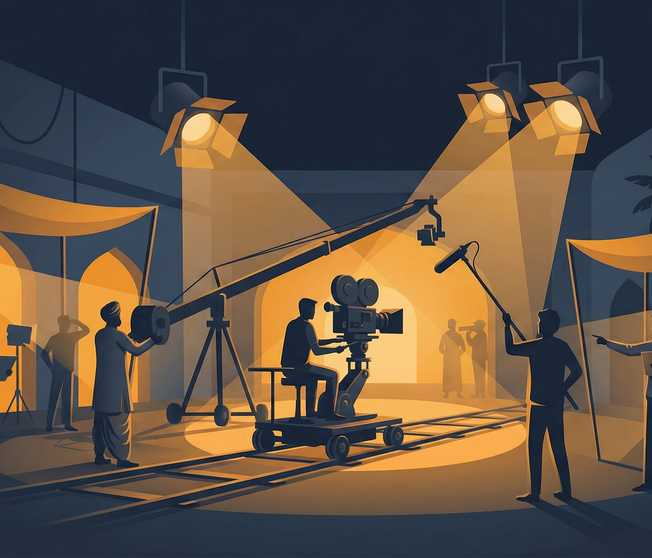
- Hero image (after title): Behind-the-scenes of a music video set with crew and camera rig
- Alt text: music video production set India director and crew behind camera
- After budget section: Side-by-side visual of a film song set (large, elaborate) vs a lean music video crew
- Alt text: film song production vs music album video crew size comparison India
- After Punjabi/Haryanvi section: Location shot from a Punjabi music video shoot (outdoor, North India)
- Alt text: Punjabi music video outdoor location shoot Chandigarh North India
- After YouTube section: YouTube analytics screen or music video thumbnail mockup
- Alt text: YouTube music video analytics India views watch time
Word Count: Approximately 2,850 words — within target range
Readability: Grade 8-9 (Flesch-Kincaid) — appropriate for the target audience of young, career-building music and film professionals
Platform Note: If publishing to WordPress, H2 for all main section headers, H3 for any sub-sections within (currently only "Film Song Budgets" / "Album Video Budgets" and similar paired subsections). The current Markdown hierarchy maps cleanly to this structure with no changes required.
Budget Disclaimer Placement: Verification disclaimers are embedded inline beneath each budget/rate table or list as italicised text — consistent with the platform's existing approach in film-crew-day-rates-india-2026.md.
Related Blog Posts