Pan-Indian Films Are Reshaping Film Careers — Here's How to Ride the Wave
-

Lavkush Gupta
-
May 04, 2026
-
8
The Baahubali Effect Was Just the Opening Credits
Let's establish the timeline, because it matters.
Before 2015, cross-language releases were common but rarely ambitious. A Tamil hit would get a Hindi dub, earn decent money in the North, and everyone would move on. The South was the South. The North was Bollywood. OTT didn't exist at scale. The star systems were hermetically sealed — Rajinikanth was a god in Chennai and an acquired taste in Delhi.
Then S.S. Rajamouli made Baahubali: The Beginning with a Rs. 180 crore budget — unheard of outside Bollywood at the time — and released it simultaneously in Telugu, Tamil, Hindi, and Malayalam. It earned Rs. 650 crore. The sequel, Baahubali: The Conclusion, earned Rs. 1,810 crore globally. The Hindi version alone outperformed most Bollywood blockbusters of that era.
That single franchise changed the calculus for every studio, every streaming platform, and every major production house in India. The conversation shifted overnight from "can a regional film travel?" to "why are we still thinking in regions?"
KGF doubled down on that premise. Pushpa shattered it completely — proving that a mass-market, working-class Telugu hero could out-gross Bollywood stars in their own territory. RRR then won the Oscar for Best Original Song, gave the world "Naatu Naatu," and ended the last remaining argument about whether pan-Indian cinema was artistically serious or just commercially savvy.
The answer, definitively, is both.
What "Pan-Indian" Actually Means for the Crew
Here's where most career advice on this topic fails you: it stops at the box office numbers and never gets to the ground level.
Pan-Indian films don't just need bigger budgets and bigger stars. They need a fundamentally different kind of crew operation.
Multilingual production pipelines. A film like RRR was shot primarily in Telugu but simultaneously prepared for Tamil, Hindi, Malayalam, and Kannada releases. That's not just post-production dubbing — it's pre-production script adaptation, dialect coaching for actors, on-set language coordination, and a post-production pipeline that processes five audio tracks, five subtitle tracks, and five marketing campaigns in parallel.
Multi-location shoots at scale. Animal was shot across Rajasthan, Jammu & Kashmir, Georgia, and multiple Mumbai locations. KGF's Kolar Gold Fields sequences required location scouting teams who understood both the historical context and the logistical reality of shooting in an abandoned mining region in Karnataka. Jawan involved shooting in Chennai, Mumbai, and international locations simultaneously — with different units running in parallel.
Cross-state VFX collaboration. The days of VFX being a Mumbai-only specialty are over. Hyderabad's Annapurna Studios has world-class VFX infrastructure. Prime Focus, Makuta VFX (who did significant work on RRR), and other studios now operate teams across cities. The best VFX supervisor for your project might be in Hyderabad. The best compositors might be freelancers based in Pune. Pan-Indian productions hire for skill, not city of origin.
Multi-industry casting and crew. Jawan brought together Shah Rukh Khan (Bollywood), Vijay Sethupathi (Kollywood), Deepika Padukone (pan-Indian), and Nayanthara (Kollywood/Mollywood). The crew blended Atlee's Tamil production team with Hindi-industry technical staff. This is now standard practice on any production with pan-Indian aspirations.
The practical implication: if you are a specialized crew professional — gaffer, focus puller, art director, costume coordinator, location manager, production sound mixer — your market just got dramatically larger. But only if you can operate across industry lines.
The Career Opportunities That Pan-Indian Cinema Has Unlocked
Let's be specific. These are the roles and skill sets that are genuinely in higher demand because of the pan-Indian shift — and will continue growing through 2030.
Multilingual Dubbing Artists
This is arguably the single hottest career path that pan-Indian cinema has created. Every major film now releases in a minimum of four languages. Every major OTT title — whether it originated in Tamil, Telugu, Hindi, or Malayalam — gets dubbed into the other three at minimum, and often into Bengali, Marathi, Punjabi, Kannada, and Odia as well.
The dubbing artist pool in India is chronically under-supplied relative to demand. A dubbing artist who can deliver in two or more languages — particularly a Hindi speaker who also has functional Tamil or Telugu, or a Telugu artist who can also deliver in Hindi — commands significantly higher rates and has near-continuous work availability.
Studios in Mumbai, Hyderabad, and Chennai are actively hunting for voice talent that can cross language lines. If you are an actor or voice professional with multilingual capability, this is the moment to position yourself explicitly for dubbing work across industries.
Location Scouts and Managers Across States
The era of "we shoot everything in Film City and a Rajasthan fort" is over for ambitious productions. Pan-Indian films are hunting for locations that feel fresh, geographically specific, and visually distinct. The Kolar Gold Fields for KGF. The valleys of Jammu for Animal. The coastal landscapes of Andhra Pradesh for various Telugu productions. The backwaters of Kerala showing up in pan-Indian OTT series.
Location managers who have developed relationships and recce knowledge across multiple states — not just their home state — are extraordinarily valuable to these productions. If you're a location professional based in Hyderabad, building contacts and knowledge in Rajasthan, Maharashtra, and Karnataka doesn't just widen your portfolio; it makes you the kind of hire that a pan-Indian production cannot function without.
VFX Artists and Supervisors
Makuta VFX, founded by Pete Draper, built some of the most stunning work seen in RRR — and that production brought together Indian and international VFX talent in ways that were genuinely new. The VFX budgets on pan-Indian productions have scaled dramatically. KGF: Chapter 2 spent an estimated Rs. 50-60 crore on VFX. Kalki 2898 AD, the ambitious sci-fi pan-Indian project, reportedly had one of the largest VFX budgets in Indian film history.
VFX artists who can work with both Tollywood's aggressive timelines and Bollywood's specific aesthetic sensibilities are in short supply. Compositors, environment artists, and VFX supervisors who have credits across multiple industries are commanding rates that would have seemed impossible five years ago.
Assistant Directors and Production Coordinators
The most underappreciated pan-Indian career opportunity is in the AD department. A first or second AD who has worked on both a Telugu and a Hindi production understands the workflow differences, the on-set culture differences, and the communication requirements that make cross-industry productions run smoothly. Productions actively seek this experience because it reduces friction when you're blending crews from two different industry cultures on the same set.
Dialect Coaches and Script Translators
This is a niche role that pan-Indian cinema has elevated from "nice to have" to "essential budget line." A film targeting national release needs actors to be believable across language versions. That requires dialect coaching for dubbed versions, script localization that goes beyond literal translation, and cultural adaptation that keeps jokes landing and emotional beats intact across linguistic contexts. This is specialized work, and there are very few people in India who do it well.
The Language Skills That Actually Matter Right Now
Let's be direct about this, because the advice you'll find elsewhere is often wrong.
You do not need to become fluent in four languages to benefit from the pan-Indian shift. What you need is strategic language positioning.
Hindi remains the distribution gateway. The Hindi-speaking market — North India plus diaspora — is still the largest single revenue pool for any pan-Indian release. If you are a South-based professional (Telugu, Tamil, Kannada, Malayalam industry) and you do not have functional working Hindi, you are leaving a significant portion of the pan-Indian market inaccessible. This doesn't mean literary Hindi — it means enough conversational fluency to communicate naturally on set with a Hindi-medium crew.
Telugu is the production language of the moment. Hyderabad is operating as the center of gravity for pan-Indian production right now. Tollywood's technical infrastructure, studio facilities (Ramoji Film City, Annapurna Studios), and production talent pool are attracting projects from across industries. Crew professionals based in or willing to work in Hyderabad, with even functional Telugu, have a significant advantage.
Tamil is the OTT language of the moment. Tamil content — Vikram, Jailer, Leo, and the wave of Mani Ratnam and Pa. Ranjith productions — is being acquired aggressively by Netflix, Amazon Prime Video, and Disney+ Hotstar. Tamil production culture is distinct and demanding, but the OTT deals attached to major Tamil projects are making them some of the most financially well-resourced productions in the country.
English matters more than people admit. Pan-Indian productions with international distribution ambitions — and post-RRR's Oscar win, that ambition has exploded — need crew who can communicate with international partners, read international co-production contracts, and interface with foreign VFX studios. If you are a mid-career professional and your English is weak, this is the time to fix that.
How Production Houses Are Hiring Differently Now
Three years ago, a production house in Hyderabad hiring for a big Telugu project would post crew calls primarily through local WhatsApp groups, personal referrals within the Tollywood network, and a handful of local industry associations. A Mumbai-based gaffer wouldn't be in the conversation unless they had a pre-existing personal relationship with someone on the production.
That has changed. Meaningfully.
Pan-Indian productions now actively scout outside their home industry for two reasons. First, scale — productions like RRR and Kalki 2898 AD are simply too large to staff entirely from one city's talent pool. Second, deliberate cross-pollination — bringing in crew from other industries is now understood as a creative asset, not an administrative headache.
What this means practically: production companies are increasingly using structured platforms and databases to find crew across industries, rather than relying entirely on local networks. The crew call for a pan-Indian production filming in Chennai might go out simultaneously in Mumbai and Hyderabad. A production coordinator in Bengaluru might land a key role on a Bollywood production filming in Karnataka. The walls between industry silos are genuinely coming down — not because anyone decided to be idealistic about it, but because the economics of pan-Indian cinema demand it.
Salary impact is also significant. Pan-Indian productions — particularly those with OTT deals attached — have budgets that track against international co-production standards rather than traditional Bollywood or regional industry day rates. A gaffer working on a major pan-Indian Netflix production is often earning 40-60% more per day than they would on a comparable budget Hindi or Telugu production five years ago. This isn't universal, and independent pan-Indian productions can still be underpaid, but the top tier of the market has genuinely moved.
OTT Made Pan-Indian Possible — and It's Not Done Yet
You cannot understand the pan-Indian boom without understanding what OTT did to the financing calculus.
Before streaming, a South Indian film releasing in Hindi required significant marketing spend — dubbing, prints, promotions across a geography that didn't have an existing audience for the film. The economics were marginal. For every Baahubali, there were a hundred films that got a perfunctory Hindi dub, released on fifty screens in Delhi, and quietly disappeared.
OTT platforms changed this at the structural level. Netflix, Amazon Prime Video, and Disney+ Hotstar operate as pan-Indian buyers. They acquire rights in all languages simultaneously. Their recommendation algorithms don't care about which industry produced a film — they care about what their subscribers are watching. And when Drishyam 2 (Malayalam remake, Hindi version) quietly became one of the most-watched films on Amazon Prime Video in Hindi-speaking India, it proved that OTT could build pan-Indian audiences for content that traditional theatrical distribution never would have reached.
For production companies, OTT pre-sales have become the financial backbone that makes pan-Indian scale possible. A production that can pre-sell its OTT rights to Netflix can budget for the VFX, the multi-state shoots, the multilingual audio pipeline — because the money is committed before the film releases. This has structurally transformed what a mid-budget pan-Indian production can actually afford to do.
The implication for crew professionals: the OTT-driven pan-Indian market is not going away. If anything, the 2026-2030 period will see it deepen. Streaming platforms are now commissioning pan-Indian originals from the start — not waiting for theatrical hits to acquire, but developing content that is pan-Indian by design, from development through delivery.
Which Cities Are Becoming New Hubs — And Where You Should Be Watching
Hyderabad is the production capital of pan-Indian cinema right now. The studio infrastructure (Ramoji Film City is the largest film studio complex in the world by area), the state government's active subsidies and support for film production, and Tollywood's technical talent base have made it the natural home for large-scale pan-Indian projects. If you are considering relocation for career purposes, Hyderabad deserves serious consideration regardless of which industry you come from.
Chennai is asserting itself as the OTT production hub for South India. The combination of Kollywood's storytelling talent, the infrastructure that has built up around major Tamil productions, and the aggressive acquisition of Tamil content by all major platforms is making Chennai a city where mid-career OTT professionals are finding consistent high-quality work.
Bengaluru is an emerging hub that most industry insiders are not taking seriously enough yet. Karnataka's film industry (Sandalwood) has historically been the smallest of the major South Indian industries, but post-KGF, the state has significant political and financial will to develop its film infrastructure. Bengaluru also has a deep technology and VFX talent pool from its IT sector — an unusual advantage that is beginning to be tapped by production companies.
Mumbai is not losing its position, but it is losing its monopoly. The city's infrastructure, star system, and distribution networks remain irreplaceable for certain categories of production. But the model where all pan-Indian ambition had to run through Mumbai is finished. The best pan-Indian productions now treat Mumbai as one node in a network, not the center that everything orbits.
Pune, Goa, and Vizag are beginning to establish themselves as secondary production locations — not hubs in the full sense, but cities where specific infrastructure (natural locations, lower cost bases, government support) is attracting specific categories of production.
Building a Cross-Industry Portfolio: The Practical Playbook
If you are a working film professional right now and you want to position yourself for pan-Indian work in the next three years, here is what actually moves the needle.
Document your work across language lines. If you have worked on a Hindi production and a Tamil production, make that visible and explicit. Your portfolio shouldn't just list your credits — it should make clear that you have operated effectively in multiple industry cultures. Casting directors and line producers for pan-Indian projects specifically look for this.
Build contacts outside your home industry deliberately. Attend industry events outside your city. The annual Hyderabad film lab meetups, Chennai's film industry networking events, and Mumbai's MAMI-adjacent industry conversations are all places where cross-industry contacts are made. Your home industry network is your safety net; your cross-industry network is your growth engine.
Get at least one major credit in a different industry before you need it. The worst time to build a cross-industry track record is when you're pitching for a specific pan-Indian project. Do the groundwork now — take a lower-rate opportunity in an unfamiliar industry to get the credit and the contact. The investment pays off asymmetrically.
Understand the business of pan-Indian, not just the craft. Know which OTT platforms are acquiring which categories of content. Know which production houses are developing pan-Indian projects. Read the trade press — Film Companion, Deadline India, Box Office India — specifically for deal news. When you know that a particular studio has signed an OTT deal for a slate of pan-Indian productions, you know where to direct your outreach six months before the crew calls go public.
Make yourself findable across industries. A producer in Chennai looking for an experienced line producer for a pan-Indian project should be able to find you without relying on personal connections. This means having a professional presence on structured industry platforms, not just WhatsApp groups and Instagram.
What 2026-2030 Looks Like If You're Positioned Right
The pan-Indian wave is not at its peak. It is at its beginning.
The productions that will define Indian cinema by 2030 are in development right now — and they will be pan-Indian by default, not by exception. The Kalki 2898 AD universe, the next Rajamouli project (whatever it turns out to be), the slate of pan-Indian originals that Netflix and Amazon are developing directly — these are the projects that the professionals who position themselves today will be working on.
The salary gap between pan-Indian and single-market work will continue to widen. The crew network that runs Indian cinema will become genuinely cross-industry rather than organized by linguistic region. The studios in Hyderabad, Chennai, and Mumbai will increasingly function as shared infrastructure rather than competing ecosystems.
And the professionals who will thrive in that environment are the ones who started thinking pan-Indian before it became the only option.
That's not a prediction. It's already happening. The only question is whether you're in position to take advantage of it.
Find Pan-Indian Opportunities Before They Hit the WhatsApp Groups
We built AIO Cine because cross-industry crew discovery in India still runs mostly on personal networks and informal channels — which means opportunities cluster around people who already have industry connections, and skip past talented professionals who are newer to the game or based outside the major hubs.
Every production house on AIO Cine is verified before they can post crew calls. That matters in an environment where pan-Indian ambitions have also attracted pan-Indian opportunists — fake productions, advance-fee schemes, and diploma mills that promise cross-industry connections they cannot deliver.
If you want to be visible to the productions that are actually hiring across industry lines right now, register on AIO Cine — because the pan-Indian opportunity is real, but it should find you through legitimate channels, not cost you what you've already earned.
SEO & Publishing Notes
Suggested Title: Pan-Indian Films Are Reshaping Film Careers — Here's How to Ride the Wave
Meta Description: RRR. KGF. Pushpa. Pan-Indian cinema is creating new careers across all industries. Here's what it actually means for crew, where to position yourself, and how to get hired.
Target Keywords:
- Primary: pan-Indian films careers
- Secondary: cross-industry film jobs India, multilingual film crew India, pan-Indian cinema opportunities, Tollywood Bollywood cross-industry work, film crew jobs pan-India
Internal Link Suggestions:
- Link "multilingual dubbing artists" to
/blog/dubbing-artist-career-india - Link "location managers" to
/blog/location-manager-career-india - Link "VFX artists" to
/blog/how-to-become-vfx-artist-india-2026 - Link "assistant directors" to
/blog/how-to-become-assistant-director-bollywood - Link "film crew day rates" to
/blog/film-crew-day-rates-india-2026 - Link "film industry salary" to
/blog/film-industry-salary-guide-india-2026 - Link "Hyderabad film industry" to
/blog/hyderabad-film-industry-career-guide - Link "Kollywood" to
/blog/kollywood-tamil-film-industry-career-guide - Link "Tollywood" to
/blog/how-to-get-into-tollywood-telugu-film-industry
Image Alt Text Recommendations:
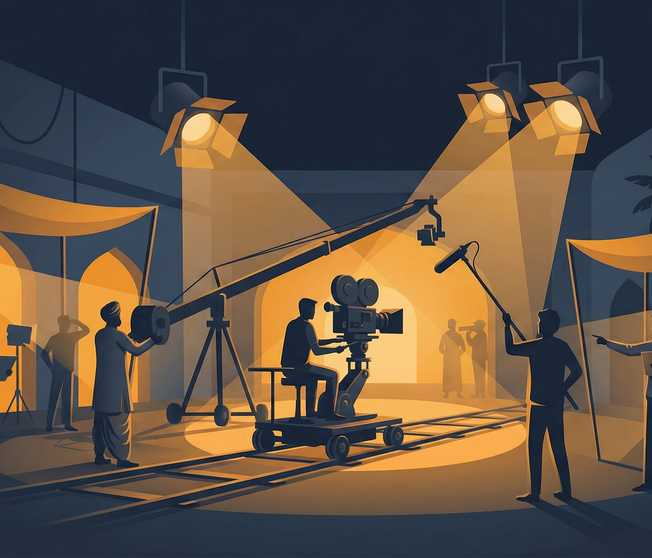
- Hero image:
Pan-Indian film crew working across industries on a large-scale production in India - RRR/Baahubali box office graphic:
RRR and Baahubali pan-Indian box office records India - City hubs map:
Pan-Indian film production hubs India — Hyderabad, Mumbai, Chennai, Bengaluru - Dubbing studio image:
Multilingual dubbing artist recording Hindi and Telugu audio for pan-Indian film India - Salary comparison chart:
Pan-Indian film crew salary vs regional industry rates India 2026
Featured Snippet Optimization Notes:
- The section "The Career Opportunities That Pan-Indian Cinema Has Unlocked" with its H3 subheadings and bold role names is structured to pull as a featured snippet for queries like "what jobs does pan-Indian cinema create" and "cross-industry film jobs India"
- The "Language Skills That Actually Matter Right Now" section should pull for "what languages to learn for Indian film industry"
- The "Which Cities Are Becoming New Hubs" section is structured for local SEO pull on queries like "pan-Indian film production cities India" and "best city for film career India"
- Add an FAQ schema block on the published page covering: "What is pan-Indian cinema?", "Which films are pan-Indian?", "How do I get hired for pan-Indian productions?", "What cities are pan-Indian film hubs?"
Content Length: Approximately 2,850 words — within the 2,500-3,000 word target range.
Recommended Publishing Platform: WordPress (Botble CMS). Use H2 for all major section headings, H3 for role subsections within the career opportunities section. Bold the role names in that section for scannability. The opening two-paragraph hook should not have a heading above it — let it run raw for maximum impact.
Related Blog Posts