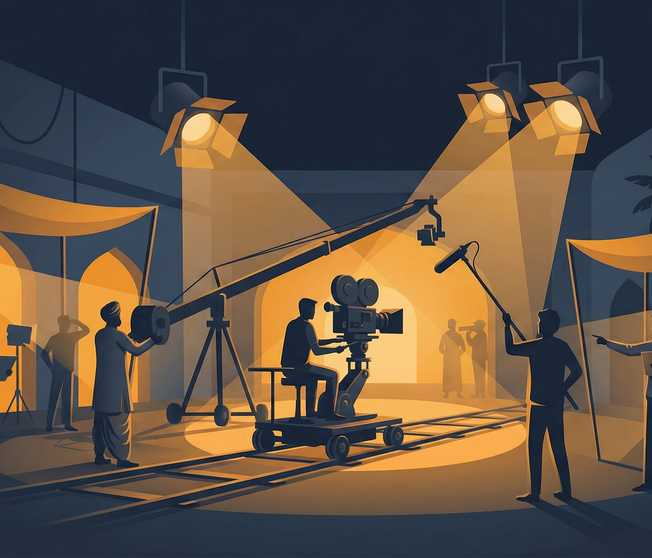
Set Photography Career in India: The Person Behind Every Movie Poster You've Seen
-

Lavkush Gupta
-
May 04, 2026
-
9
What Does a Set Photographer Actually Do?
The job title sounds simpler than it is. A set photographer isn't just someone wandering around with a camera taking pictures. They are the visual memory of a production.
Here's what the role actually covers:
Unit stills photography — capturing moments that mirror the film's look: angles, lighting ratios, and composition that match what the cinematographer is doing, so the stills feel like they came from inside the film rather than beside it. These are the images used for posters, press kits, OTT platform thumbnails, and theatrical one-sheets.
Production documentation — recording the practical reality of the shoot. Wardrobe continuity reference shots, set design documentation, prop arrangement before a reset. These images serve the production internally and are critical for VFX supervision and continuity departments.
Behind-the-scenes (BTS) photography — candid moments on set that feed social media, press junkets, and the "making of" content that streaming platforms now treat as a product in its own right. This is a growing portion of the job.
Portrait sessions — formal, controlled stills of the lead cast, often shot during breaks in principal photography or on dedicated portrait days. These go to magazine features, press tours, and awards season campaigns.
Event coverage — muhurat shots, production launch events, location press visits. These have a PR function and a tight turnaround requirement.
One set photographer can be doing all of these on the same day. That's the job.
BTS Photographer vs. Unit Still Photographer: Know the Difference
Before you pitch yourself to a production, understand that these are two distinct roles — and conflating them will make you look like an outsider.
A unit still photographer (the senior role) is embedded in the core crew. They work in direct coordination with the director, DP (Director of Photography), and the publicity department. Their images represent the film's official visual identity. They are typically present for every major shoot day and have negotiated image approval rights built into their contract.
A BTS photographer (or BTS videographer — the role has blurred) is usually brought in for specific shoot days, press visits, or social media content bursts. Their content has a shorter shelf life and a less formal approval chain. Many BTS photographers also shoot short video clips, reels, and time-lapses.
On big-budget Hindi productions, these are two separate hires. On mid-budget films and most regional productions, the unit still photographer does both. On indie films and web series, whoever shows up with a camera and doesn't annoy the director does both plus makes chai runs.
Why Every Production Needs a Set Photographer (Even When They Don't Know It)
We've seen small productions try to skip this hire. It always costs them more than the day rate they saved.
The marketing department needs images months before release. The OTT platform wants a thumbnail package before they'll confirm the streaming deal. The trade press wants exclusive stills for their feature. The publicist needs 40 approved images for the press kit by Monday. And the production — scrambling at that point — starts asking the spot boy if he took any pictures on his phone.
Set photography is infrastructure. It serves:
- Theatrical marketing — poster design, hoarding art, newspaper inserts
- Digital marketing — social media content calendars running weeks before release
- Press and PR — exclusive photo stories in film magazines, OTT promotional deals
- Archival — studio libraries, retrospectives, documentary material, anniversary campaigns
- Internal production use — continuity, VFX reference, director's personal archive
The shift to streaming has actually increased demand. Netflix, Amazon Prime Video, JioCinema, and SonyLIV all have aggressive content marketing arms that want still photography and BTS content delivered on schedule. A web series shooting 8 episodes may need a still photographer for the entire 90-day schedule — that's steady work.
The Skills You Actually Need
Photography ability is table stakes. What separates working set photographers from photographers who tried and gave up is everything else.
Technical photography skills:
- Shooting in near-silence during takes (mirrorless bodies mandatory — we'll get to gear)
- Reading artificial lighting setups quickly and adjusting exposure without flash
- Capturing peak action in short windows between "Action" and "Cut"
- Colour grading that matches the film's look board or DI grade
- Fast, professional culling and delivery under deadline
Set skills — the ones nobody teaches you:
- Reading the room: knowing when the director is approachable and when you become invisible
- Understanding shot lists well enough to anticipate where to be without asking
- Building trust with the AD (Assistant Director) who controls your access
- Not disrupting continuity by moving through frame lines
- Understanding the difference between a "hot set" (don't touch anything) and a reset
Interpersonal skills — more important than you think:
- Working with actors who range from relaxed collaborators to people who hate candid photography
- Navigating image approval processes with publicists, stars' managers, and studio marketing heads
- Understanding confidentiality: certain shots, plot elements, and costumes are under NDA
- Handling rejection without creating awkwardness on a set you'll be at for another 60 days
The diplomat-photographer combination is rare. If you have it, you will work.
Equipment: What You Need and What You'll Want
Here's an honest breakdown. Market prices are approximate and shift — verify before purchasing.
Essential kit:
- Mirrorless body (2 bodies minimum) — Sony A7 IV, Canon EOS R6 Mark II, or Nikon Z6 III. Mirrorless is not optional on professional sets. DSLR shutter noise will get you thrown off. Budget: Rs. 1,80,000 – Rs. 2,80,000 per body (market estimate).
- Fast zoom lenses — A 24-70mm f/2.8 and a 70-200mm f/2.8 cover 90% of set photography. Budget: Rs. 80,000 – Rs. 2,00,000 per lens depending on brand and condition (market estimate; good used glass is worth pursuing early in your career).
- Fast prime for low light — 50mm f/1.4 or 85mm f/1.8 for intimate scenes under practicals.
- High-capacity, fast SD/CFexpress cards — never skimp on storage on a set.
- Laptop for on-set culling — productions sometimes want selects same day.
- External hard drives (2) — redundant backup is non-negotiable. You cannot lose these images.
Gear you'll want once you're established:
- Second camera body for simultaneous portrait and candid coverage
- 135mm prime for compressed, cinematic portraits of actors
- Colour calibration card for matching the DP's look
- Silent shooting mode settings memorised — know your camera blindly
Total starting kit investment: Rs. 6,00,000 – Rs. 10,00,000 (market estimate). This is why assisting first makes financial sense.
How to Break In: The Actual Path
Nobody hands you a Bollywood set photographer contract. Here's how the people doing this job actually got there.
Step 1: Assist an established set photographer. This is the single most effective entry point. Established unit still photographers on mid-size productions sometimes take assistants. Your job will be carrying gear, managing card transfers, doing initial culls, and watching how the principal photographer moves on set. You will learn more in 30 days of assisting than in 3 years of workshops. Pay is minimal (Rs. 500 – Rs. 1,500/day is realistic for entry assistants — market estimate), but the access is invaluable.
Find these photographers through: FWICE affiliates, production company contact lists, and — increasingly — platforms like AIO Cine where verified productions post crew calls including photography roles.
Step 2: Build your portfolio on indie and short films. Short films don't pay much (often nothing), but they give you something a paying client needs to see: evidence that you can work on a set. Shoot 10-15 short films. Focus on variety — different looks, lighting conditions, genres. Your portfolio should show that your stills feel cinematic, not like event photography at a film set.
Student films from FTII, Satyajit Ray Film and Television Institute, and private film schools are an underutilised source of early-career set photography experience.
Step 3: Get on web series and digital productions. The Zee5s, ALT Balkis, and YouTube Original-level productions are mid-budget, fast-moving, and significantly less gate-kept than theatrical films. They need still photographers, they have slightly more flexible hiring pipelines, and they will pay. This is where many working set photographers built their first real credits.
Step 4: Build relationships with publicists. The publicity department is often the one who hires or recommends the set photographer. A publicist who trusts your turnaround time, your composition, and your discretion will bring you onto every project they touch. One solid relationship with a film publicist can sustain an entire career.
Day Rates and Payment Structures
Set photography in India is not a salaried profession. You are hired per production or per day.
Day rates (market estimates — verify with FWICE or industry peers):
- Entry-level / assisting: Rs. 1,500 – Rs. 3,000/day
- Mid-level (2-4 years, own kit, indie and web series credits): Rs. 5,000 – Rs. 12,000/day
- Established (Bollywood or major OTT productions): Rs. 15,000 – Rs. 35,000/day
- Senior unit still photographer on major theatrical release: Rs. 40,000 – Rs. 80,000/day or negotiated package per production
These are market estimates sourced from industry conversations. Actual rates vary by production budget, city, negotiation, and the photographer's credit list. Always confirm current rates with peers and FWICE representatives before negotiating.
Productions sometimes offer package deals: a flat fee for the entire shoot, inclusive of all deliverables. These can be more lucrative than day rates if the shoot schedule is compressed, or significantly less if it runs long.
Usage rights and licensing fees are separate from day rates and discussed below.
Working with Actors: The Unwritten Rules
This section exists because nobody writes it down and everyone learns it the hard way.
Some actors are generous collaborators who understand that set photography serves the film's marketing and embrace it. Others have contractual image approval rights and view every candid frame as a potential PR liability. You need to handle both with equal grace.
Practical rules for working with actors on set:
- Never photograph an actor between takes without reading the room first. Actors in character, exhausted, or in a difficult emotional scene do not want to be photographed.
- Know which actors have image approval in their contracts. Their manager or publicist will tell you, usually on day one. Respect it absolutely.
- When shooting posed stills, direct confidently but briefly. Actors are used to direction; what they are not used to is a still photographer who wastes their time with unclear asks.
- Never share any set images on your personal social media without explicit written approval from the production and the relevant talent's team. This is career-ending behavior and it happens more than you'd think.
- Candid moments — genuine laughter, an unguarded expression between takes — are often the most valuable images in a press kit. Train yourself to capture these without being seen doing it.
The Publicity Department Is Your Real Client
The director hired you. But the publicity team is who you're working for, functionally.
Understand what they need before you start shooting:
- Which scenes will be used in trailers (need stills to match)
- Which cast members have social media stories planned around them
- What the poster brief looks like (composition, colour, mood)
- Whether there are embargo dates on certain plot-revealing images
- Their preferred delivery format, resolution, and turnaround
A still photographer who attends the marketing brief with the publicity team before the shoot starts will always outperform one who just shows up and shoots. Productions remember this.
Delivering Your Images: The Professional Standard
Image delivery is where amateurs reveal themselves.
Format: RAW + JPEG selects is standard. The production needs RAW files for poster retouching and print; they need JPEGs for fast digital use.
Resolution: Minimum 24MP for poster-quality work. Delivery at full resolution unless otherwise specified.
Turnaround: Selects (curated best-of from the day's shoot) within 24 hours of each shoot day. Full edited gallery within 48-72 hours of wrap, depending on production scale.
Colour: Your edits should complement, not contradict, the film's established look. Ask for a look reference document or screenshots from the DI suite if available.
Organisation: Deliverable folders labelled by scene, day, actor, and image type. Productions with multiple sequences cannot spend time hunting through unsorted galleries.
Backup: Keep your own archive for minimum 2 years post-release. Productions will come back for anniversary campaigns, OTT relicense deals, and retrospective content.
Copyright and Usage Rights in Indian Film Industry
This is where most new set photographers get exploited, and it's worth understanding clearly.
Under Indian copyright law, the photographer is the first owner of copyright in a photograph. However, the production will almost certainly ask you to assign copyright or grant an exclusive licence as part of your contract.
What you need to know before signing:
- Work-for-hire clauses fully transfer copyright to the production. This is standard in large studio contracts and is typically non-negotiable. Understand what you're agreeing to.
- Exclusivity clauses may prevent you from using any set images in your own portfolio without written permission. Negotiate portfolio rights explicitly and in writing before you sign.
- Usage rights separate from day rates can be negotiated for advertising campaigns, merchandise, and international distribution — though this is more common in Western markets than in India currently.
- Credit is not guaranteed in India unless you specifically negotiate it. Request a photography credit on the film's official poster and press kit. Most productions will agree if you ask early.
Get a lawyer to review your first few contracts. The Rs. 3,000 you spend on an hour of legal advice is worth more than the Rs. 30,000 you might lose by signing away rights without understanding them.
Building Your Portfolio: What Actually Works
Your portfolio as a set photographer needs to prove one thing: that you can make a still image that looks like it belongs in the film.
What to include:
- Minimum 60-80 images across 4-6 different productions (even if they are short films)
- Variety of genres and moods — not just glamour stills
- Both candid BTS moments and formal unit stills
- Evidence that you can shoot in low light, artificial light, and outdoor conditions
- Clean, consistent colour grading
What to skip:
- Event photography from film premieres or award shows (different skill set, signals you don't know the difference)
- Social media BTS content that looks like phone photography
- Behind-the-scenes images of yourself working on set (this is not a self-promotion exercise)
Platform: Build a dedicated website. Instagram works as a discovery tool but a curated website with password-protected private galleries for production house review is the professional standard.
The Digital Shift: Video, Reels, and What the Job Looks Like Now
Five years ago, a set photographer only needed to shoot stills.
Today, productions increasingly expect BTS video content as part of the same deliverable package. Short clips for Instagram Reels, YouTube Shorts, Twitter/X posts, and the "making of" featurette that streaming platforms use as an acquisition hook.
This doesn't mean you need to be a full videographer. But understanding basic cinematic video capture — handheld stabilisation, b-roll logic, simple interview setups — makes you significantly more hireable in the current market.
Productions that shoot 90 days and want social media content across that window would previously have hired a separate BTS videographer. Now they often ask the still photographer to handle both, with a budget bump. If you can do both competently, you have a real advantage.
City-Specific Opportunities
Mumbai remains the primary market for Hindi film and the headquarters of every major OTT platform's India operation. Competition is highest here, but so is volume. A working set photographer in Mumbai can be continuously employed across theatrical, web series, ad film, and music video productions.
Hyderabad is the second market and growing fast. Tollywood productions, South Indian OTT originals for Amazon Prime Video and Netflix, and the growing international co-production scene (several Hollywood productions scout and partially shoot in Telangana) create genuine opportunity.
Chennai and the Tamil film industry (Kollywood) have a well-established production infrastructure and a more tight-knit crew community. Breaking in takes longer, but the relationships are more durable once built. Tamil productions also export heavily to global Tamil diaspora markets, which means international press attention.
Emerging: Kochi (Malayalam film industry / Mollywood) is producing some of the most critically acclaimed content in Indian cinema right now. The crew community is accessible, productions are often willing to work with newer photographers, and the budgets — while smaller than Mumbai — are growing.
Career Progression: Where This Can Go
Set photography is not a dead end. It is, for the people who play it strategically, a launchpad.
Set Photographer → Unit Publicist: Several working publicists started as set photographers. The overlap in skills — visual storytelling, actor relationships, marketing awareness — is substantial.
Set Photographer → Marketing Executive: Production houses and OTT platforms hire people who understand visual content at a production level. A set photographer with strong delivery skills and marketing instincts can transition into in-house content or marketing roles.
Set Photographer → Portrait Photographer / Commercial: Film credits open commercial doors. A photographer with Bollywood or major OTT credits on their site is taken seriously by advertising agencies and fashion brands.
Set Photographer → Director of Photography: Less common, but it happens. Several working DPs started as photographers learning composition and light on sets before transitioning into motion.
Famous Set Photographers in India Worth Knowing
Learning from those who built this craft before you is essential. While comprehensive documentation of India's set photography community is limited (the invisibility problem again), a few names have broken through:
- Pradeep Chandra has documented some of the most iconic Bollywood productions of the last two decades. His work across multiple Shah Rukh Khan films defined what Bollywood press photography looked like for an era.
- The still photography community connected to the Film Photographers Association in Mumbai represents the professional body most relevant to this career path.
Spend time on film tribute accounts and archival film Instagram pages — many uncredited set photographs surface through these channels and allow you to study composition and technique from working professionals.
Your Next Move
Set photography is one of the few crew positions in Indian cinema where a technically skilled outsider can actually break in — if they approach it strategically, build the right relationships, and understand that the camera is only 40% of the job.
The rest is set sense, diplomacy, and delivering what a marketing department needs before they know they need it.
If you're serious about pursuing set photography as a career, start where the opportunities are posted by verified productions. We built AIO Cine because too many crew members — photographers included — were wasting months chasing fake gigs from unverified contacts. Every production house on the platform is verified before they can post a crew call. Registration is free.
The right opportunity should find you on a real set — not in a WhatsApp group that leads nowhere.
Frequently Asked Questions
Do I need a film school degree to become a set photographer? No. A strong portfolio of set work demonstrably outweighs any formal degree in this specific role. Photography qualifications help technically, but set experience is what productions hire.
Can I start in my city and build toward Mumbai? Yes, and this is often the smarter path. Local indie productions, regional OTT content, and ad films in Tier 1 cities outside Mumbai give you real credits and tighter crew communities. Many successful Mumbai-based set photographers started in Pune, Hyderabad, or Chennai.
How do I find productions that need a set photographer? Directly through production company contacts, through assisting established photographers, through film school networks, and through verified crew-call platforms like AIO Cine.
Is the role physically demanding? Yes. You will stand for 10-14 hours on your feet, move equipment frequently, and often shoot in challenging conditions — extreme heat, low light, outdoor environments. Physical stamina is part of the job.
Salary and day rate figures in this article are market estimates based on industry conversations and publicly available information. Rates vary by production budget, city, negotiation, and experience level. Always verify current rates with FWICE representatives or experienced peers before negotiating any contract.
SEO Notes
Suggested Title: Set Photography Career in India: The Person Behind Every Movie Poster You've Seen
Meta Description: Everything you need to know about building a set photographer career in India — day rates, gear, how to break in, working with actors, and city-specific opportunities in Bollywood and beyond.
Target Keywords:
- Primary:
set photographer career India - Secondary:
film still photographer jobs,movie set photography India,unit still photographer Bollywood,BTS photographer film set India
Internal Link Suggestions:
- Link "fake gigs from unverified contacts" to the fake casting calls blog post
- Link "FWICE" references to the FWICE membership guide blog post
- Link "Register on AIO Cine" to the registration/signup page
- Link "crew calls" to the AIO Cine crew jobs listing page
Image Alt Text Recommendations:
- Hero image:
set photographer working on Bollywood film set in Mumbai - Gear section image:
mirrorless camera kit for film set photography India - BTS image:
unit still photographer capturing behind the scenes on Indian film production - Portfolio section image:
film still photography portfolio India - City section image:
film production set Hyderabad Tollywood
Additional SEO Notes:
- The FAQ section at the end is structured for featured snippet eligibility on question-form queries
- H2 and H3 headings contain natural keyword placements for crawl discoverability
- Word count target (2,500-3,000 words) is competitive for this keyword cluster — verify against current SERP top results and adjust if needed
- Consider adding a structured data FAQ schema block on the published page to enhance SERP appearance
- Publish date should be current (2026) and updated annually — freshness signals matter for career-advice content
Related Blog Posts