The Most Underrated Career in Indian Cinema: How to Become a Sound Designer (2026)
-

Lavkush Gupta
-
May 04, 2026
-
10
Close your eyes during Baahubali 2. Right now. Just listen.
The arrow whistling past your ear. The roar of the waterfall that feels physical, like it's pressing against your chest. The grunt of Prabhas that doesn't just come from a speaker — it seems to come from inside the scene. The crowd noise layered thirty-deep, each layer placed in a different point in 3D space around you.
Now open your eyes. Who made that?
Not the director. Not the composer. Not the VFX team.
That was a sound designer. A sound recordist. A Foley artist. A re-recording mixer. A dialogue editor. An entire invisible department that most audiences will never know the names of, will never think to Google, and will never see on a film poster.
They are the most underrated craftspeople in Indian cinema. And right now, in 2026, they are the most in-demand too.
This is the career you probably haven't seriously considered. It's time you did.
Why Sound Is 50% of the Film Experience and Gets 5% of the Credit
Here's a test directors use on student films: watch a scene with only the picture, no audio. Then watch the same scene with only the audio, no picture. Almost always, the audio version communicates more — emotion, location, time of day, social context, tension, release.
George Lucas, who built Skywalker Sound into the greatest audio facility in film history, said it directly: "Sound is half of the experience." Walter Murch, who edited Apocalypse Now, went further: he called the ear "the sentinel sense" — the one sense that even a sleeping animal keeps active.
Indian cinema has known this intuitively for a century. The moment Bollywood figured out sound recording in the 1930s, it invented the musical film as a genre. Sound was foundational. And yet, walk into any film school in India today and count the students in the sound department versus the direction department. You'll find ten directors for every one sound student.
This creates a paradox and an opportunity.
The paradox: audiences immediately notice bad sound. They tune out, they get headaches, they leave a scene feeling vaguely unsatisfied without knowing why. Watch a low-budget Indian web series with mediocre sound design and you can feel the quality gap — even if you can't name it. Sound quality shapes the perceived production value of a film more than almost any other single technical element.
The opportunity: because so few people train for it, the ones who do are in perpetual, genuine demand.
The Sound Department: Five Careers, One Profession
The "sound team" isn't a single role. It's a pipeline of specialized crafts. Here's how they connect.
1. Production Sound Recordist
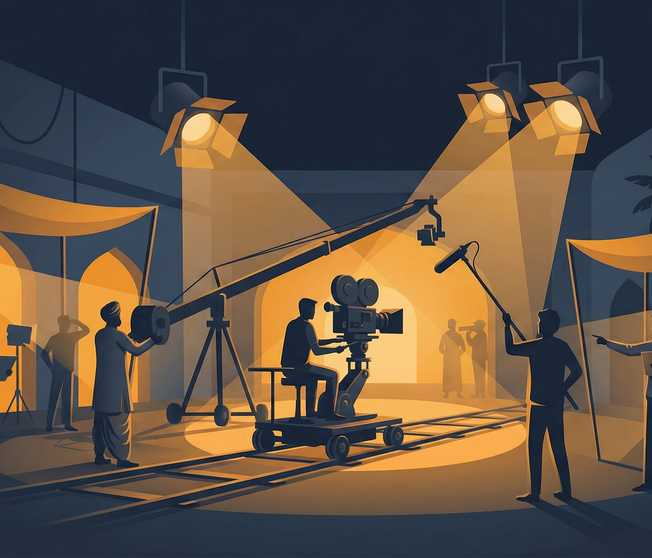
This is the person on set with the boom mic, the field recorder, and the sound cart. Their job: capture clean, usable dialogue and production atmosphere during the shoot. This is harder than it sounds (pun entirely intended). You're fighting air conditioning units, planes passing overhead, generators, set noise, dialogue overlap, reverberant locations, and boom shadows — simultaneously, in real time, with a director who wants to move on to the next shot.
The production sound recordist is the first link in the chain. If they miss a line, the post-production team has to loop it — and looped dialogue (ADR) rarely matches the emotional truth of what was captured on set. A great sound recordist saves the film. A poor one costs the film weeks in the edit.
Entry salary range: Rs. 15,000-25,000/month (assistant sound recordist). Rs. 40,000-80,000/month as a seasoned recordist on commercial productions. Rs. 8,000-25,000/day on ad films and TVCs.
2. Sound Designer
The sound designer is the architect of the film's auditory world. In post-production, they build — from scratch — every sound effect, ambient texture, and non-musical audio element in the film. The thud of a fist. The specific hum of a spaceship engine that has never existed. The rain on a tin roof that tells you exactly where in South India we are.
Great sound designers collect sounds obsessively. They have hard drives filled with recordings of empty cathedrals, construction sites, monsoon rain, animal sounds, mechanical machinery, and things that defy easy categorization. From these libraries — and from sounds they design synthetically using software — they construct the world of the film.
Salary range: Rs. 30,000-70,000/month on OTT series. Rs. 80,000-2,50,000 per project for features. Top sound designers in Mumbai command Rs. 5-15 lakh per film.
3. Foley Artist
Foley is the art of recreating everyday sound effects in sync with picture. Footsteps on marble. The rustle of a saree. A glass placed on a wooden table. The creak of a door. These sounds are often unusable from the set recording and must be recreated live by a Foley artist performing them in a specialized studio, watching the film projected, matching their movements to the actor on screen.
It sounds simple. It is, in practice, one of the most physically demanding and technically precise crafts in post-production. Good Foley artists in India are extremely rare and extremely busy.
Salary range: Rs. 20,000-50,000/month on a retainer at a post-production studio. Rs. 5,000-20,000/day freelance on feature projects.
4. Dialogue Editor
The dialogue editor receives all the recorded dialogue from the shoot — production sound, ADR, improvised takes — and assembles it into a clean, continuous track. They make decisions about which take of every single line to use, how to hide edit points, how to manage noise floor inconsistencies between takes, and when to flag lines that need to be re-recorded.
This is a precision craft. A dialogue editor might spend a full day on three minutes of a single scene.
Salary range: Rs. 25,000-60,000/month in-house at a post-production house. Rs. 30,000-80,000 per episode for OTT series.
5. Re-Recording Mixer (or Mix Engineer)
The re-recording mixer sits at the final stage of the sound pipeline: the dub stage. They take every element — dialogue, music, sound effects, Foley, ambience — and balance them into a single, cohesive mix. On a Dolby Atmos project, this means placing every sound in three-dimensional space — height channels included — so that the mix works in a 128-speaker theatrical setup and also translates to a smartphone speaker.
This is the top of the sound department pyramid. A re-recording mixer with feature film credits is one of the rarest and highest-compensated professionals in Indian post-production.
Salary range: Rs. 80,000-2,00,000/month at a major post-production facility. Rs. 3-10 lakh per film for senior mixers on theatrical releases.
The Dolby Atmos Revolution That Changed Everything
Here's why 2026 is a genuinely exceptional moment to enter sound.
Three years ago, Dolby Atmos was a technology used primarily by large Hollywood productions and a handful of Indian prestige releases. Today it's essentially mandatory for any film targeting a theatrical release in tier 1 Indian cities, and it's the delivery spec that Netflix India and Amazon Prime Video increasingly require for their flagship originals.
Dolby Atmos is an object-based audio format that allows mixers to place sounds anywhere in a three-dimensional space — including overhead. In a properly equipped theatre, it's not surround sound, it's spatial sound. When rain falls in a film mixed in Atmos, it falls from above you, not from speakers beside you.
This shift has created a specific technical skills gap. Atmos mixing requires specialized training, certified facilities, and a different mental model of how to construct a soundscape. The number of engineers in India fully trained in Atmos mixing is small. The demand from OTT platforms and theatrical distributors is growing quarter by quarter.
OTT platforms have also driven volume. When a platform like Netflix commissions 20 Indian originals simultaneously across Hindi, Tamil, Telugu, Malayalam, and Kannada, each one needs a full sound team through production and post. The math creates jobs that simply didn't exist five years ago. Streaming hasn't diminished the sound profession — it's turbocharged it.
The Resul Pookutty Effect: When Indian Sound Got an Oscar Moment
On February 22, 2009, a sound mixer from Kerala named Resul Pookutty walked up to the stage at the Kodak Theatre in Hollywood and accepted an Academy Award for Best Sound Mixing for Slumdog Millionaire.
He was the first Indian to win an Oscar in a sound category. He was 35 years old.
The moment was larger than the award. It was a signal — internationally and domestically — that Indian sound professionals could compete at the highest level in the world. Pookutty had trained at FTII Pune, worked his way up in the Indian industry, and then taken his craft to the global stage. He won alongside the kind of Hollywood production pipeline that most Indian sound professionals had been told was unreachable.
What Pookutty proved is what practitioners already knew: the craft of Indian sound work — particularly the recording and mixing traditions developed over decades in Mumbai and Chennai — is world-class. The deficit has never been talent. It's been visibility, training infrastructure, and the assumption (among aspiring professionals) that sound is a secondary career choice.
Post-Pookutty, that assumption is harder to maintain. His career established a blueprint. FTII Sound. Industry apprenticeship. Feature film credits. International work. Oscar nomination. The path is documented. Other Indian sound professionals are following it.
Equipment and Software: What the Profession Actually Uses
You don't need to own everything. But you need to understand everything.
On the production sound side:
- Boom microphones: Sennheiser MKH 416 (the industry workhorse — short shotgun, excellent off-axis rejection), Rode NTG5 (lighter, affordable alternative for low-budget work)
- Wireless lavalier systems: Sennheiser G4 series (widely used in India), Sony UWP-D series (common in broadcast), Lectrosonics (professional-tier, used on large features)
- Field recorders: Sound Devices MixPre-6 II (the standard entry-level professional recorder), Sound Devices 888 (the professional standard for feature film shoots)
- Mixers: Sound Devices 688/888 are both recorder and mixer in one unit — the field standard globally
On the post-production side:
- Pro Tools: This is the non-negotiable industry standard for all professional audio post-production in India and worldwide. If you work in sound post for film or TV, you work in Pro Tools. Every dialogue edit, sound design session, and dub stage runs on it.
- Logic Pro: Extremely useful for sound design and music production integration. Many sound designers use Logic for designing sounds and synthesis, then bring assets into Pro Tools for the final session.
- iZotope RX: The de-facto standard for audio restoration and noise reduction. RX is what dialogue editors use to clean problematic location recordings — reducing air conditioning hum, removing wind noise, cleaning up clipped dialogue.
- Nuendo: Steinberg's professional DAW, used at some post-production facilities, particularly those doing broadcast work.
- Plugins: Waves, Fab Filter, Soundtoys, McDSP — these are the primary plugin ecosystems used in Indian post-production facilities.
Understanding the signal chain from mic capsule to Pro Tools session to dub stage monitoring is foundational. You don't master this from YouTube. You master it from hours — thousands of hours — behind a recording desk.
Education Paths: Where to Actually Learn This
FTII Pune — Sound Engineering & Design
The Film and Television Institute of India offers a three-year diploma in Sound Recording and Design. It is, without question, the most prestigious sound education available in India. The course covers location recording, studio recording, sound design, and mix. Graduates have access to the strongest peer network in the Indian industry.
The entrance exam (FTII Joint Entrance Test) is competitive. The course is government-subsidized, making it extraordinarily affordable — fees in the range of Rs. 1-2 lakh total for the three-year program. The catch: you must be a graduate to apply, and seats are limited.
If you can get in, go.
SAE Institute Mumbai / Delhi
SAE is an international audio and media education group with campuses in Mumbai and Delhi. The Audio Production diploma covers DAW operation, studio recording, mixing, and post-production. The courses are more practically focused than FTII, with more hands-on studio time early in the curriculum. Industry connections are decent in Mumbai.
Fees are significantly higher than FTII — expect Rs. 3-6 lakh. But the advantage is a structured, Western-curriculum approach to professional audio that gets you operating Pro Tools from day one.
Whistling Woods International Mumbai
WWI offers courses in sound that include film sound design and post-production. The Film City Mumbai location gives students proximity to working professionals in a way that classroom programs in other cities can't replicate. If your goal is the Hindi film industry, WWI's network advantage is real.
The Self-Taught Path via Podcasting and Music Production
This route is underrated and absolutely viable — particularly for getting your first three years of experience. The workflow is:
- Learn Pro Tools or Logic Pro properly (SAE's online resources, YouTube channels like In The Mix and Produce Like A Pro, Avid's own training materials).
- Start recording podcasts. The demand for podcast audio in India is enormous — brands, news organisations, comedians, educators — all producing audio content that needs competent recording and editing.
- Build music production skills. Music producers understand frequency, dynamics, spatial placement, and mix translation — all of which directly transfer to sound design.
- Assistant on short film sets as a boom operator or sound trainee. Offer your time, offer your learning, and watch how professional recordists work.
The self-taught sound professional who can demonstrate technical competence — through a strong reel — is taken seriously in India's mid-market and independent film sector.
Freelance Sound Work: Building Income While Building Credits
This is the part nobody talks about enough.
The transition into full-time film sound work doesn't happen overnight. In the meantime, here are the freelance markets that pay real money and build real skills:
Ad Films and TVCs: The highest-paying consistent work for sound professionals outside of features. A two-day ad film shoot can pay a sound recordist Rs. 15,000-40,000 for two days of work. The turnaround is fast, the budgets are healthy, and the clients are (usually) professional. Mumbai and Hyderabad have robust ad film markets.
Corporate Videos and Brand Content: Every major brand in India produces video content continuously. Production quality expectations have risen sharply. Corporate video sound work is consistent, well-paying, and builds fundamental skills.
Podcasts and Audio Series: India's podcast market has grown dramatically since 2020. Brands and media companies are paying Rs. 10,000-40,000 per episode for professionally produced audio. As a sound engineer who understands voice recording, noise reduction, and audio branding, you're equipped for this work from day one.
Audiobooks: The Indian audiobook market is expanding. Production houses and publishing companies commission audio recording sessions that pay per hour of finished audio — rates of Rs. 3,000-8,000 per finished hour are common.
Music Videos: Music labels and independent artists constantly need production sound recordists. The work is fast-paced, pays reasonably, and adds credits to your reel.
Web Series (Independent and Mid-Tier): Before you're working on a Netflix original, you're working on independent web series, regional OTT productions, and YouTube-distributed drama content. These don't pay features rates, but they build long-form experience and professional relationships.
The strategy is straightforward: freelance work funds your life while you build film credits. Every ad film you record, every podcast you produce, every corporate video you mix — it makes you better. And better sound professionals work on better films.
Salary Ranges Across the Sound Department (2026 Estimates)
The following are market estimates based on Hindi film industry standards in Mumbai. Regional markets (Hyderabad, Chennai, Kochi) run 15-25% lower for equivalent experience levels.
| Role | Fresher (0-2 years) | Mid-Level (3-7 years) | Senior (7+ years) | |------|--------------------|-----------------------|-------------------| | Sound Trainee / Boom Operator | Rs. 10,000-18,000/mo | — | — | | Assistant Sound Recordist | Rs. 15,000-25,000/mo | Rs. 30,000-50,000/mo | — | | Production Sound Recordist | Rs. 25,000-45,000/mo | Rs. 50,000-90,000/mo | Rs. 1,000-2,500/day on features | | Dialogue Editor | Rs. 20,000-35,000/mo | Rs. 40,000-70,000/mo | Rs. 60,000-1,20,000/mo | | Foley Artist | Rs. 15,000-30,000/mo | Rs. 35,000-60,000/mo | Rs. 50,000-90,000/mo | | Sound Designer | Rs. 25,000-40,000/mo | Rs. 50,000-90,000/mo | Rs. 1-5 lakh/project | | Re-Recording Mixer | Rs. 35,000-55,000/mo | Rs. 70,000-1,50,000/mo | Rs. 2-10 lakh/film |
Ad film premiums: production sound recordists typically earn 2-3x their per-day film rate on ad film shoots. Post-production sound designers charge Rs. 15,000-60,000 per day on TVC post-production projects. These are market estimates — verify current rates through professional networks.
Why Sound Professionals Are in Short Supply in India
This is not a polished talking point. It's a structural reality.
The number of working sound professionals who can handle the full technical requirements of a modern Indian theatrical release — production sound, sound design, Dolby Atmos mixing — is small. Not hundreds. Not thousands. Dozens of genuinely senior practitioners.
Compare this to any other film craft. Direction, editing, cinematography, production design — all have much larger professional pools. Sound has a supply gap, and here's why it exists:
Sound education has historically been invisible. Film schools have trained directors and cinematographers with enthusiasm. Sound courses were afterthoughts at most institutions until the last decade. There are more acting workshops in Mumbai in a single month than sound engineering courses in the entire country in a year.
The craft looks technical, which scares away creative people. There's a false binary that sound is either music production (creative) or audio engineering (technical). In reality, sound design is one of the most profoundly creative disciplines in cinema. It just happens to require technical fluency. That combination is rare and, therefore, valuable.
Atmos and immersive audio have accelerated the gap. The professionals who were already in the pipeline for traditional 5.1 surround work now need to retrain or upskill for object-based spatial audio. The pipeline that was thin is now being asked to deliver a much more complex product.
If you are a music producer, an audio engineer, a podcast producer, or a recording enthusiast who has ever thought about film sound — the industry is actively waiting for people like you.
Building Your Sound Reel: What Actually Belongs in It
Your sound reel is your calling card. Here's what to put in it — and what to leave out.
What to include:
- Your three strongest projects, full stop. Not your ten. Not your twenty. Three. Sound professionals have very little patience for long reels. If you haven't grabbed them in ninety seconds, you've lost them.
- A variety of scenarios. A dialogue-heavy interior scene, an action sequence with layered sound effects, an atmospheric exterior or nature scene. These three scenarios demonstrate range.
- Clean location recordings. If you're showcasing production sound work, include raw location audio that demonstrates clean capture — not just post-produced material.
- Before/after moments for dialogue editing. If you do dialogue editing, show a thirty-second clip with the problem audio followed by your cleaned version. This is more impressive than any finished, polished piece.
- Atmos content, clearly labeled. If you've worked on any Atmos-mixed content, include it and flag it prominently. In 2026, this is a significant differentiator.
What NOT to include:
- Student exercises on obviously synthetic sounds. Even if the exercise is technically competent, it lacks the context of a real scene.
- Projects where sound is buried under music. A reel dominated by a composer's score tells us nothing about your sound work.
- Long ambient pads with no editorial decision-making visible. Ambience matters, but show us that you can construct a full sound world.
Where to host it: SoundCloud (for audio-only), Vimeo (for synced video with sound), and a personal website with an embedded player and downloadable reference. Keep your reel accessible without requiring a login or a request. Gatekeeping your reel is the fastest way to not get hired.
The Short Supply Is Your Opportunity
Let's bring this back to where it matters.
The Indian film and OTT industry is producing more content than ever before. The technical quality expectations — driven by global competition on streaming platforms and multiplexing audiences who know what Dolby Atmos feels like — are rising year on year. The creative bar for sound, driven by examples like RRR, Animal, Sacred Games, and the entire Mollywood new wave, is rising alongside it.
And the pool of trained, professional sound people in India remains critically small.
You don't have to displace anyone to find work in this field. You have to show up, train properly, build your reel project by project, and be willing to start with short films and ad films before you're mixing features. The career ladder is real, the compensation is real, and the creative satisfaction — of building a world that an audience will inhabit for two hours and never consciously notice, which is actually the highest compliment in sound design — is unlike anything else in cinema.
Resul Pookutty walked into FTII Pune with ambition and craft and walked out with a career that ended on an Oscar stage. That path didn't begin at an Oscar podium. It began with understanding microphones.
Where does yours begin?
Your Next Step: Make Yourself Findable
Sound professionals are actively being searched for on crew call platforms across India right now. Production houses looking for sound recordists for ad films, Foley artists for OTT post-production, dialogue editors for regional web series — these are real, current, recurring needs.
Create your profile on AIO Cine, where every production house is verified before they can post a crew call. List your department, your specialization (production sound, sound design, post-production mixing), your location, your equipment, and link your reel. Indian productions — from independent short films to OTT originals to ad film production companies — use the platform to find exactly the kind of technical crew that is in shortest supply.
The work is there. The shortage is real. The craft is extraordinary.
Build your reel. Register your profile. The industry needs your ears.
All salary figures are market estimates for 2026 and vary by city, project type, production budget, and individual experience. Verify current rates through professional networks and FWICE affiliates.
SEO Notes:
- Internal linking opportunities: Link to the cinematographer career guide, the AD career guide, the OTT jobs post, the FTII/film institutes post, and the film crew day rates post. Sound design appears as a cross-reference in several of these.
- Image suggestions: (1) A production sound recordist with boom mic on set, alt text: "production sound recordist with boom mic on Indian film set"; (2) Pro Tools session on a dub stage, alt text: "Pro Tools session at Indian post-production studio for film sound design"; (3) Dolby Atmos certification logo or dub stage interior, alt text: "Dolby Atmos mixing suite India film post-production"; (4) Resul Pookutty portrait (rights-cleared), alt text: "Resul Pookutty Oscar-winning Indian sound designer Slumdog Millionaire."
- Featured snippet optimization: The salary table and the "Five Careers" section with the numbered list structure are both strong candidates for snippet extraction.
- Schema markup: Add HowTo schema if the reel-building section is formatted as a step sequence on the WordPress/Botble CMS end.
- Secondary keyword density check: Ensure "sound recordist salary India" appears in at least 2 subheadings or within the first line of key paragraphs; "audio post production career" should appear in the opening 300 words.
- Word count: Approximately 2,900 words — within the 2,500-3,000 brief.
Related Blog Posts