The Spot Boy's Guide: The Most Underrated Entry Point Into Indian Cinema
-

Lavkush Gupta
-
May 04, 2026
-
12
What Does a Spot Boy Actually Do? (It's Not What You Think)
The tea stereotype is the most damaging thing that ever happened to this career path. Yes, a spot boy will sometimes make chai and bring it to the director's chair. That is the least interesting 2% of the job.
Here is what actually happens on a working day:
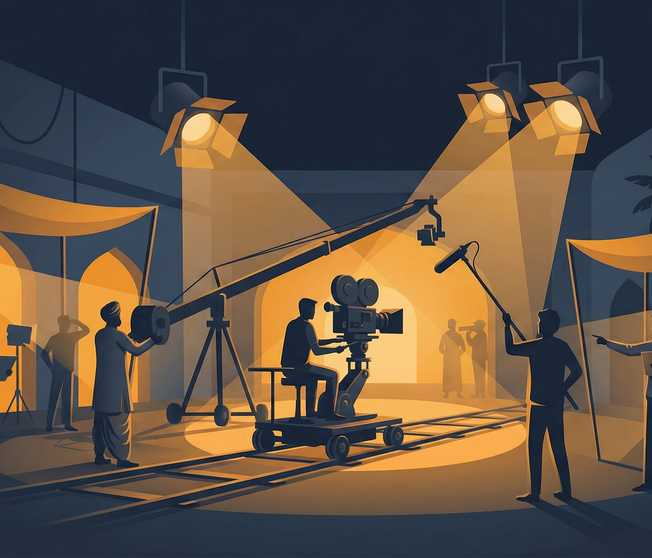
Set preparation and breakdown. Before the camera rolls, someone has to dress the set — move furniture, position props, tape down cables, cover reflective surfaces, bring in equipment from the production truck, and make sure the space matches what the art department designed. After the shot, someone tears it all down and resets for the next scene. That someone is the spot boy, working alongside the art department and production team.
Prop management. On smaller productions, spot boys are the last line of defense for props continuity. If the hero's coffee cup was half-full in the previous shot, it needs to be half-full again. If a painting was on the left wall in the morning scene, it stays there all day. Spot boys develop sharp eyes for this. Some transition directly into script supervision because of it.
Actor comfort and support. This is where the real relationship-building happens, and we'll come back to it. A spot boy attends to actors between takes — holding an umbrella on an outdoor shoot, bringing water, adjusting a costume piece, making sure the talent is comfortable enough to do their best work. In this role, you are physically close to the people who run this industry. Use that proximity wisely.
Continuity assistance. Beyond props, spot boys track the physical state of the set across long shooting days. Experienced spot boys become invaluable continuity anchors, especially on shoots without a dedicated script supervisor.
Equipment relaying. Spot boys carry equipment between departments — lights, reflectors, C-stands, clapperboards, lens bags. You handle gear constantly. By month three you know what a pancro diffuser does, what a 5K HMI weighs, and why you never drag a sandbag.
Set cleanup between takes. Every take generates mess — tape, packaging, catering detritus, moved furniture. The spot boy maintains the cleanliness and order of the workspace between shots so the crew can function efficiently.
Errand running. Stationery, snacks, a specific prop the director just decided they need, medicine from the nearest chemist for a crew member who's sick. Spot boys are the set's logistics layer.
This is a role that puts you at the intersection of every single department on a film set. You are always present, always needed, always watching.
Why This Is the Best Entry Point Nobody Talks About
Let's think about what you need to build a film career: knowledge of how productions actually work, relationships with people in every department, and a reputation for being someone people want to work with again.
A film school graduate gets one of those three. Maybe one and a half if they're lucky. A spot boy gets all three, paid, on a real production, from day one.
You see every department operate. Over six months as a spot boy, you will watch the DOP light a scene from scratch. You will watch the director work with actors. You will be close enough to the sound department to understand what they're fighting against on a difficult location. You will watch the production designer solve problems with a fraction of the budget they need. You will understand, viscerally, how a film set actually runs — not the theory of it, the sweaty, chaotic, brilliant reality of it.
No classroom replicates this. Film schools teach you to talk about cinema. Spot boy work teaches you to make it.
You build relationships with everyone. And we mean everyone. The spot boy is the one person who crosses department lines freely. The gaffer knows your name. The lead actor knows your face. The AD has yelled at you and apologized and yelled at you again. The production coordinator knows you're reliable. These are the relationships that get you your next job, and the one after that. The film industry runs on trust built over time, and the spot boy role gives you more time building that trust with more people than any other starting position.
You build a reputation fast. In this industry, your reputation is your CV. A spot boy who is sharp, fast, anticipatory, and cheerful under pressure will be talked about. People will ask for them by name. Coordinators will say, "Yeah, call him, he's good." That's the machine that moves careers.
The barrier to entry is the lowest in the industry. You don't need a portfolio. You don't need a degree. You don't need an agent. You need to show up, be reliable, and be willing to work hard in unglamorous conditions. For first-generation industry entrants — people from outside Mumbai, people without industry contacts — this is the door that is actually open.
A Spot Boy's Daily Routine: What You're Actually Signing Up For
Shifts start before the sun. On a typical shoot day, a spot boy will arrive on location 45 minutes to an hour before the general crew call. This is not optional. This time is used for basic set preparation — clearing the space, receiving props from the art department vehicle, setting up the craft services station, and running any last-minute errands the production coordinator needs before the camera unit arrives.
Once the shoot starts, the rhythm is dictated by the camera. You are active between takes and during setups. When the director calls "rolling," you step back. When they call "cut," you move. The pace is unrelenting.
On a 12-hour shooting day (which is considered normal — 14-16 hours is not unusual), you will be on your feet for the majority of it. There is very little sitting. Meals happen fast and often at odd hours.
Location shoots are physically harder. You're managing everything in environments you have no control over — heat, rain, dust, uneven terrain, and none of the infrastructure of a purpose-built studio. Mumbai's Film City and Hyderabad's Ramoji Film City are comparatively civilized; real location work in the mountains or on village streets is a different level of physical demand.
The day ends when the last shot is completed, the set is cleared, and the equipment is loaded back into vehicles. Then you go home and do it again tomorrow.
What You'll Earn: Pay Ranges (Market Estimates)
The following figures are market estimates based on industry knowledge current as of early 2026. These vary significantly by city, production size, production house, and whether you are working on a Hindi film, regional language film, television serial, OTT production, or advertising film. Always verify current rates directly with the production coordinator or FWICE representatives before accepting any engagement.
Daily rate (spot boy, non-union): Rs. 600 to Rs. 1,200 per day depending on the production budget. Some large budget Hindi films may go slightly higher.
Daily rate (spot boy, FWICE card holder): Rs. 900 to Rs. 1,500 per day. Union membership floors tend to be higher and offer more protection against non-payment. (More on this below.)
Television serial spot boy (monthly contract): Rs. 12,000 to Rs. 22,000 per month, typically with more consistent work and fixed days off.
OTT productions: Rates have climbed over the last three years as streaming budgets have expanded. Rs. 1,000 to Rs. 1,800 per day is increasingly common on premium OTT shoots.
Advertising films: Ad shoots typically pay better per day than narrative productions — Rs. 1,200 to Rs. 2,500 per day — but the work is less consistent.
Spot dada (senior experienced spot boy running a team): Rs. 2,500 to Rs. 5,000 per day, plus often a percentage markup on the team rates. This is a genuine middle-management position and the income reflects it.
Keep in mind that film shoots are not year-round. You will have gaps between productions. Television serials offer more consistent income but less variety and typically lower rates. Many experienced spot boys diversify across both.
Important verification disclaimer: All pay figures in this section are market estimates only. Rates fluctuate with production type, city, and negotiation. Verify current rates with FWICE (Film Workers India Cine & Entertainment) or directly with production coordinators before accepting any work.
The Spot Dada System: How Spot Boy Teams Actually Work
If you work on a large Hindi film production, you won't find one spot boy. You'll find a team of six to fifteen, led by an experienced senior called the spot dada.
The spot dada is not a title bestowed by management — it's earned through years on set and through the trust of both the production team and the spot boys working under them. A spot dada is essentially a subcontractor: the production coordinator calls the spot dada, quotes the shoot requirements, and the spot dada assembles and manages the team. The dada handles the logistics, receives the lump payment, and distributes wages.
This system matters for newcomers because your entry point is often through a spot dada. If you can get in with a dada who works regularly with a production house, you have consistent work. You become part of a working unit. The dada knows the production house's expectations, the rhythms of their shoots, and which productions are worth taking.
A good spot dada is also an informal mentor. Watch how they move on set — their economy of motion, their anticipation of needs, their ability to communicate instantly with every department. That is a masterclass in professional set behavior you cannot buy.
Equipment and Supplies: What a Spot Boy Carries
A working spot boy's kit is not glamorous, but it is specific. Over time you build up what you carry based on what you've been caught without.
The basics: a cleaning cloth, a small multipurpose tool, cable ties (always needed, never where you left them), a black marker, masking tape, gaffer tape (your own small roll — not from the department roll, your own), a notebook and pen, and a phone with contacts for every vendor the production has worked with.
For outdoor shoots: sunscreen, a compact umbrella, a small first aid kit. You are often the person closest to the actor when they need something small and immediate.
Physical basics: comfortable closed-toe shoes that you don't mind ruining. Not fashion sneakers. Not slippers. Shoes that can take twelve hours on concrete and don't mind spilled paint. A water bottle for yourself — you will forget to hydrate if you don't have it on your person. A dark, easily moveable layer for cold or air-conditioned studio shoots.
The experienced spot boys you will watch have all of this internalized. They have the thing ready before anyone asks for it. That anticipation is the actual skill of the job.
The Art of Anticipating Needs
This is the differentiator. This is the thing that turns a spot boy into someone a production coordinator talks about positively, someone a director asks for by name, someone who gets promoted out of the role in under a year.
Anticipation is not complicated to understand and it is genuinely difficult to practice. It means understanding the rhythm of a shooting day well enough to know what is needed before anyone has consciously formed the thought to ask for it.
The director is setting up a dialogue scene between two actors. The scene is emotional. It's taken three takes and the energy is high. What does the lead actor need between take three and take four? Water. A moment of quiet. Perhaps a slight costume adjustment because they've been moving. Not conversation. Not noise. You know this because you have been paying attention for hours.
The camera is about to move for a new angle. The crew is repositioning. The art department is resetting props. Where is the spot boy? Already clearing the cable run the camera will need to travel across. Already moving the chair that is in the new frame. Already.
This kind of presence — attentive, quiet, useful without being intrusive — is what sets apart the people who move up from the people who stay.
The Honest Part: Working Conditions and What Will Be Hard
We built AIO Cine because we believe people entering this industry deserve honest information, not curated glamour. So let's be direct about the challenges.
The hours are brutal. A 16-hour day is not an anomaly. It is a Tuesday. The industry has made some movement toward better working conditions, but on the ground, especially on smaller productions, the expectation of unlimited availability is still pervasive.
The physical labor is real. You will be lifting, carrying, standing, and moving for most of your working day. If you have physical limitations, you need to be thoughtful about how and where you position yourself.
You will sometimes be treated poorly. Not always, not by everyone, and the industry is better than it was twenty years ago. But the hierarchies on a film set are steep, and spot boys are at the bottom of a steep hierarchy. You will be shouted at. You will be blamed for things that are not your fault. Some crew members will speak to you as if you are invisible. This is not acceptable behavior, but it is real behavior that you should be prepared for. Learn to separate the signal from the noise — one person's bad day is not a statement about your worth or your future.
Pay can be irregular. Especially on smaller productions. Know before you start who is paying and when. This is another reason FWICE membership matters — the union has grievance mechanisms, even if imperfect ones.
The gap periods are psychologically difficult. Between productions, you may go two or three weeks without work. If you have moved from another city for this, those gaps are expensive and isolating. Build your network actively during this time. Stay in touch with coordinators. Be visible.
How to Get Your First Spot Boy Job
There is no audition. There is no application form. This is a word-of-mouth economy, and here is how you enter it.
FWICE registration. The Film Workers India Cine & Entertainment union has a production department that covers spot boys. Getting your FWICE card is not the first step — it requires proof of work days — but understanding the system and making contact with your local FWICE office should happen early. In Mumbai, the FWICE office in Andheri is the main point of contact. They can direct you to the relevant department and advise on how to build toward your card.
Production coordinators. These are the people who actually hire spot boys for productions. Find them. On Instagram and LinkedIn, production coordinators for Hindi films and television serials are increasingly visible. A polite, specific DM — "I am looking for spot boy work, I am based in Andheri, here are my availability and contact details" — is not unusual and is often effective.
The local spot dada network. If you are in Mumbai's Goregaon or Andheri area, or near Film City in Goregaon, spend time in the locations where crew gather between shoots. These networks are geographic and social. Being present and being known in the right places matters.
Small productions first. Web series, short films, advertising shoots, corporate productions — these are more accessible to newcomers than a big Hindi film. Build your days. Build your contacts. Build toward bigger productions.
Ramoji Film City, Hyderabad. For those targeting the Telugu film industry, Ramoji Film City in Hyderabad is the largest integrated film production facility in the world and operates with a large permanent crew. The production departments there have their own hiring channels and the Telugu industry has its own equivalent networks to Mumbai's. Regional language industries — Telugu, Tamil, Kannada, Malayalam, Marathi — all have their own production ecosystems worth researching.
The Stepping Stone: From Spot Boy to Anywhere You Want to Go
Here is the career path nobody maps out for you.
Year one as a spot boy, if you are paying attention and building relationships, puts you in position for a lateral or upward move in year two. What that move looks like depends on what you have been gravitating toward on set.
If the camera work has been pulling you in, you are already talking to the camera department. You have been watching the focus puller. You have offered to carry lenses. You angle toward becoming a camera PA or a clapper loader assistant.
If the directing side fascinates you, you are building a relationship with the third AD or the set PA. You are watching the shot breakdown. You understand how the AD system works. You position yourself for a production assistant role and then the long apprenticeship toward the director's department.
If production logistics is where your brain works, the production coordinator has noticed that you are organized, reliable, and good under pressure. That path leads to production assistant, then assistant production coordinator, then eventually production coordination or line producing.
If art and set design excites you, the art department has been your secret classroom. You know the props better than anyone. You speak the art director's language. You move toward art PA.
The spot boy role is, structurally, a rotation through every department on a film. The move up comes from deciding which rotation you want to stay in — and then making yourself useful enough in that department that they want to bring you in properly.
The industry has seen this path play out many times. There are assistant directors working today on major productions who started as spot boys. There are production coordinators who carried props on their first shoot. The industry knows that this is how people enter. It is not embarrassing. It is how it works.
City-Specific Opportunities: Where to Plant Yourself
Mumbai. The Hindi film and television industry is concentrated in the western suburbs — Andheri, Goregaon, Malad, and Versova. Film City in Goregaon is a hub of constant production activity. If you are targeting Hindi films and major OTT productions in Hindi, Mumbai is where you need to be. The competition is higher, the network is denser, and the opportunities are broader.
Hyderabad. Ramoji Film City is the anchor, but the Telugu film industry is spread across Hyderabad's Film Nagar area. The Telugu industry has been one of the highest-grossing in India for several years running, and its production volumes have climbed significantly post-2022. The spot boy ecosystem here is substantial and active.
Chennai. The Tamil film industry runs out of Chennai, with production activity concentrated around areas like Vadapalani and the outskirts where location shoots happen. Kollywood is one of India's most prolific industries and has its own union structures.
Smaller cities. Regional language industries — Marathi (Pune/Mumbai), Kannada (Bengaluru), Malayalam (Kochi/Thiruvananthapuram) — all have spot boy ecosystems that are less competitive and often more accessible to newcomers. Starting in a smaller regional industry and then moving to a larger one is a legitimate and increasingly common path.
Building Relationships on Set: The Real Curriculum
The best piece of advice we can give you for your first three months on set: learn everyone's name and what they do, and make sure they know yours.
Not in an aggressive networking way. In a genuine, professionally curious way. The gaffer who explains why they're using a particular light for this scene is giving you a free education. The AD who tells you what the shot list means for the day is teaching you production planning. The costume department head who explains why continuity of wardrobe matters more than you think is opening a door.
Be curious. Be quiet when quiet is needed. Be fast. Be reliable. Say less and do more, especially in the first months.
And remember: the industry is small. Extraordinarily small, given how large India is. The person who was the third AD on a small Marathi short film you worked three years ago is now a first AD on a big Hindi production. They remember you. They will either call you or not call you based on who you were on that set.
Every day on set is an audition for every job you will ever want.
Getting Started on AIO Cine
When you are ready to find your first spot boy engagement or your first production assistant opportunity, you need a platform where the production houses are real and verified.
This industry has a documented problem with fraudulent crew calls — fake productions that collect "registration fees" from desperate newcomers, or vanish after weeks of unpaid work. We built AIO Cine specifically because of this. Every production house on the platform is verified before they can post a crew call. Spot boy positions, production assistant roles, and junior crew openings get posted by production teams who have been through our verification process.
Registration is free. Your profile takes ten minutes to set up. And every opportunity you find there comes with a layer of protection that word-of-mouth referrals and random Instagram DMs simply cannot offer.
Register on AIO Cine at aiocine.com — because your first break in this industry should be a real one.
The Bottom Line
The spot boy role is not a consolation prize. It is not something you do when nothing else worked out. It is a deliberate, intelligent strategy for entering one of the world's most competitive creative industries without connections, without a degree, and without money.
It is hard work. The hours are real, the physical demand is real, and the hierarchy will test your patience. But the education you get — watching every department operate, building relationships with people across the entire production, developing the kind of anticipatory professionalism that distinguishes exceptional crew — is genuinely irreplaceable.
Every department head on a major Indian production started somewhere. Most of them started at the bottom. The ones who moved up fastest were the ones who were paying attention while they were there.
The set is your classroom. The crew is your faculty. And the degree, when you've earned it, means something that no institution can issue.
Show up. Be reliable. Pay attention. Build toward where you want to go.
The industry is waiting.
SEO & Publishing Notes
Suggested Title: The Spot Boy's Guide: The Best Entry-Level Film Job in India Nobody Tells You About
Meta Description: Want to break into Indian cinema with zero connections? The spot boy role is the most underrated entry point in Bollywood. Here's everything you need to know — what you'll do, what you'll earn, and how to move up fast.
Target Keywords:
- Primary: spot boy career India
- Secondary: film set entry level jobs India, how to start in Bollywood from zero, spot boy salary India, Bollywood entry level jobs
Internal Link Suggestions:
- Link "FWICE membership" to the FWICE membership card guide post (
/blog/fwice-membership-card-guide-2026) - Link "fake crew calls" or "verified production house" to the fake casting calls guide post
- Link "assistant director" to the how-to-become-assistant-director-bollywood post
- Link "film set etiquette" to the film-set-etiquette-guide-india post
- Link "film crew day rates" to the film-crew-day-rates-india-2026 post
- Link "AIO Cine registration" to aiocine.com registration page
Image Alt Text Recommendations:
- Hero image: "spot boy working on Bollywood film set carrying equipment"
- Body image (set preparation): "film set preparation crew India arranging props before shoot"
- Body image (spot dada): "experienced spot boy team leader on Indian film set"
- Body image (Film City): "Film City Goregaon Mumbai production activity outdoor shoot"
- Body image (Ramoji): "Ramoji Film City Hyderabad largest film studio India production crew"
- CTA section image: "AIO Cine Productions film industry job board India verified crew calls"
Additional SEO Notes:
- This post targets informational search intent — users want to understand the role and pathway, not immediately apply for something. Structure is correct for this intent.
- The H2 "What Does a Spot Boy Actually Do?" directly addresses the most common informational query and is optimized for a featured snippet pull.
- Consider adding a FAQ section at the bottom in a future revision — questions like "Is spot boy a permanent job?" and "Can a girl be a spot boy in India?" are actively searched.
- The pay figures section with clear labels and a disclaimer is structured for a featured snippet on salary queries.
- Internal links to city-specific guide posts (Mumbai, Hyderabad, Kollywood, etc.) will significantly strengthen topical authority.
- Estimated word count: approximately 2,800 words. Within target range.
Related Blog Posts