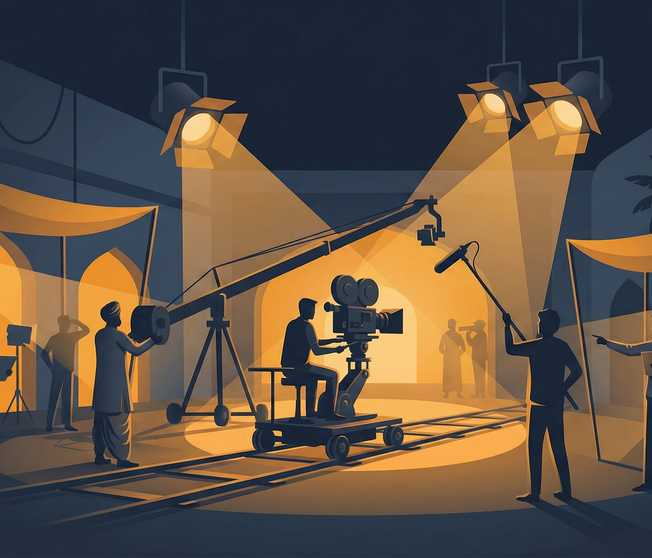
DIT Career in India: The Most In-Demand Film Job Nobody's Training For
-

Lavkush Gupta
-
May 04, 2026
-
8
Every big-budget Indian production rolling in 2026 is shooting on RED MONSTRO, ARRI ALEXA 35, or Sony Venice 2. Each camera generates somewhere between 1 TB and 6 TB of raw data per shooting day. That data contains every frame of the film — every performance, every burst of natural light that the DP waited three hours for, every take the director is counting on. It is irreplaceable. And it has to be ingested, verified, backed up, colour-managed, and delivered to editorial — all while the unit is still shooting the next scene.
One person owns that entire pipeline on set. That person is the DIT: the Digital Imaging Technician.
And here is the wild part: in India right now, there are not enough of them. Not even close.
Productions are pulling focus pullers into DIT seats, pulling IT professionals from post houses, pulling colorists away from colour suites because the trained DIT pool is genuinely thin. Meanwhile, the budgets going into Indian cinema — theatrical, OTT, brand films, international co-productions — are funnelling more and more into digital cinema cameras that demand exactly this role. The skill gap and the demand curve are pointed in opposite directions. That is a career opportunity if we have ever seen one.
So let us break this down properly. What the job actually is, what the day looks like, what you need to learn, what the money looks like, and how you get there from wherever you are standing right now.
What a DIT Actually Does (Not the Wikipedia Version)
The job title sounds bureaucratic. The actual job is half-scientist, half-artist, half-logistics manager — yes, three halves, because this role genuinely overflows its own container.
At its core, a DIT is responsible for everything that happens to camera data from the moment it comes off the card to the moment it leaves set in a format editorial can use. But that one-line description does not do it justice.
On-Set Data Management
When the camera assistant hands over a full card — a CFexpress card from an ALEXA 35, an R3D from a MONSTRO, an X-OCN from a Venice 2 — the DIT takes possession of it. This is not a casual handoff. The DIT logs it, marks it, initiates an ingest, and does not let that card go back to camera rotation until the ingest is verified with a checksum. A checksum is a mathematical fingerprint of the data. If the copy does not match the original down to the last bit, the DIT knows before the card is reformatted. Productions that skip this step have lost scenes. Real ones. Ones that required expensive reshoot days. The checksum is not optional.
From a single card, the DIT typically makes a minimum of two copies — often three — going to separate drives, often via a RAID system. One drive stays with production. One goes to the editor. One is an offsite safety copy. The 3-2-1 rule — three copies, two media types, one offsite — is the baseline. Some productions with serious post supervision add a fourth cloud backup for good measure.
The Colour Pipeline and Live Grading
Here is where the DIT stops being a data technician and starts being an imaging collaborator. The DP is the author of the visual language of the film. The DIT is the person who makes sure that visual language is preserved and communicated accurately — from what the DP sees in the monitor on set to what the colorist sees in the DI suite weeks later.
This happens through LUT management. A LUT — Look-Up Table — is essentially a colour transform. When a camera is shooting in LOG format (a flat, low-contrast capture mode that preserves maximum dynamic range), the image on a standard monitor looks washed out and grey. A LUT bakes in a preview transform so monitors on set show something close to the intended look. The DIT builds or manages these LUTs, distributes them to village monitors, client monitors, and the director's feed, and makes sure everyone on set is looking at the same intended image.
Beyond passive LUT management, senior DITs also perform live grading — real-time colour adjustments during or between takes using a DaVinci Resolve panel connected to the DIT cart. This is a genuine creative collaboration with the DP. Want the shadows three stops cooler? Want a push toward golden tones before the magic hour shot? The DIT executes it in real time, and both the DP and director can see the result immediately. This is the part of the job that creative directors and DoPs love — having a conversation about the image without waiting until post.
Quality Control
Every card that comes in goes through QC before it leaves the DIT's hands. The DIT checks for corrupted files, dropped frames, codec errors, metadata completeness (scene number, take, camera ID, lens data), and playback integrity. Some productions also run colour QC — checking that the image is within the expected parameters for the agreed look. If a card comes in damaged or a file is corrupted, the DIT is the person who catches it, escalates it, and works with the camera team to understand what happened. This is not a blame game — it is a recovery process. But you have to catch the problem before it becomes a disaster.
Dailies and Editorial Delivery
Once ingested, checked, and backed up, the DIT transcodes the camera originals into deliverables. For editorial, this typically means a lower-resolution proxy format — ProRes 422 LT or DNxHD — that an editor can cut on a laptop without it catching fire. These proxies carry the applied LUT so the editor is cutting with a rough grade applied, not a flat log image. The DIT attaches the right metadata so that when the conform happens in post, the offline edits link back to the original camera files seamlessly.
On larger productions, the DIT coordinates with the DIT facility — a post house managing the overnight dailies pipeline — to deliver files that feed into a review platform like Frame.io or Frameright, where the director can approve or flag takes remotely.
Why India Needs DITs Right Now (And Why the Pool Is Still Thin)
India's camera landscape changed faster than its training infrastructure. Five years ago, most mainstream Bollywood and South Indian productions were shooting on ARRI AMIRA or Sony F55 — manageable cameras with relatively lean data workflows. Then the streaming money hit.
Netflix, Amazon Prime Video, Disney+ Hotstar, Apple TV+ — all pushing Indian production partners toward cinema-grade deliverables. International co-productions demanding ARRI RAW or Sony X-OCN workflows with proper LUT pipelines baked in from day one. Producers who once said "we will sort out the data in post" are now being told by streaming QC departments that a film shot without proper on-set colour management will not pass the technical delivery check.
So productions upgraded their cameras. The data went from manageable to enormous. A ten-day shoot on a RED MONSTRO at 8K with two cameras running can generate 40-60 TB of data. That data needs real infrastructure — a real DIT — not a focus puller running ShotPut Pro on a borrowed MacBook between takes.
And yet the formal training pipelines have not caught up. FTII covers some colour science fundamentals. SRFTI touches on it. A handful of private institutes have added "digital workflow" modules. But a structured, practical DIT training path that produces job-ready technicians? It largely does not exist in India. The people doing the job well learned it the hard way — through camera assisting, through working with international crews, through obsessive self-study.
That gap is the opportunity.
The Daily Workflow: What a Shoot Day Actually Looks Like
Let us walk through a typical shooting day so the rhythm is concrete.
6:00 AM — Cart setup and system check. The DIT arrives before the crew call. The DIT cart — a custom-built workstation on wheels — goes up and gets powered. That means the main workstation (typically a high-spec Mac Studio or PC tower), the RAID array, the reference monitor, the vectorscope and waveform display, the Resolve colour panel, and the network switch connecting the DIT station to village monitors and client feed. Everything gets checked. Software opens. LUT profiles load. The ingest station is ready before the first card comes in.
7:30 AM — First card of the day. Camera starts rolling. The first card fills. The clapper loader hands it to the DIT. The DIT logs it in the media binder — scene, take range, camera roll number — and initiates the ingest via the chosen software. Most professionals on international or premium productions use Pomfort Silverstack or Hedge. Some productions use ShotPut Pro. The software verifies checksums automatically.
Continuous through the day — The ingest loop. This is the rhythm of the job. Card in, log, ingest, verify, card out, repeat. Between ingests, the DIT monitors the colour feed, adjusts LUT output if the DP wants changes, answers questions from the director about how a particular shot looked, and keeps a running continuity log of which looks correspond to which scenes.
During breaks — QC and backups. Lunch break is prime time for running full QC on the morning's cards and confirming all three backup copies are verified. The DIT does not eat until the backups are confirmed. That is not a dramatic statement — it is just how serious practitioners approach the job.
End of day — Dailies prep and handoff. When the unit wraps, the DIT stays behind to complete any remaining ingests and begin the dailies transcode. Depending on the production setup, these go directly to the editor via a shared drive or network transfer, or they get prepped for the overnight dailies facility. The DIT updates the camera reports and handover documents, locks the drives in the production safe or secured transport, and finally goes home. On a heavy shooting day, this can mean a 14-16 hour on-set presence.
The Skills You Need to Build
Let us be direct about this. The DIT skill set is genuinely broad. You need to be comfortable in technical territory that overlaps IT, colour science, and on-set film production simultaneously. Here is the map.
Colour Science
This is the non-negotiable intellectual foundation. You need to understand how cameras capture light in different colour spaces (REDWideGamutRGB, ARRI Wide Gamut, S-Gamut3.Cine), how LOG gamma curves work (Log3G10, LogC, S-Log3), what a colour transform does mathematically, and how to build and evaluate LUTs using DaVinci Resolve's built-in ACES or custom pipeline. You need to be able to look at a waveform and vectorscope display and know what you are seeing. This is learned — it takes time — but it is learnable outside of any formal institution.
Data Management and IT
You need to understand RAID configurations (RAID 0, 1, 5, 6, 10) — what each protects against and what it does not. You need to understand filesystem compatibility (exFAT for cross-platform, HFS+ or APFS for Mac-only workflows, NTFS for PC). You need to understand network fundamentals: how to set up a local network on set so the DIT station feeds to a village monitor via a media server. Checksum verification, file system integrity, drive health monitoring — these are table stakes.
Hardware Management
The DIT cart is a personal investment and a working tool. Most professional DITs own their own cart. A mid-range setup — workstation, RAID array, reference monitor, vectorscope, cables, power distribution — runs between Rs. 8 lakh and Rs. 25 lakh depending on the level. Production companies rent the DIT cart from the DIT as part of the deal, which is how the economics work. You need to know how to maintain the hardware, troubleshoot drive failures under time pressure, and manage power on location where generator power is dirty and unpredictable.
Software Proficiency
DaVinci Resolve is the cornerstone. Every working DIT needs to be deeply fluent in Resolve — not just the colour page, but the media management, the LUT editor, the remote grades workflow. This is the industry standard and there is no substitute.
Pomfort Silverstack is the gold standard for on-set data management on premium productions. It handles ingest, checksum verification, LUT application, and dailies generation in a single integrated pipeline. It costs money, but working DITs consider it non-negotiable.
Hedge is a fast, reliable file transfer application with checksum verification — simpler than Silverstack, used on productions where the full Silverstack workflow is not required.
ShotPut Pro is widely used in India for mid-budget productions — approachable, cost-effective, and does the core job well.
Livegrade (also from Pomfort) handles live grading and LUT distribution on set — it connects to cameras and monitors via SDI and network, allowing real-time look management across the entire village.
DIT vs Data Wrangler: The Confusion That Costs Productions Money
This distinction matters because India's production industry uses the terms interchangeably, which is wrong, and which sometimes leads to producers hiring the cheaper option and getting burned.
A data wrangler does data management: ingest, backup, checksum, dailies delivery. That is the technical pipeline. It is essential and it requires real skill, but it is not colour management.
A DIT does everything the data wrangler does, plus: colour science, live grading, LUT management, on-set quality control of the image (not just the files), and active collaboration with the DP on the visual look. A DIT is a creative and technical collaborator. A data wrangler is a technical operator.
The distinction only holds up if the person in the DIT seat can actually perform both halves. Some people calling themselves DITs in the Indian market are doing data wrangling only. Some people calling themselves data wranglers have deep colour science knowledge and are quietly doing DIT work at data wrangler rates. The market is not yet standardised.
If you are going to compete at the top level — international productions, premium OTT, high-budget theatrical — you need the full DIT skill set. The colour science half is what gets you there.
Working With the DP and the Colorist
The DIT sits at the intersection of two relationships that define the quality of the work.
With the DP: This is the primary creative relationship on set. The DP has a vision for the image. The DIT's job is to understand that vision technically, help realise it through look development before and during the shoot, and protect it through the data pipeline so it arrives intact in post. Great DITs develop a shorthand with their DPs. They know when to suggest a LUT adjustment and when to stay quiet. They understand that the DP is the author and the DIT is the technical guardian of that authorship. The best DIT-DP partnerships develop over multiple projects and are genuinely collaborative — some of the best-looking films in recent Indian cinema owe part of their visual consistency to a DIT who understood the DP's language.
With the colorist: The DIT is the bridge between set and the colour suite. The LUT management on set, the camera metadata, the on-set look decisions — all of this becomes the starting point for the colorist's work in post. A DIT who communicates clearly with the colorist (sharing Resolve grades, LUT files, shooting notes, camera reports) makes the DI process dramatically more efficient. Some DITs work directly with the same colorist across multiple projects, and the handover becomes increasingly smooth because they speak the same colour language.
How to Actually Break In: The Self-Taught and Mentorship Path
There is no single accredited DIT certification programme in India that the industry recognises. That is both a problem and an advantage for you. It means the door is open to anyone who builds the real skills and can demonstrate them.
Here is the path that has actually worked for people breaking into this role in India.
Start with DaVinci Resolve. Blackmagic Design offers free training and certification through their online learning portal. The DaVinci Resolve Certified User and Certified Colorist programmes are legitimate and recognised internationally. Do them. All of them.
Learn colour science independently. Alexis Van Hurkman's "Color Correction Handbook" is the closest thing to a DIT bible that exists. Mixing Light (mixinglight.com) has video tutorials that are genuinely excellent. Pomfort's own knowledge base is detailed and free. The Cinematography Database YouTube channel covers camera science in depth. There is no shortage of material — there is only a shortage of people who actually commit to getting through it.
Get hands on a camera system. Rent time at a local camera house. Many RED and ARRI dealers in Mumbai, Chennai, and Hyderabad will let serious professionals spend time with cameras for a nominal fee or in exchange for helping with demo days. Understand what RAW actually looks like coming off the card. Build your first proper ingest workflow even if there is no production involved.
Assistant your way in. Most working DITs in India started as camera assistants or loader/clappers. If you are currently in the camera department, you already have proximity. Ask the DIT on your current production if you can observe. Offer to help with the end-of-day ingest. Ask questions that demonstrate you have been studying. Nobody who has been through the self-taught path turns away someone who is genuinely trying to learn it properly.
The IT-to-DIT path. If you come from an IT background, your data management and networking skills are immediately useful. The gap is colour science and the on-set culture. Prioritise the colour science education and find a way to get on set — even as a junior runner or camera PA — to learn how productions actually work. The technical knowledge transfers; the on-set judgment has to be lived.
Day Rates and Career Progression
All figures below are market estimates based on industry conversations and are not guaranteed. Day rates vary significantly by production budget, city, and individual negotiation.
Junior DIT / Data Wrangler (0-2 years experience): Rs. 3,000-7,000 per day. At this stage you are likely doing data management under a senior DIT's supervision, or handling the full DIT role on lower-budget productions.
Mid-level DIT (2-5 years experience): Rs. 8,000-20,000 per day on mainstream theatrical and OTT productions. Your cart hire fee (for productions using your equipment) adds Rs. 3,000-8,000 per day on top of your personal rate.
Senior DIT on premium productions: Rs. 25,000-50,000 per day, plus cart hire. International productions — European and American co-productions shooting in India — often pay on ITES or foreign worker rate structures which can be significantly higher, particularly if the Indian DIT has the international contacts to book these.
What drives the number up: Experience with specific camera systems (ARRI RAW in particular commands a premium), a roster of named DPs who will specifically request you, international production credits, demonstrated colour science depth, your own high-spec cart.
Career progression: The natural trajectory from DIT runs in two directions. Toward the colour suite — many experienced DITs become professional colorists, working in DI facilities on theatrical and OTT post. The on-set colour science foundation translates directly. The other direction is toward post supervision or digital imaging management on large productions — overseeing the entire post pipeline from on-set through delivery. Both are senior, well-compensated roles with more stable hours than set life.
Where the Work Is: City-Specific Demand in India
Mumbai is the primary market. Bollywood theatrical, OTT originals, brand films, and a growing number of international productions passing through all generate DIT demand here. The network concentration is highest. If you are building a DIT career, Mumbai is where the density of opportunity is.
Hyderabad is growing fast. Telugu cinema has been some of the most technically sophisticated production in India for the past five years — Tollywood is not behind on camera technology or on-set workflow ambition. RRR, Kalki 2898 AD, and similar productions have normalised cinema-grade data workflows. The DIT market here is smaller than Mumbai but considerably less competitive.
Chennai mirrors Hyderabad for Tamil productions. Kollywood has significant budgets and serious technical standards on major releases. The ad film and corporate production market here is also substantial.
Bangalore has a growing commercial film and brand content scene, and is increasingly relevant for OTT originals and for international productions using Karnataka locations.
Delhi NCR is the ad film capital of India — enormous volume of TVC and branded content that increasingly shoots on cinema-grade cameras and needs proper data management.
Smaller regional industries — Marathi, Kannada, Malayalam, Bengali, Odia — are adopting digital cinema cameras faster than their DIT training is keeping pace. This means opportunity, but also means you may need to educate producers about why they need the role at all, which takes a different kind of patience.
The Future: Cloud Workflows and On-Set AI
The DIT's role is not contracting — it is expanding. Two developments are reshaping what on-set imaging management looks like.
Cloud-native dailies pipelines are becoming real for premium productions. Instead of physical drives going to the editing suite, encrypted files transfer overnight to cloud storage and review platforms, with directors and editors accessing cuts remotely in near-real time. This changes the DIT's logistics but not the underlying skill set — it actually adds network engineering to the DIT's toolkit, because you are now managing a production network with enough bandwidth to send terabytes overnight from a location shoot.
On-set AI tools are beginning to surface for tasks like automated metadata tagging, quality control flagging, and even basic colour consistency checking between shots. These tools assist the DIT — they do not replace the colour science judgment, the DP relationship, or the data management accountability. What they do is handle the repetitive scanning tasks faster, freeing the DIT to focus on the higher-level work. The DITs who learn to integrate these tools early will be more efficient, not obsolete.
The camera resolution race continues. 8K is already normal on premium productions. As camera systems get more powerful and capture more data, the DIT's role becomes more — not less — central to production.
Your Next Move
If you are a camera assistant who has been curious about the DIT seat, start with the DaVinci Resolve certification. Do it this week, not someday.
If you are an IT professional who has always wanted to work in film, your advantage is your data management instincts. The creative gap is bridgeable. Start building it.
If you are already working somewhere in production and the DIT conversation keeps coming up around you, that is not coincidence. Productions are hungry for people who can do this properly.
The Indian film industry is at an inflection point where camera technology has outpaced the training infrastructure by a significant margin. The DIT career sits right at that gap. The productions are here. The cameras are here. The data is absolutely here.
The trained people are not. Yet.
Register on AIO Cine, where every production house is verified before they can post crew calls — because your first DIT credit should come from a real production, not a scheme.
SEO Notes
Suggested Title: DIT Career India: The Most In-Demand Film Job Nobody's Training For
Meta Description: A complete guide to the DIT career in India — what a digital imaging technician does, day rates, software, hardware, and how to break in. Updated 2026. (155 characters)
Primary keyword placement: "DIT career India" appears in the title, opening section, city-specific section, and closing paragraph. "Digital imaging technician film" appears in the meta description and body text. Both are integrated naturally without stuffing.
Featured snippet opportunity: The "DIT vs Data Wrangler" section uses bold definition labels and is structured for featured snippet extraction. Consider formatting it as a two-column comparison table for stronger snippet eligibility. The "What a DIT Actually Does" section with its H3 sub-sections also targets position-zero for "what does a DIT do on set."
Internal linking suggestions:
- Link "colorist" to
/blog/colorist-di-career-indiafrom the "Working With the Colorist" section - Link "focus puller" or "camera assistant" to
focus-puller-career-india.mdfrom the break-in section - Link "film crew day rates" to
film-crew-day-rates-india-2026.mdfrom the day rates section - Link "cinematographer" to
how-to-become-a-cinematographer-in-india.mdfrom the DP relationship section - Link "virtual production" to
virtual-production-led-volume-india.mdfrom the future section - Link "OTT platform jobs" to
ott-platform-jobs-india-2026.mdfrom the why India needs DITs section
External linking suggestions:
- Blackmagic Design's free DaVinci Resolve certification portal (official Blackmagic site)
- Pomfort's official Silverstack and Livegrade product pages
- Mixing Light (mixinglight.com) for colour science education resources
Image placement suggestions:
- Hero image: DIT cart on a professional film set (alt text: "professional DIT cart setup on Indian film set with calibrated monitors and RAID storage")
- Section image near workflow: DIT workstation with waveform and vectorscope monitors (alt text: "digital imaging technician monitoring colour pipeline on set India")
- Section image near software tools: DaVinci Resolve colour page on a DIT workstation (alt text: "DaVinci Resolve colour grading interface used by DIT on set India")
- Section image near hardware: DIT cart components including LUT box, card readers, and RAID array (alt text: "DIT workstation hardware components including LUT box and high-speed card readers film set")
Content length: Approximately 2,900 words — within the 2,500-3,000 word target.
Readability: Written at Grade 8-9 level — accessible to technically curious readers without assuming prior film production knowledge.
Search intent match: Primarily informational (what is a DIT, how to become one) with a secondary commercial intent signal (day rates, career path). Structure mirrors what a searcher asking "DIT career India" or "digital imaging technician film India" is actually trying to understand.
Page title tag recommendation: "DIT Career in India 2026: Skills, Day Rates & How to Break In | AIO Cine"
Topic cluster note: This post pairs well as a hub page linking to the colorist career post and cinematographer guide, creating a topic cluster around the camera and data department that supports ranking for a broader set of related keywords.
Related Blog Posts