16 Free Audition Monologues (Original): Dramatic, Comedic and Intense
-

Lavkush Gupta
-
Nov 29, 2026
-
24
An audition monologue is a short solo speech, usually 1–2 minutes, that an actor performs to show casting directors their range, emotional truth and character work. Below are 16 original audition monologues written by the AIO Cine team, sorted by gender-neutral role, age and genre (dramatic, comedic, intense and contemporary). They are free to use for auditions, self-tapes, showreels, classes and practice. You won't walk into the room with the same speech as 40 other actors.
Usage note: you may perform these monologues freely for auditions, self-tapes, acting classes and non-commercial showreels. Please credit "AIO Cine" if you post a performance online. Commercial use (in a film, ad or published collection) requires permission.
How to choose the right audition monologue
- Play your age and type. Choose a character you could realistically be cast as today.
- Keep it short. 60–90 seconds is ideal. Casting directors often decide in the first 15 seconds.
- Look for a journey. The best monologues have a shift: the character wants something, hits an obstacle, and changes tactic or feeling.
- Talk to someone. Pick monologues spoken to a specific person, not just thinking aloud.
- Have contrast ready. Prepare one dramatic and one comedic piece, so you can show range when asked.
- Avoid overdone pieces. Famous film speeches invite comparison. Fresh material gets fresh attention.
Dramatic monologues
1. "The Missed Call" (dramatic, 20s–30s, any gender)
To a sibling, after their father's funeral.
You want to know why I didn't come home? Fine. He called me. The night before. I saw his name on my screen and I let it ring, because I was tired, because I thought, "He'll just ask if I've eaten, if I'm saving money, the same five questions." I thought there'd be a tomorrow for the same five questions. So don't tell me I didn't care. I've listened to his voicemail forty times. It's eleven seconds long. He just says my name, and then, "Okay, call me back." That's it. Okay, call me back. And I can't. Do you understand? I can never call him back.
2. "Twelve Years" (dramatic, 40s–60s, any gender)
To a business partner who is selling the company.
Twelve years. I mortgaged my house for this place. I missed my daughter's school play because the shipment was late, remember? You told me, "This is for them, this is for the future." And now you sit there with your lawyer and your nice new watch and tell me it's "just business." No. Business is numbers. This was a promise. You didn't sell a company today. You sold me. And the worst part? I'd have given it to you if you'd only asked.
3. "The Letter" (dramatic, teens–20s, any gender)
To a parent who found their college rejection letter.
I was going to tell you. I was. I just wanted one more week of you looking at me like that, like I was the thing that went right. Every time a relative calls, you say my name like it's a medal. So yes, I hid it. I hid it under my mattress like a little kid hiding a broken glass. Because I didn't fail an exam, Ma. I failed you. And I don't know how to be in this house as the person who did that.
4. "Night Shift" (dramatic, 30s–50s, any gender)
A nurse, to a young doctor after losing a patient.
Sit down. No, sit. Drink this. You're going to want to replay it, every second, every number on that monitor. Do it once. Then stop. You did everything right, and he still died, and both of those things are true. That's the part nobody teaches you. Twenty-two years I've done this. I still remember my first. Her name was Meena. She liked mango sweets. Remember his name. Remember something he liked. And then go wash your face, because bed fourteen needs you, and bed fourteen is still alive.
Comedic monologues
5. "The Interview" (comedic, 20s–30s, any gender)
To a stone-faced job interviewer.
My greatest weakness? Honestly? Interviews. Like this one. Right now. I'm aware that I've used the word "synergy" four times and I don't know what it means. I just feel like you do. Look, my strengths: I'm punctual. I was here forty minutes early. I sat in your parking lot rehearsing answers to my steering wheel. The steering wheel loved me. Hired me on the spot. So really, you're just confirming a decision my car already made.
6. "Group Chat" (comedic, teens–20s, any gender)
To a best friend, holding a phone in horror.
I sent it to the family group. The family group. Not you, the family group, with Nani, with Bade Papa, with Pinky Aunty who forwards good-morning roses every day at 5 a.m. And they've seen it. Three blue ticks. Nani replied with a thumbs up! What does that mean? Does she approve? Is that a threat? I can never go to a wedding again. I'm changing my name. I'm moving to a hill station. I'm going to be a goat farmer.
7. "The Wedding Speech" (comedic, 30s–50s, any gender)
An unprepared relative, at a microphone.
Hello. Is this on? Okay. Hi. I wasn't told I was speaking. I was told I was "sitting near the stage." Which I now realise was a trap. So, the couple. Lovely. Very… married. I've known the groom since he was six, when he ate a crayon and blamed the dog. We didn't have a dog. That's the kind of creativity this marriage will need. To the bride: you're very brave. To the caterer: I'll see you at the dessert table. Thank you.
8. "Customer Service" (comedic, 20s–40s, any gender)
On hold, to an automated phone line.
Representative. Re-pre-sen-ta-tive. No, I don't want to "hear about our new offers." I want to talk to a human. A person. Someone with a mother. Press nine? Fine. Nine. …That took me back to the start! You did that on purpose. I can hear the music mocking me. It's the same flute song for forty minutes. I know every note. I'm going to hum it at my own funeral. "Your call is important to us." Then pick it up!
Intense and thriller monologues
9. "The Confession" (intense, 20s–40s, any gender)
To a police officer in an interrogation room.
You keep asking where I was at eleven. I'll tell you where I was. I was outside his window. I watched him laugh at the TV, eat dinner, check his phone, like nothing happened. Like my brother wasn't in the hospital because of him. I stood there for an hour with my hand in my pocket. And then I walked away. That's my confession, officer. Not that I did something. That I wanted to. Write that down. See if there's a law for it.
10. "Last Warning" (intense, 30s–50s, any gender)
A calm, dangerous character to someone who owes money.
Relax. Sit. I'm not here to shout. Shouting is for people who aren't sure. I'm very sure. You borrowed. You promised. You smiled at me. I liked that smile. And then you disappeared, and you made me drive four hours in this heat to find a man who didn't want to be found. So now we have a new arrangement. You have until Friday. Not because I'm kind. Because I'm patient. And patience, my friend, is much, much worse.
11. "The Witness" (intense, teens–20s, any gender)
To a lawyer, before testifying.
Everyone keeps saying "be brave." Easy to say from that side of the table. You get to go home after. I have to walk past his family in the corridor every day this week. His mother looked at me today like I'm the one who did it. I'm nineteen. I just saw what I saw. So yes, I'm going to say it in court. Not because I'm brave. Because if I don't, I'll have to live with the version of me who stayed quiet. And I've met that version. I don't like them.
Contemporary and romantic monologues
12. "Airport" (romantic, 20s–30s, any gender)
To a partner leaving for a job abroad.
Don't say "we'll make it work." Everyone says that at airports. Say something real. Say you'll miss the way I hum when I cook. Say you'll call when it's 3 a.m. here and you can't sleep there. Say you'll be bored of the fancy cafés and miss the chai stall that never has change. I'm not asking you to stay. I'd never ask you to stay. I'm asking you to come back. That's all. Just… come back the same.
13. "Swipe Left" (contemporary comedy-drama, 20s–30s, any gender)
On a first date that's going badly, finally being honest.
Can I be honest? My profile says I love hiking. I've hiked once. I cried. It was a hill. My photos are from my cousin's wedding, which is the only day I've ever looked like that. And I said I'm "passionate about travel," but I mostly travel to my fridge. I'm tired of being the brochure version of myself. So, hi. I'm the real one. I watch the same three shows on repeat and I'm scared of pigeons. You can leave. I'll understand. But I'd really like you to stay.
14. "First Day of Shooting" (contemporary, 20s–30s, any gender)
An actor to their reflection, before their first film shot.
Okay. Okay, okay, okay. Breathe. You've practised this in front of the mirror two hundred times. The bathroom mirror at home, with the crack in the corner, where Mummy yelled, "Who are you talking to?" I was talking to this. To today. Every audition where they said "too dark," "too tall," "too ordinary"? They're not here. The camera is here. And the camera doesn't know what you were told. It only knows what you do next. So do something worth seeing.
Monologues for older actors
15. "The Garden" (dramatic, 60s+, any gender)
To an adult child who wants to sell the family home.
You see a house. Old pipes, a roof that leaks in July. I see the guava tree your grandfather planted the year you were born. Those marks on the kitchen door? Your height, every birthday till fifteen, when you said it was embarrassing. I know it's sensible to sell. I know the flat would be easier. I'm not arguing with sense. I'm just asking you to let me water the garden one more season. Let me say goodbye to it properly. That's all old people want: a proper goodbye.
16. "Retirement Party" (comedy-drama, 60s+, any gender)
A speech at their own retirement party.
Thirty-eight years. I was told to keep this short, which is funny, because nobody told the projector that in 1991. You've given me a watch. Thank you. Very thoughtful, giving a man a clock on the day he no longer needs to be anywhere. I'll miss this place. The tea is terrible. The AC has two settings: Arctic and Sahara. But you, all of you, made me get up every morning. And starting Monday, I'm going to find out who I am when nobody needs a file signed. Wish me luck.
How to perform an audition monologue: 8 tips
- Know who you're talking to. Picture one specific person, and what you need from them.
- Find the turn. Mark the moment the character changes tactic or feeling, and play it clearly.
- Don't perform to the casting director. In the room, place your scene partner just beside the camera or panel, not on them.
- Slate cleanly. Name, height and location, as the brief asks, then a beat before you begin.
- Start in the middle. Begin with energy, as if the scene has already started.
- Use stillness. On camera, less movement reads as more truth.
- End with a beat. Hold the final moment for a second before breaking character.
- Prepare to be redirected. Casting directors may ask for a different take. Flexibility is part of the test.
Recording a monologue self-tape
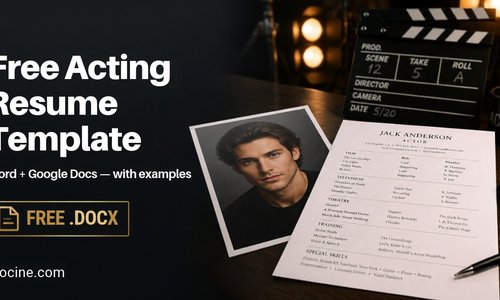
Most auditions now begin online. Frame yourself from mid-chest up, use soft light facing you, record clean sound, and keep your eyeline just off the lens. Then upload it to your free AIO Cine talent profile and apply to casting calls. You'll also need a professional acting résumé and great headshots. New to acting? Start with our guide to how to become an actor.
Frequently asked questions
How long should an audition monologue be?
Usually 60 to 90 seconds, and never more than 2 minutes unless the casting brief asks for it.
Can I use these monologues for auditions?
Yes. These original AIO Cine monologues are free to use for auditions, self-tapes, classes and non-commercial showreels. Please credit AIO Cine if you share a performance online.
Should I use a dramatic or comedic monologue?
Prepare both. Use the one that matches the role, and keep the other ready in case you're asked to show range.
Can I use a monologue from a famous movie?
You can, but it's risky. Casting directors will compare you to the famous performance. Fresh or lesser-known material lets them see you.
Do I need to memorise my monologue?
Yes, completely. Knowing the words cold frees you to listen, react and make specific choices.
What is the best monologue for a beginner?
Choose a contemporary piece close to your age and natural energy, spoken to a specific person, with a clear emotional shift.
Related Blog Posts