Shot Types and Camera Angles Explained: The Complete Guide (2026)
-

Lavkush Gupta
-
Nov 29, 2026
-
23
Shot types are the standard ways filmmakers frame a subject, defined by three things: shot size (how much of the subject is in frame, from extreme wide to extreme close-up), camera angle (where the camera looks from: eye level, high, low, overhead, Dutch), and camera movement (static, pan, tilt, dolly, tracking, handheld, crane, and so on). Choosing the right combination is how directors and cinematographers control what the audience sees, and what it feels.
This guide covers every major shot type with what it is, when to use it and what it communicates. At the end there's a quick-reference table and a free shot list template to plan your own shoot.
Part 1: Shot sizes (framing)
Shot size describes how big the subject appears in the frame. Most sizes are named by how much of a human body is visible.
1. Extreme wide shot (EWS / ELS)
What it is: A vast view where the subject is tiny or absent: a city skyline, a desert, a mountain range.
Use it for: Opening a film or sequence, showing scale, isolating a character in a huge world.
It communicates: Scale, loneliness, epic scope, "where we are".
2. Wide shot / long shot (WS / LS)
What it is: The full subject is visible with plenty of surroundings.
Use it for: Establishing the geography of a scene, so the audience understands where everyone is.
It communicates: Context and the relationship between characters and space.
3. Full shot (FS)
What it is: The character from head to toe, filling the frame vertically.
Use it for: Dance, action, physical comedy, costume reveals, and any time the whole body matters.
It communicates: Body language and physical performance.
4. Medium wide shot (MWS) / cowboy shot
What it is: Roughly knees up. Named "cowboy shot" from Westerns, where it framed the holster.
Use it for: Two or three people interacting, walk-and-talks, and showing gestures with some environment.
It communicates: Group dynamics and confidence.
5. Medium shot (MS)
What it is: Waist up. The workhorse of film and TV.
Use it for: Dialogue, everyday interaction, and interviews.
It communicates: Neutral, natural observation, as if we're in the room.
6. Medium close-up (MCU)
What it is: Chest or shoulders up.
Use it for: Emotional dialogue where you still want a little context, and news and documentary interviews.
It communicates: Connection with the character's feelings.
7. Close-up (CU)
What it is: The face fills most of the frame.
Use it for: Key emotional beats, reactions and important lines.
It communicates: Intimacy and intensity. The audience reads every flicker of the eyes. In mobile-first formats like vertical dramas, close-ups do most of the storytelling.
8. Extreme close-up (ECU / XCU)
What it is: A single detail: eyes, lips, a trigger finger, a ticking watch.
Use it for: Building tension, highlighting a crucial object, stylised moments.
It communicates: Urgency, obsession, and "this matters".
9. Insert shot
What it is: A close shot of an object or action: a phone screen, a letter, hands on a keyboard.
Use it for: Giving the audience information they need. It's often shot separately by a second unit.
Part 2: Shots defined by subjects and point of view
10. Two shot
Two characters in the same frame. It shows their relationship, and the distance or closeness between them says a lot.
11. Over-the-shoulder shot (OTS)
Framed from behind one character, looking at another. It's the standard for conversations and keeps both characters connected in the audience's mind.
12. Point-of-view shot (POV)
The camera shows exactly what a character sees. It puts the audience inside the character's head, which is common in horror and thrillers.
13. Reaction shot
A shot of a character responding to something. Often the reaction is more powerful than the action itself.
14. Establishing shot
Usually a wide or extreme wide shot at the start of a scene that tells the audience where (and sometimes when) we are.
15. Cutaway
A shot of something other than the main action (a clock, a crowd, a passing car), used to show context or to smooth an edit.
Part 3: Camera angles
| Angle | Camera position | Effect on the audience |
|---|---|---|
| Eye level | At the subject's eye height | Neutral, natural, relatable |
| High angle | Above, looking down | Subject looks smaller, weaker, vulnerable |
| Low angle | Below, looking up | Subject looks powerful, heroic, threatening |
| Overhead / bird's-eye | Directly above | God-like view, pattern, detachment |
| Worm's-eye | On the ground, looking up | Extreme power or scale (buildings, giants) |
| Dutch angle (canted) | Camera tilted sideways | Unease, disorientation, madness |
| Shoulder level / hip level | Slightly below the eyes / at the hips | Subtle power shifts and Western-style standoffs |
Tip: Indian mass-entertainment cinema famously uses low angles and slow motion for a hero's entry, which is a textbook example of an angle doing emotional work.
Part 4: Camera movements
| Movement | What happens | Typical use |
|---|---|---|
| Static | Camera doesn't move | Stability, observation, comedy timing |
| Pan | Camera rotates left/right on a fixed point | Following action, revealing space |
| Tilt | Camera rotates up/down | Revealing height, a character's full look |
| Push-in / dolly in | Camera physically moves toward the subject | Growing realisation, tension, emphasis |
| Pull-out / dolly out | Camera moves away | Isolation, revealing context, endings |
| Tracking / trucking | Camera moves alongside the subject | Walk-and-talks, chases |
| Crane / jib | Camera rises or falls through space | Grand openings and endings, scale |
| Handheld | Operator holds the camera | Realism, chaos, documentary feel |
| Gimbal / Steadicam | Smooth, floating movement | Long takes, following characters through spaces |
| Zoom | Lens changes focal length (camera stays) | Sudden emphasis, a 1970s style, documentary |
| Dolly zoom ("Vertigo effect") | Dolly one way while zooming the other | Shock, dizziness, a world-shifting moment |
| Drone / aerial | Flying camera | Landscapes, establishing shots, chases |
Part 5: How lenses change a shot
- Wide lenses (e.g. 14–24mm on full frame): exaggerate depth and distort faces up close. Good for space, energy and unease.
- Normal lenses (around 35–50mm): close to human vision, so they feel natural.
- Telephoto lenses (85mm and up): compress the background, flatter faces and isolate subjects with a shallow depth of field.
The same "close-up" feels completely different on a 24mm lens a foot from the actor than on an 85mm lens from across the room.
Shot types quick-reference cheat sheet
| Shot | Abbreviation | Best for |
|---|---|---|
| Extreme wide | EWS | Scale, opening a story |
| Wide / long | WS / LS | Geography of a scene |
| Full | FS | Whole-body action |
| Medium wide / cowboy | MWS | Small groups, gestures |
| Medium | MS | Dialogue |
| Medium close-up | MCU | Emotional dialogue |
| Close-up | CU | Emotion, reactions |
| Extreme close-up | ECU | Detail, tension |
| Over-the-shoulder | OTS | Conversations |
| Point of view | POV | Character perspective |
| Insert | INS | Objects, information |
How to choose the right shot
- Ask what the audience must feel or know at this moment. Information calls for a wider shot or an insert. Emotion calls for a closer one.
- Get closer as the emotion rises. Many scenes start wide and move tighter as tension builds.
- Use angles for power. Shift between low and high angles as power changes hands in a scene.
- Move the camera with a purpose. Every move should mean something: a reveal, an emphasis, following energy.
- Cover yourself for the edit. A classic coverage pattern is wide (master), medium, close-ups for each character, and inserts.
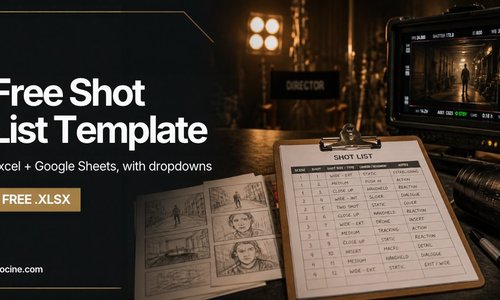
- Plan it in a shot list. Write every shot down before the shoot day using our free shot list template, then schedule the day with a call sheet.
Who decides the shots on a film set?
The director decides what each moment needs to communicate. The director of photography (DOP / cinematographer) designs how to achieve it: shot size, lens, angle, movement and light. The camera operator executes the framing and the focus puller keeps it sharp. Want to work in the camera department? Browse camera and crew jobs on AIO Cine, or read how to become a cinematographer.
Frequently asked questions
What are the basic types of shots in film?
The basic shot sizes are extreme wide, wide, full, medium wide, medium, medium close-up, close-up and extreme close-up. Common shots defined by subject include the two shot, over-the-shoulder, point-of-view, insert and establishing shot.
What is the difference between a shot type and a camera angle?
Shot type (shot size) is how much of the subject is in the frame. Camera angle is the position the camera views the subject from, such as eye level, high angle, low angle or Dutch angle.
What is the most common shot in movies?
The medium shot and close-up are the most common, because most film storytelling is dialogue and emotion between characters.
What does a low-angle shot mean?
A low-angle shot looks up at the subject, making them appear powerful, dominant or threatening.
What is a Dutch angle?
A Dutch angle tilts the camera sideways so the horizon is diagonal, creating a feeling of unease, tension or disorientation.
What is coverage in filmmaking?
Coverage is the set of shots filmed for a scene (usually a wide master plus mediums, close-ups and inserts) so the editor has options to build the scene.
How many shots are in a typical scene?
It varies widely. A simple dialogue scene might use 4–8 setups, while an action scene can need dozens. Plan them in a shot list before the shoot.
Related Blog Posts